
Standard Lumber Size Chart: Nominal vs Actual Lumber Dimensions in the USA
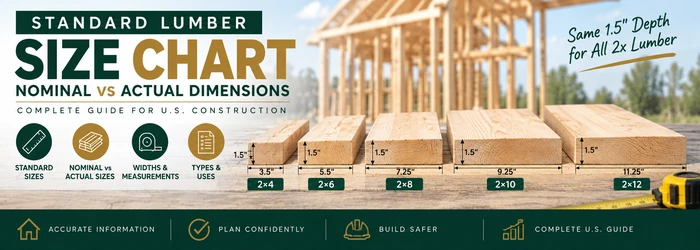
When buying lumber in the United States, the size printed on the label is often different from the size you measure with a tape. A 2×4 is not actually 2 inches by 4 inches, and a 2×6 does not measure a full 2 inches by 6 inches.
This difference exists because common lumber sizes are generally identified by their nominal dimensions, while the finished boards have smaller actual or dressed dimensions.
For example:
- A nominal 2×4 commonly has dry dressed dimensions of 1.5 × 3.5 inches.
- A nominal 2×6 commonly measures 1.5 × 5.5 inches.
- A nominal 2×8 commonly measures 1.5 × 7.25 inches.
- A nominal 2×10 commonly measures 1.5 × 9.25 inches.
- A nominal 2×12 commonly measures 1.5 × 11.25 inches.
This guide brings the most useful standard lumber sizes, actual lumber dimensions, nominal measurements, board widths, dimensional lumber terminology, and metric equivalents into one reference for U.S. construction.
The dimensional relationships below are based primarily on the U.S. Department of Commerce American Softwood Lumber Standard PS 20. The standard provides nominal and minimum dressed sizes for boards, dimension lumber, and timbers.
Standard Lumber Size Chart
The following chart covers many of the dimensional lumber sizes commonly encountered in U.S. construction.
| Nominal Lumber Size | Actual/Dry Dressed Size | Approx. Metric Size |
|---|---|---|
| 1×2 | 3/4″ × 1-1/2″ | 19 × 38 mm |
| 1×3 | 3/4″ × 2-1/2″ | 19 × 64 mm |
| 1×4 | 3/4″ × 3-1/2″ | 19 × 89 mm |
| 1×5 | 3/4″ × 4-1/2″ | 19 × 114 mm |
| 1×6 | 3/4″ × 5-1/2″ | 19 × 140 mm |
| 1×8 | 3/4″ × 7-1/4″ | 19 × 184 mm |
| 1×10 | 3/4″ × 9-1/4″ | 19 × 235 mm |
| 1×12 | 3/4″ × 11-1/4″ | 19 × 286 mm |
| 2×2 | 1-1/2″ × 1-1/2″ | 38 × 38 mm |
| 2×3 | 1-1/2″ × 2-1/2″ | 38 × 64 mm |
| 2×4 | 1-1/2″ × 3-1/2″ | 38 × 89 mm |
| 2×6 | 1-1/2″ × 5-1/2″ | 38 × 140 mm |
| 2×8 | 1-1/2″ × 7-1/4″ | 38 × 184 mm |
| 2×10 | 1-1/2″ × 9-1/4″ | 38 × 235 mm |
| 2×12 | 1-1/2″ × 11-1/4″ | 38 × 286 mm |
| 4×4 | 3-1/2″ × 3-1/2″ | 89 × 89 mm |
| 4×6 | 3-1/2″ × 5-1/2″ | 89 × 140 mm |
Important: These values should be treated as standard dry dressed dimensions rather than a guarantee that every piece of lumber will measure exactly the same. Moisture content, manufacturing tolerances, surfacing, species, and specialty products can affect finished dimensions. PS 20 specifically recognizes dimensional change as wood gains or loses moisture.
What Is the Difference Between Nominal and Actual Lumber Size?
The easiest way to understand lumber dimensions is to separate two terms:
Nominal size is the conventional name used to identify a piece of lumber.
Actual size is the finished thickness and width of the board after manufacturing and surfacing.
So when someone asks for a “2×4,” they are normally referring to its nominal size. The familiar dry dressed size associated with that nominal designation is approximately 1.5 × 3.5 inches.
The same principle applies to many common boards:
2×6 nominal → 1.5 × 5.5 inches dressed
2×8 nominal → 1.5 × 7.25 inches dressed
2×10 nominal → 1.5 × 9.25 inches dressed
2×12 nominal → 1.5 × 11.25 inches dressed
The American Wood Council notes that nominal terms such as 2×4 can be used in retail labeling when the applicable nominal and actual/minimum surfaced-size information is properly displayed under the relevant rules.
What Does Nominal Width Mean?
Nominal width means the width used in the conventional name of a lumber product rather than necessarily its finished measured width.
For example, in the name 2×6, the “6” represents the nominal width. A common dry dressed 2×6 has an actual width of approximately 5.5 inches.
Similarly:
| Nominal Width | Common Dry Dressed Width |
|---|---|
| 2″ | 1-1/2″ |
| 3″ | 2-1/2″ |
| 4″ | 3-1/2″ |
| 5″ | 4-1/2″ |
| 6″ | 5-1/2″ |
| 8″ | 7-1/4″ |
| 10″ | 9-1/4″ |
| 12″ | 11-1/4″ |
This distinction is important when planning wall thicknesses, framing layouts, openings, connections, hardware, and material quantities.
A nominal width should therefore not automatically be entered into a construction calculation as the physical width of the finished board.
What Is Dimensional Lumber?
Dimensional lumber is sawn lumber manufactured to established nominal-size categories and commonly used for structural framing and other construction applications.
The American Wood Council’s National Design Specification describes “Dimension” lumber as lumber from 2 inches through 4 inches nominal thickness and at least 2 inches nominal width. It includes classifications associated with structural light framing, light framing, studs, and joists and planks.
Common examples include:
- 2×4 wall studs
- 2×6 wall and framing members
- 2×8 joists
- 2×10 joists and rafters
- 2×12 joists, rafters, and other framing members
However, the dimensions alone do not tell you how much load a piece of lumber can safely carry.
Structural capacity can also depend on species, grade, span, spacing, loading, moisture/service conditions, member orientation, connections, and applicable building-code requirements.
For structural calculations, the AWC NDS states that computations should use net/actual dimensions rather than nominal dimensions.
Why Is a 2×4 Not Actually 2 Inches by 4 Inches?
The term 2×4 is a nominal designation rather than a promise that the finished board will measure exactly 2 inches by 4 inches.
Lumber is processed and surfaced as part of manufacturing. The resulting dressed product is smaller than its nominal designation.
For common dry dimension lumber, a nominal 2×4 corresponds to a minimum dressed size of approximately:
1-1/2 inches × 3-1/2 inches
This is not unique to 2×4 lumber. The same nominal-versus-dressed relationship applies throughout standard dimensional lumber.
That is why construction drawings, hardware selection, calculations, and detailed layouts must distinguish between the name of the lumber and its net dimensions.
Common 2x Lumber Sizes
Nominal 2-inch lumber is among the most familiar material categories in U.S. wood-frame construction.
2×4 Lumber
Nominal: 2″ × 4″
Dry dressed: 1-1/2″ × 3-1/2″
Metric equivalent: approximately 38 × 89 mm
2×4 lumber is widely associated with light-frame construction, including wall framing and other applications appropriate to its grade and design.
2×6 Lumber
Nominal: 2″ × 6″
Dry dressed: 1-1/2″ × 5-1/2″
Metric equivalent: approximately 38 × 140 mm
A 2×6 provides greater depth than a 2×4 and is commonly encountered in wall and framing applications.
2×8 Lumber
Nominal: 2″ × 8″
Dry dressed: 1-1/2″ × 7-1/4″
Metric equivalent: approximately 38 × 184 mm
2×8 lumber is frequently encountered in floor, roof, and other framing systems where the design calls for that member size.
2×10 Lumber
Nominal: 2″ × 10″
Dry dressed: 1-1/2″ × 9-1/4″
Metric equivalent: approximately 38 × 235 mm
2×10 members are commonly associated with deeper framing applications such as joists and rafters where permitted by the design.
2×12 Lumber
Nominal: 2″ × 12″
Dry dressed: 1-1/2″ × 11-1/4″
Metric equivalent: approximately 38 × 286 mm
2×12 is one of the deeper commonly recognized 2x dimensional lumber sizes.
The American Wood Council gives the same metric equivalents for these common 2x actual dimensions: 2×4 = 38×89 mm, 2×6 = 38×140 mm, 2×8 = 38×184 mm, 2×10 = 38×235 mm, and 2×12 = 38×286 mm.
Common 1x Board Sizes
Nominal 1-inch boards are also smaller after dressing.
For many common dry boards:
- 1×2 → 3/4″ × 1-1/2″
- 1×3 → 3/4″ × 2-1/2″
- 1×4 → 3/4″ × 3-1/2″
- 1×6 → 3/4″ × 5-1/2″
- 1×8 → 3/4″ × 7-1/4″
- 1×10 → 3/4″ × 9-1/4″
- 1×12 → 3/4″ × 11-1/4″
This distinction becomes particularly important in finish work, shelving, trim-related projects, cabinetry, and woodworking, where fractions of an inch can affect fit.
Boards, Dimension Lumber, and Timbers Are Not the Same Size Category
One reason lumber sizing becomes confusing is that “lumber” includes more than one size classification.
Under PS 20, boards, dimension lumber, and timbers have different nominal/dressed-size relationships.
In simplified terms:
Boards include products with nominal thicknesses below 2 inches.
Dimension lumber includes common structural-size categories such as nominal 2x, 3x, and 4x material.
Timbers are larger members, and their dressed-size reductions do not necessarily follow the same simple rule people memorize for a 2×4.
Therefore, you should not assume that every nominal lumber dimension loses exactly 1/2 inch.
For example, a dry dressed nominal 2×6 is 1.5 × 5.5 inches, while wider 2x material such as a nominal 2×8 is 1.5 × 7.25 inches.
Lumber Widths: Why the Difference Changes on Wider Boards
A common mistake is using a rule such as:
“Actual lumber is always half an inch smaller.”
That shortcut works for some common dimensions but not for every width and lumber category.
Consider common dry dressed widths:
- Nominal 4″ → 3.5″
- Nominal 6″ → 5.5″
- Nominal 8″ → 7.25″
- Nominal 10″ → 9.25″
- Nominal 12″ → 11.25″
The reduction from nominal size therefore changes depending on the nominal dimension and classification.
For accurate work, use the actual/dressed dimension from the applicable standard or product information rather than relying on a universal subtraction rule.
Rough Lumber vs Dressed Lumber
Another important distinction is between rough and dressed lumber.
Rough lumber has not necessarily been surfaced to the same finished dimensions as standard dressed lumber. Dressed lumber has been surfaced, resulting in a smoother and more standardized finished cross-section.
PS 20 establishes minimum dressed dimensions and also contains provisions for rough lumber.
This matters because two pieces sold under related nominal descriptions may not have identical physical measurements if their manufacturing or surfacing conditions differ.
For construction planning, confirm whether the specified product is:
- rough-sawn,
- surfaced/dressed,
- dry or green,
- standard or special size.
Dry Lumber vs Green Lumber Dimensions
Moisture also matters.
Wood changes dimensions as its moisture content changes. PS 20 therefore distinguishes between dry and green dressed sizes, and notes that lumber can shrink or expand in response to moisture conditions.
For example, PS 20 gives slightly larger minimum dressed dimensions for many green products than for their dry counterparts.
This is one reason a tape measurement taken from an individual board should not be treated as proof that the entire nominal-size system is inaccurate.
For structural design, use the dimensions and design provisions required by the applicable standard and code rather than estimating from nominal labels.
Lumber Size vs Lumber Length
Thickness and width are not the same issue as length.
A board identified as 2×8×10 generally communicates:
- nominal thickness: 2 inches,
- nominal width: 8 inches,
- length: 10 feet.
The first two numbers describe the nominal cross-section. The final number normally identifies the board’s length.
So a nominal 2×8×10 dry dressed piece may have a cross-section around 1.5 × 7.25 inches, while its specified length is handled separately.
PS 20 states that standard lumber lengths are specified according to grading rules and provides separate provisions for trimmed lengths.
Lumber Types and Sizes
Lumber should not be selected by dimensions alone.
A construction project may involve different lumber species, grades, treatments, moisture conditions, and product categories even when two pieces share the same nominal dimensions.
For example, two pieces may both be labeled 2×8 but have different structural properties because their species or species group, grade, and condition differ.
A grade mark can provide information such as the species, grade, grading agency, and mill identification. AWC notes that this information helps establish the structural properties associated with the lumber.
Therefore:
Size tells you the geometry. Grade and species help tell you the structural properties.
Do not use the size chart alone to determine allowable span or load capacity.
How to Read a Lumber Size
Suppose a plan specifies a 2×10.
The correct interpretation is not automatically “a board measuring exactly 2 inches thick and 10 inches wide.”
Instead:
Nominal designation: 2×10
Common dry dressed dimension: 1.5″ × 9.25″
Approximate metric equivalent: 38 × 235 mm
If that member is being used structurally, its actual/net dimensions are relevant to engineering calculations.
The NDS specifically distinguishes nominal size from the net dimensions used in structural computations.
Nominal Lumber Size vs Actual Size: Quick Reference
| Nominal | Actual |
|---|---|
| 1×4 | 3/4″ × 3-1/2″ |
| 1×6 | 3/4″ × 5-1/2″ |
| 1×8 | 3/4″ × 7-1/4″ |
| 1×10 | 3/4″ × 9-1/4″ |
| 1×12 | 3/4″ × 11-1/4″ |
| 2×4 | 1-1/2″ × 3-1/2″ |
| 2×6 | 1-1/2″ × 5-1/2″ |
| 2×8 | 1-1/2″ × 7-1/4″ |
| 2×10 | 1-1/2″ × 9-1/4″ |
| 2×12 | 1-1/2″ × 11-1/4″ |
| 4×4 | 3-1/2″ × 3-1/2″ |
Why Actual Lumber Dimensions Matter in Construction
Using nominal dimensions where actual dimensions are required can cause errors in:
- wall thickness calculations,
- floor and roof framing layouts,
- blocking,
- openings,
- connectors and hangers,
- built-up assemblies,
- material takeoffs,
- woodworking,
- finish dimensions,
- structural calculations.
For example, four nominal 2-inch members placed side by side do not create an 8-inch finished width if each member is actually 1.5 inches thick.
Four 1.5-inch members create:
4 × 1.5″ = 6″
This difference can become significant when several members are combined.
Metric Lumber Dimensions
For readers working between U.S. customary and metric units, convert the actual dimension, rather than treating the nominal designation as an exact measurement.
The American Wood Council specifically recommends converting the actual dimensions. Examples include:
- 2×4 → 38 × 89 mm
- 2×6 → 38 × 140 mm
- 2×8 → 38 × 184 mm
- 2×10 → 38 × 235 mm
- 2×12 → 38 × 286 mm
This preserves the physical dimensions of the member rather than converting the nominal product name literally.
Frequently Asked Questions
What is the actual size of a 2×4?
A common dry dressed 2×4 measures approximately 1.5 inches × 3.5 inches.
What is the actual size of a 2×6?
A common dry dressed 2×6 measures approximately 1.5 inches × 5.5 inches.
What is the actual size of a 2×8?
A common dry dressed 2×8 measures approximately 1.5 inches × 7.25 inches.
What is the actual size of a 2×10?
A common dry dressed 2×10 measures approximately 1.5 inches × 9.25 inches.
What is the actual size of a 2×12?
A common dry dressed 2×12 measures approximately 1.5 inches × 11.25 inches.
What does nominal lumber size mean?
Nominal size is the conventional size designation used to identify lumber. It is not necessarily the finished physical thickness and width.
What does nominal width mean?
Nominal width is the width contained in the lumber’s conventional size designation. For example, the “6” in a nominal 2×6 is its nominal width, while its common dry dressed width is approximately 5.5 inches.
Is actual lumber size always 1/2 inch smaller?
No. That shortcut does not work for every lumber dimension. For example, a nominal 8-inch width commonly has a dry dressed width of 7.25 inches, while a nominal 12-inch width commonly becomes 11.25 inches.
Are nominal size and rough size the same thing?
Not necessarily. Nominal size is a product designation. Rough and dressed describe manufacturing/surfacing conditions. Always check the applicable product specification when exact dimensions matter.
Do green and dry lumber have exactly the same dimensions?
Not necessarily. PS 20 provides different minimum dressed dimensions for dry and green lumber in various size categories, and wood can change dimension as moisture content changes.
Should structural calculations use nominal or actual lumber dimensions?
Structural calculations should use the applicable net dimensions, not simply the nominal dimensions. The AWC National Design Specification explicitly makes this distinction.
Final Takeaway
A lumber size such as 2×4, 2×6, 2×8, 2×10, or 2×12 is primarily a nominal designation. The physical dry dressed board is smaller.
The most important common conversions to remember are:
2×4 = 1.5 × 3.5 inches
2×6 = 1.5 × 5.5 inches
2×8 = 1.5 × 7.25 inches
2×10 = 1.5 × 9.25 inches
2×12 = 1.5 × 11.25 inches
For accurate construction work, distinguish between nominal size, actual/dressed size, width, thickness, and length, and verify the specific product when exact dimensions or structural performance matter.

