
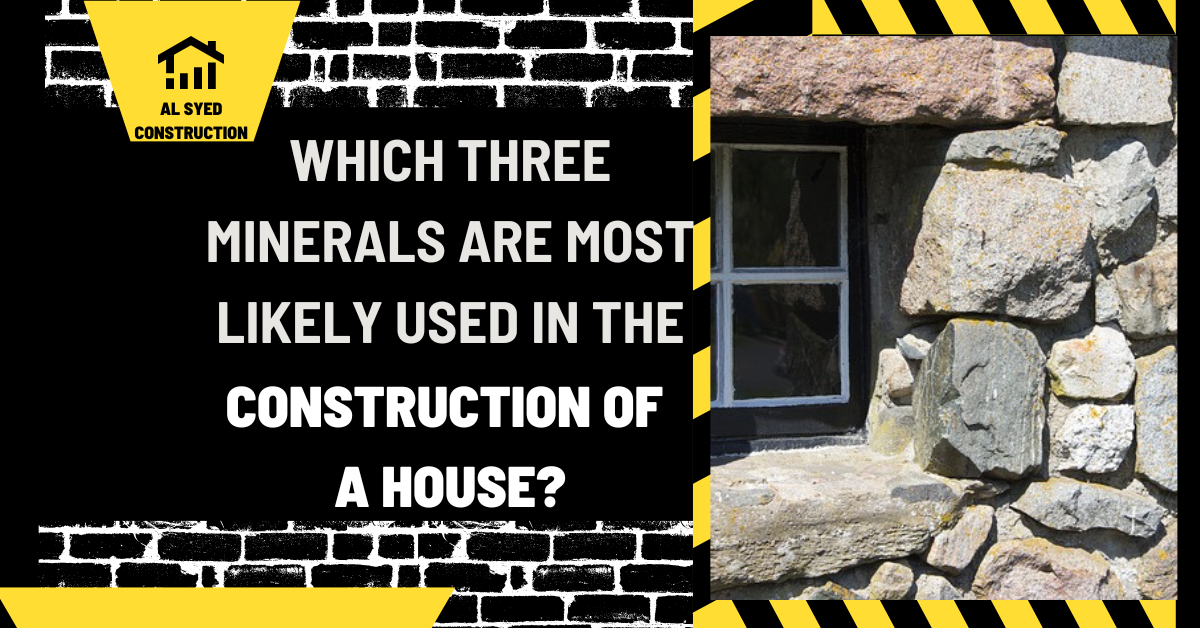
Which Three Minerals Are Used to Build a House?
Three minerals that commonly contribute to house construction are quartz, feldspar, and calcite. They usually reach a building site as ingredients in manufactured products or as parts of natural stone rather than as loose mineral specimens. Quartz is important in sand, glass, and many rocks; feldspar is abundant in granite and ceramic products; calcite is a major component of limestone and a key raw material in cement and lime. The exact answer depends on whether a question is about structural materials, finishes, or the geology of a particular region.
What “used in construction” means
A mineral is a naturally occurring solid with a characteristic chemical composition and crystal structure. A construction product, by contrast, is an engineered material such as concrete, glass, brick, tile, or dimension stone. Minerals become useful when they are extracted, processed, combined, and tested to meet a product specification. A house therefore contains many mineral resources even when no one can see a recognizable crystal. Concrete may contain aggregates made from mineral grains, glass relies on silica-rich raw materials, and ceramic finishes use processed clays and feldspar-bearing ingredients.
There is no single three-mineral list that describes every house. A timber-frame home in one region may rely on different local stone and aggregate than a masonry home elsewhere. Still, quartz, feldspar, and calcite are a helpful starting group because they connect directly to common materials. They also illustrate three different roles: a durable silica source, an ingredient in ceramics and igneous rock, and a carbonate source for cement and lime.
Quartz: a hard, widespread building ingredient
Quartz is silicon dioxide and occurs in many rocks, including granite, sandstone, and quartzite. Its hardness and resistance to ordinary weathering help explain why quartz-rich sand and crushed rock are common aggregates. In concrete, aggregate occupies much of the volume and helps create a stable, economical mixture. The aggregate must be selected and graded for the intended concrete; the presence of quartz by itself does not guarantee good performance. Particle shape, cleanliness, strength, moisture, and compatibility with cement also matter.
Silica-rich sand is also used to make many types of glass. Windows, doors with glazing, and some interior features rely on manufactured glass whose properties depend on the recipe and processing. Quartz-bearing stone can serve as a countertop or flooring material, though “engineered quartz” is a manufactured composite and is not the same thing as a solid piece of mineral quartz. When comparing a natural stone slab with a composite product, check the product’s care instructions, heat limitations, fabrication details, and warranty.
Quartz is useful but requires safe handling during fabrication. Cutting, grinding, or drilling certain stone and masonry products can create respirable crystalline silica dust. That exposure is controlled through the work plan, equipment, ventilation, and applicable safety rules. A homeowner should not dry-grind a countertop or concrete surface as a casual repair. Contractors should follow the material supplier’s safety information and the site’s dust-control requirements.
Feldspar: common in granite and ceramic products
Feldspar is a large mineral group found in many igneous rocks. Granite often contains feldspar together with quartz and other minerals, which gives the stone its varied colors and speckled appearance. Granite may be used for countertops, steps, cladding, paving, or other architectural elements when the selected grade and finish suit the application. A product’s performance depends on the whole stone, its thickness, support, fabrication, anchorage, and exposure, not only on the fact that feldspar is present.
Feldspar is also used as a flux in ceramic manufacturing. In a kiln, a flux helps ingredients form a dense, cohesive body at the intended firing temperature. Ceramic tile, sanitaryware, and some other fired products can therefore contain feldspar-bearing raw materials. The mineral is not a guarantee of a specific color or water absorption: the complete formulation and firing process establish those properties. When choosing tile, use the product’s technical data for its intended location and maintenance rather than inferring suitability from its ingredients.
In a home, feldspar’s contribution is often indirect. It may be part of the granite in a kitchen, a ceramic tile body, or a crushed stone source. Installers need the product-specific instructions for cutting, support, adhesive, grout, and movement joints. A polished slab and a textured exterior paver may contain similar mineral families but require very different detailing.
Calcite: limestone, cement, and lime
Calcite is calcium carbonate and is the principal mineral in many limestones. Limestone can be quarried as dimension stone or processed into aggregate, but its most familiar construction role is as a raw material for cement and lime. Cement manufacturing heats carefully proportioned mineral feedstocks to make clinker, which is ground with other ingredients to produce cement. Cement then reacts with water in concrete and mortar. It is a binder in the mixture, while sand and stone generally provide much of the aggregate skeleton.
Calcite also occurs in marble, which forms when limestone is changed by heat and pressure. Marble may be used for floors, wall panels, vanity tops, or decorative details. It can be attractive but is typically more sensitive to acids and scratching than many homeowners expect. Lemon juice, vinegar, and some cleaners can etch calcite-rich stone. Use a cleaner and sealer only when the stone supplier recommends them, and understand that a sealer can reduce absorption without making marble impervious to damage.
Because calcite-rich materials vary, designers consider strength, porosity, weather exposure, finish, and maintenance. A limestone appropriate for an interior feature may not suit a freeze-thaw exposed wall. Product tests and project specifications are more useful than a generic label such as “natural stone.”
How the minerals become building products
Mining is only the first stage. Producers crush, screen, wash, blend, or chemically process raw materials, then manufacture a product under controlled conditions. A concrete aggregate source is tested for grading and durability. Glass raw materials are melted and formed. Ceramic ingredients are blended, shaped, fired, and inspected. Cement raw meal is proportioned and processed at high temperature. The finished product’s performance depends on each stage and on how it is installed in the building.
This distinction matters when reading a material description. “Quartz-based” does not tell you whether a countertop is natural or engineered. “Limestone aggregate” does not establish concrete strength. “Ceramic tile” does not specify slip resistance, water absorption, or whether the product is intended for a shower floor. Ask for the product data sheet and installation instructions that apply to the exact product number and use.
Minerals across a typical house
Consider a single home from foundation to finish. Crushed stone or sand may form part of the foundation drainage and concrete. Silica-rich sand may become window glass. Limestone-derived cement may bind concrete, mortar, or grout. Granite containing feldspar and quartz may be fabricated into a counter. Ceramic tile may rely on feldspar as a flux and contain other mineral ingredients. Gypsum-based wallboard and mineral insulation add further resources beyond the three examples. The house is a system of processed materials, each selected for a specific function.
Matching product to location is more important than choosing by mineral name. Exterior exposure, moisture, load, fire requirements, cleaning methods, and accessibility affect the specification. A stone finish should have appropriate support; a cementitious product needs correct curing; glass needs safe edge treatment and framing; and tile needs a suitable substrate. If a design requires a particular color or performance, use approved samples and technical documentation.
Responsible sourcing and practical checks
Ask where a product will be used and which properties matter before comparing material labels. For stone, review finish, thickness, edge treatment, anchorage, and maintenance. For concrete or mortar, follow the mix and curing specifications. For ceramic products, check application guidance and test data. For glass, confirm safety glazing requirements where applicable. Keep invoices, product labels, and installation records so replacement materials can be matched later.
Responsible sourcing also includes worker safety and environmental controls. Mining and processing can affect land, water, transport, and energy use. Project teams can request supplier information about sourcing and manufacturing, while installers should control dust and handle chemicals as directed. Reuse, local availability, and durability may matter more than a mineral’s name in isolation. A long-lasting product that is suited to its location can reduce the need for early replacement.
Common questions
Are quartz, feldspar, and calcite found in every house?
No. They are common examples in building materials, but a home’s exact mineral content depends on local resources, product choices, and construction methods.
Is quartz the same as engineered quartz countertop?
No. Natural quartz is a mineral. Engineered quartz is a manufactured surface made from mineral particles and binding materials; follow its own care and fabrication instructions.
Does calcite make marble waterproof?
No. Calcite is a mineral constituent, not a waterproofing system. Marble can absorb liquids and can be etched by acids; use it only where its properties and maintenance fit.
Why does feldspar matter in tile?
Feldspar can act as a flux in ceramic manufacturing, helping the body mature during firing. The complete tile specification—not one ingredient—determines where it can be installed.




Leave a Reply
Want to join the discussion?Feel free to contribute!