
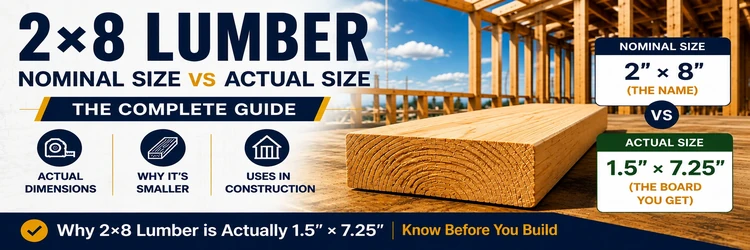
Actual Size of a 2×8 Lumber in Construction in the USA
If you are buying dimensional lumber for a construction project in the United States, one of the first things you may notice is that a board labeled 2×8 is not actually 2 inches by 8 inches.
The name 2×8 refers to the board’s nominal dimensions, while the finished board you purchase is smaller because dimensional lumber is surfaced and processed during manufacturing.
So, what is the actual size of a 2×8?
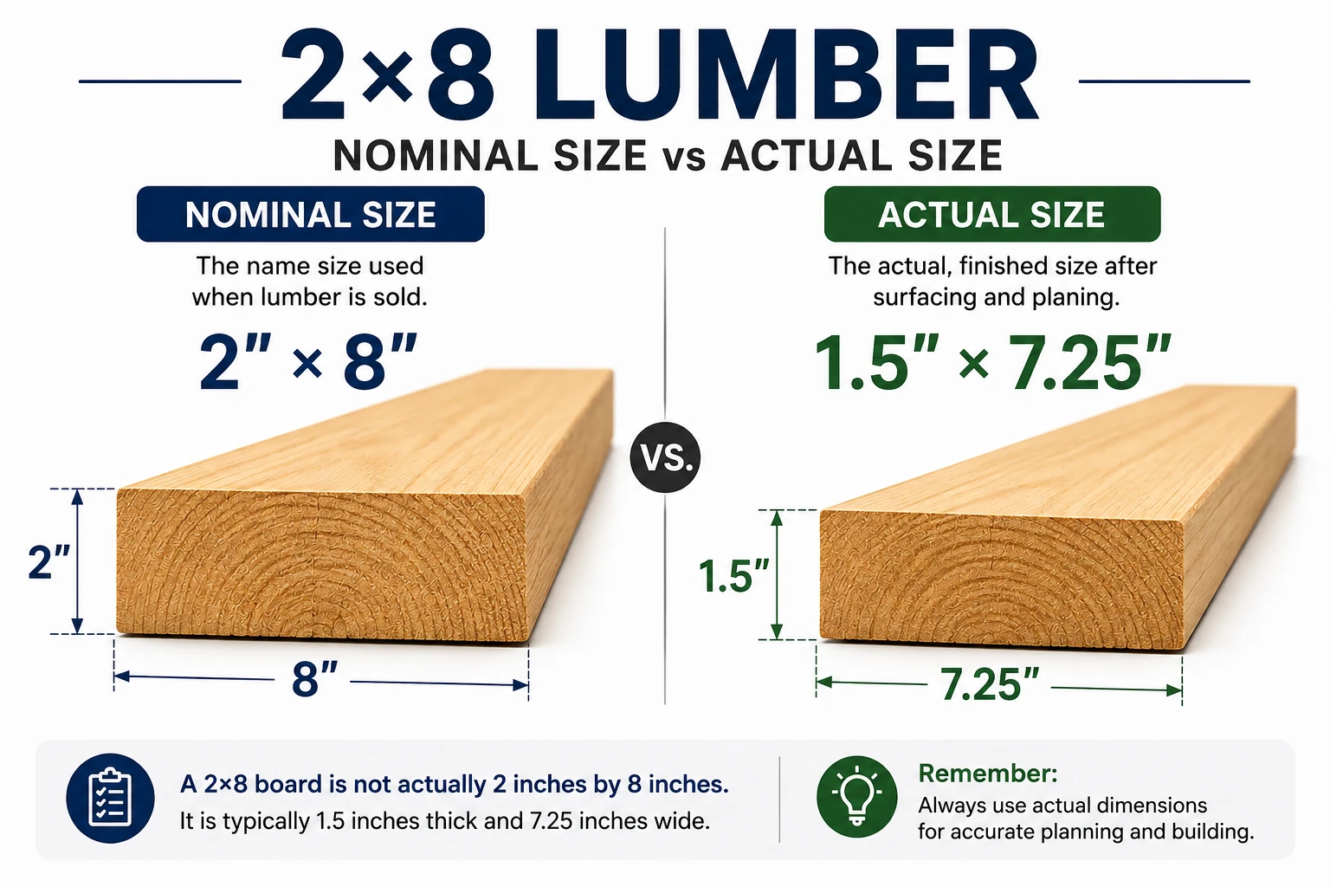
For standard surfaced dimensional lumber, a 2×8 is typically 1.5 inches thick and 7.25 inches wide.
That difference between nominal and actual dimensions is important when designing walls, floors, roofs, decks, furniture, framing systems, and other construction projects.
This guide explains the actual dimensions of 2×8 lumber, why the size is different from its name, how much a 2×8 measures in different units, where it is commonly used, and what homeowners, builders, contractors, and DIYers should know before purchasing or designing with it.
Quick Answer: What Is the Actual Size of a 2×8?
The typical actual dimensions of standard surfaced 2×8 dimensional lumber are:
| Dimension | Nominal Size | Actual Size |
|---|---|---|
| Thickness | 2 inches | 1.5 inches |
| Width | 8 inches | 7.25 inches |
| Length | Varies | Varies |
Therefore, when you purchase a standard 2×8 board from a lumber supplier or home improvement store, you should generally expect the cross-section to measure approximately 1.5 inches × 7.25 inches.
The length is a separate dimension and depends on the particular board you purchase.
Common lengths can include:
- 8 feet
- 10 feet
- 12 feet
- 14 feet
- 16 feet
- Longer lengths for specific applications
The actual available lengths depend on the species, grade, supplier, and product.
Nominal Size vs Actual Size
The most important concept to understand is the difference between nominal lumber size and actual lumber size.
A board sold as a 2×8 is identified using its nominal dimensions.
However, dimensional lumber is typically sawn larger and then processed to produce a consistent finished product.
The board is surfaced or planed, which removes material from its original rough dimensions.
As a result, the finished dimensions are smaller than the nominal dimensions.
For a standard 2×8:
Nominal size: 2 inches × 8 inches
Typical actual size: 1.5 inches × 7.25 inches
This naming convention applies to many common dimensional lumber sizes used in U.S. construction.
For example:
| Nominal Lumber Size | Typical Actual Size |
|---|---|
| 2×4 | 1.5 × 3.5 in |
| 2×6 | 1.5 × 5.5 in |
| 2×8 | 1.5 × 7.25 in |
| 2×10 | 1.5 × 9.25 in |
| 2×12 | 1.5 × 11.25 in |
This is why a contractor ordering 2×8 lumber does not normally expect a board that physically measures 2 inches by 8 inches.
Why Is a 2×8 Not Actually 2×8?
The difference comes from how dimensional lumber is manufactured and processed.
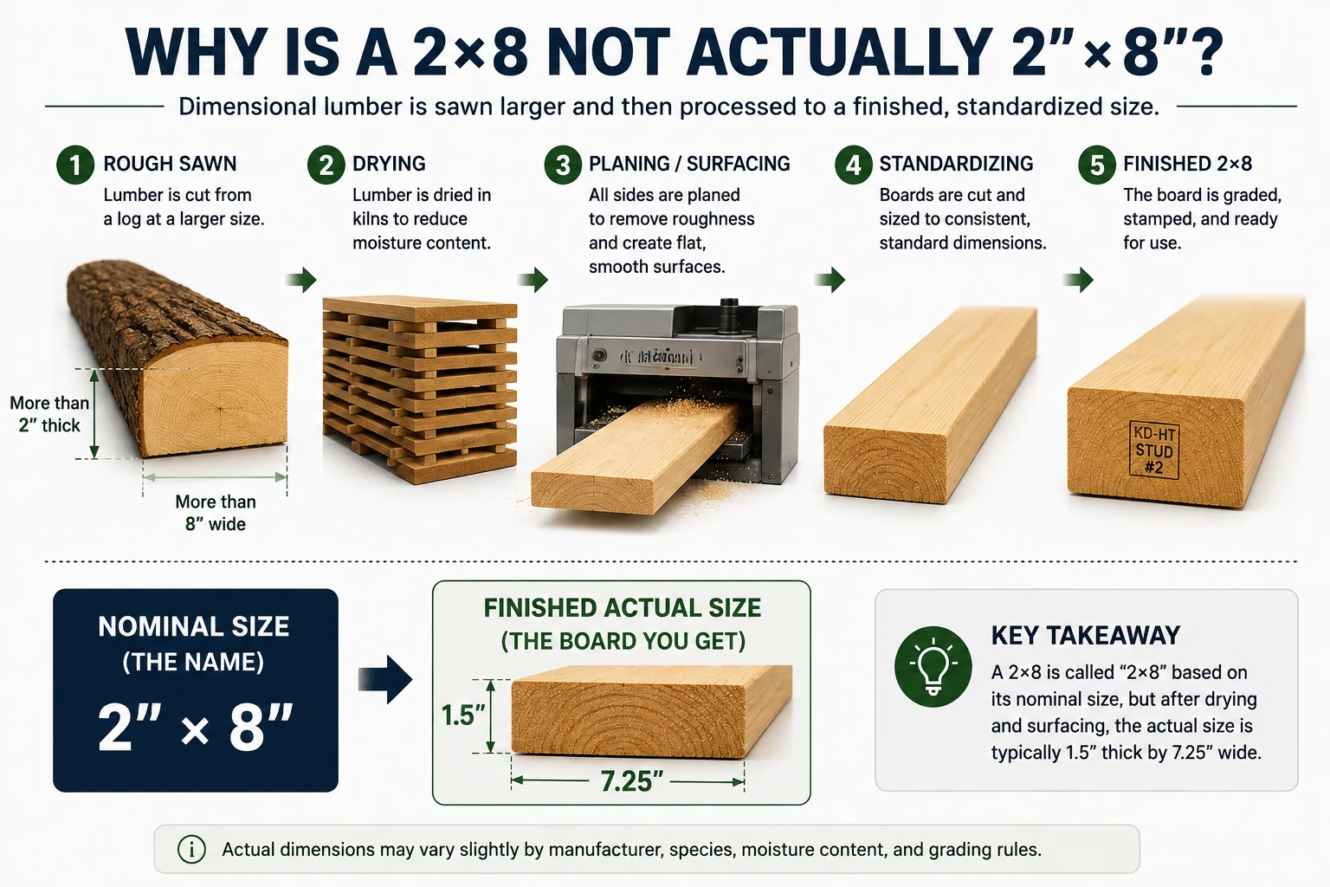
Lumber begins as a larger rough-sawn piece.
During production, the board is:
- Sawn from the log.
- Dried to reduce moisture.
- Surfaced or planed.
- Finished to standardized dimensions.
- Graded and prepared for sale.
The surfacing process removes material from the board.
That produces a smoother, more consistent finished product but also reduces its final dimensions.
This is why the term 2×8 remains the nominal product designation even though the finished board is approximately 1.5 inches × 7.25 inches.
2×8 Actual Dimensions in Feet
When purchasing lumber for construction, the cross-sectional dimensions are usually given in inches while the length is commonly sold in feet.
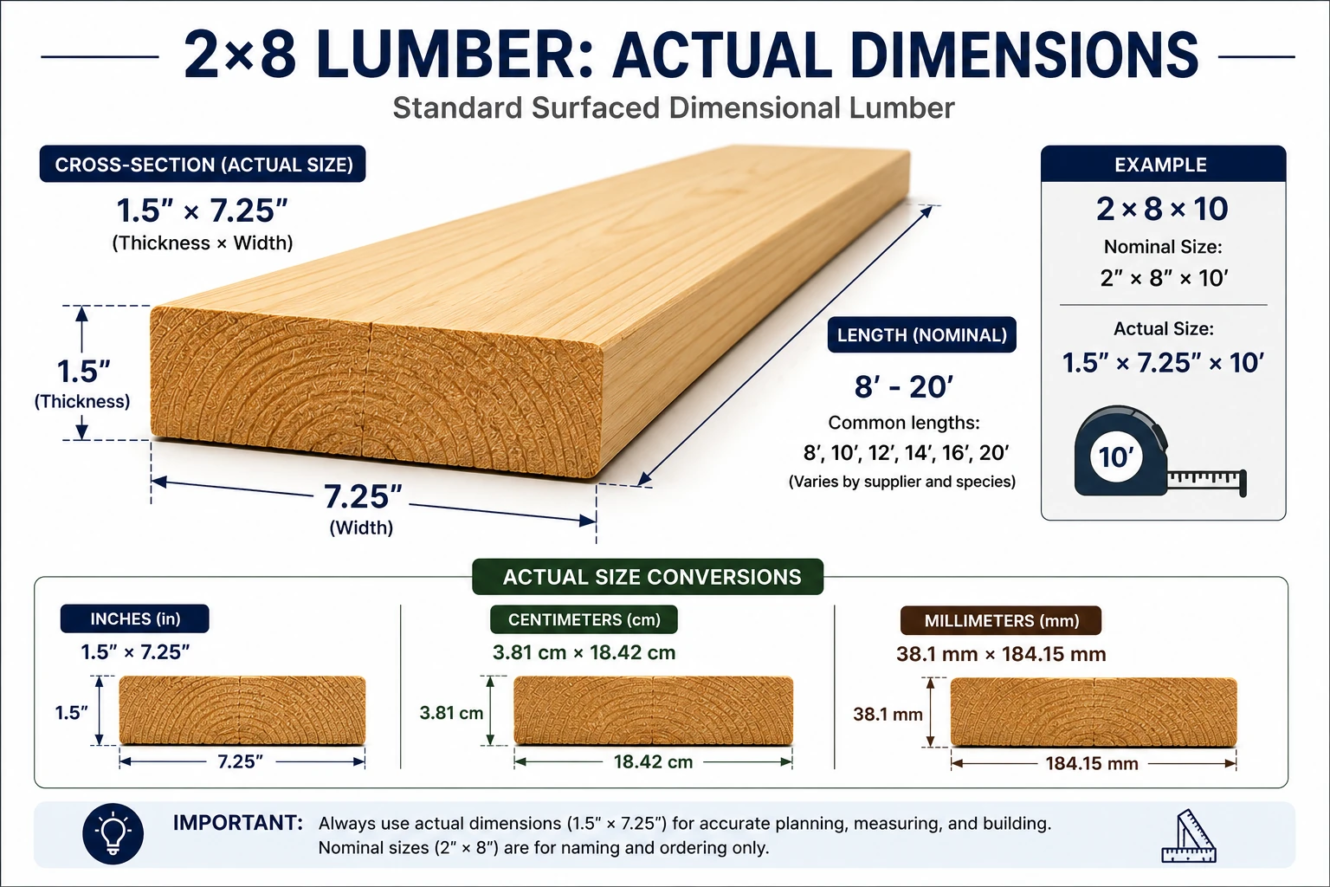
For example:
A 2×8×10 board means:
- Nominal thickness: 2 inches
- Nominal width: 8 inches
- Length: 10 feet
The typical finished cross-section would be approximately:
1.5 inches × 7.25 inches × 10 feet
Similarly, a 2×8×12 would typically have an actual cross-section of 1.5 inches × 7.25 inches and a length of 12 feet.
2×8 Actual Size in Centimeters
For projects involving metric measurements, the typical actual dimensions can also be converted into centimeters.
A board measuring approximately 1.5 inches × 7.25 inches corresponds to roughly:
- 3.81 cm thick
- 18.42 cm wide
So a standard 2×8 has an actual cross-section of approximately:
3.81 cm × 18.42 cm
The exact measured dimensions can vary slightly depending on the lumber product, manufacturer, moisture content, and finishing process.
2×8 Actual Size in Millimeters
For more precise metric planning:
- 1.5 inches = approximately 38.1 mm
- 7.25 inches = approximately 184.15 mm
Therefore, the typical actual cross-section is approximately:
38.1 mm × 184.15 mm
These conversions can be useful when coordinating U.S. lumber with metric drawings, imported components, or engineering documentation.
Standard 2×8 Lumber Size Chart
The following table provides a quick reference for standard 2×8 dimensions.
| Measurement | Nominal | Typical Actual |
|---|---|---|
| Thickness | 2 in | 1.5 in |
| Width | 8 in | 7.25 in |
| Thickness | 5.08 cm | 3.81 cm |
| Width | 20.32 cm | 18.42 cm |
| Thickness | 50.8 mm | 38.1 mm |
| Width | 203.2 mm | 184.15 mm |
This distinction is particularly important when you are calculating clearances, framing dimensions, material quantities, or the available space around structural members.
How Big Is a 2×8 Compared With Other Lumber?
Understanding the size of a 2×8 becomes easier when you compare it with other common dimensional lumber.
| Lumber | Typical Actual Thickness | Typical Actual Width |
|---|---|---|
| 2×4 | 1.5 in | 3.5 in |
| 2×6 | 1.5 in | 5.5 in |
| 2×8 | 1.5 in | 7.25 in |
| 2×10 | 1.5 in | 9.25 in |
| 2×12 | 1.5 in | 11.25 in |
Notice that the thickness remains approximately 1.5 inches across these common 2-inch nominal lumber sizes, while the width increases.
That increasing width can provide different structural characteristics and makes larger boards suitable for applications where greater depth is required.
Common Uses for 2×8 Lumber in Construction
2×8 lumber is widely used in residential construction and other building applications.
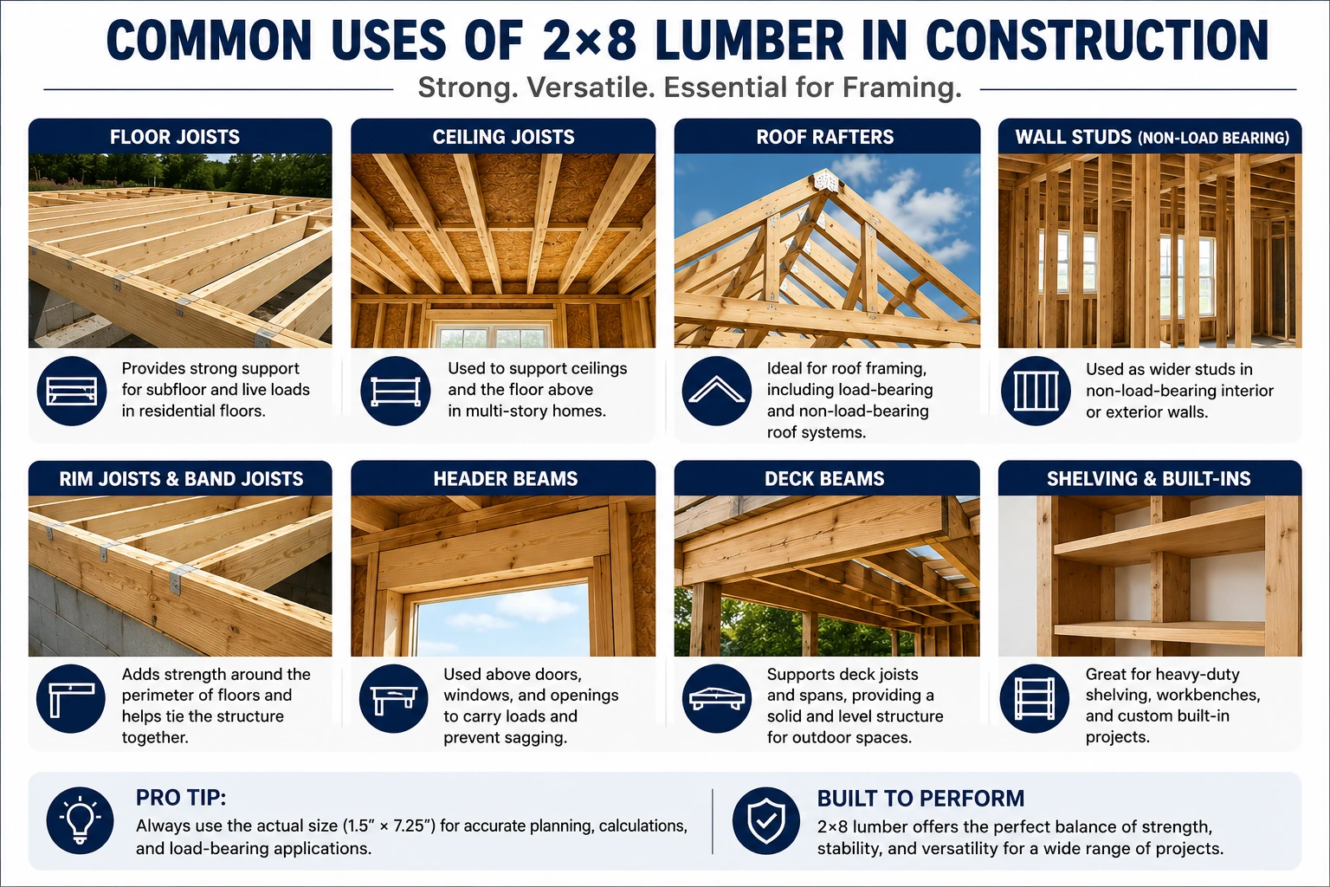
Depending on the species, grade, engineering requirements, and local building requirements, 2×8 boards may be used for:
- Floor joists
- Roof framing
- Rafters
- Headers
- Beams in appropriate applications
- Deck framing
- Stair components
- Wall framing in certain situations
- Blocking
- Structural supports
- General framing
However, the fact that a board is 2×8 does not automatically mean it is suitable for every structural application.
Structural capacity depends on much more than the physical dimensions of the board.
2×8 Floor Joists
One of the common applications of 2×8 lumber is residential floor framing.
Floor joists support the floor assembly and transfer loads to beams, walls, or other structural supports.
Whether a 2×8 can be used as a floor joist depends on factors such as:
- Lumber species
- Lumber grade
- Span
- Joist spacing
- Load requirements
- Deflection limits
- Support conditions
- Applicable building requirements
Therefore, the actual 2×8 dimensions are only the starting point.
You should not determine the allowable span of a floor joist based solely on the fact that it is a 2×8.
2×8 Roof Rafters
2×8 lumber can also be used in certain roof framing applications.
Roof rafters must support the roof assembly and loads imposed on the structure.
Depending on the design, these loads can include:
- Roofing materials
- Roof sheathing
- Insulation
- Ceiling loads
- Snow
- Wind
- Maintenance loads
The appropriate rafter size and spacing must therefore be determined according to the structural design and applicable requirements.
2×8 Deck Framing
2×8 boards are also commonly encountered in deck construction.
They may be used for:
- Deck joists
- Beams in appropriate designs
- Rim boards
- Structural framing
Deck design is highly dependent on span, spacing, species, grade, connection details, and local requirements.
A 2×8 used as a deck joist should therefore be evaluated based on the complete deck design rather than simply its nominal size.
Can a 2×8 Be Used as a Header?
A 2×8 may be used as part of a header assembly in some construction situations, but this depends on the opening size and structural load above it.
Factors can include:
- Opening width
- Number of stories
- Roof load
- Floor load
- Wall configuration
- Lumber species
- Grade
- Number of plies
- Local requirements
A header should not be sized simply by looking at the nominal lumber dimension.
For structural openings, use an appropriate span table, engineering design, or local building requirements.
2×8 Load Capacity Is Not Determined by Size Alone
A common question is:
“How much weight can a 2×8 hold?”
There is no single answer.
A 2×8 board can have very different load capacities depending on how it is being used.
Important factors include:
- Orientation
- Span
- Species
- Grade
- Moisture
- Support conditions
- Load duration
- Point loads
- Uniform loads
- Connections
A 2×8 used vertically as a short post is fundamentally different from a 2×8 spanning several feet as a floor joist.
For that reason, the actual size of the board should not be confused with its structural capacity.
If you are looking for load capacity, use a dedicated structural load-capacity resource rather than relying on the dimensions alone.
2×8 Span Depends on the Application
Another common question is:
“How far can a 2×8 span?”
Again, there is no universal span.
A 2×8 floor joist may have one allowable span under one set of conditions and a different allowable span under another.
The same applies to rafters and other structural applications.
Span depends on:
- Species
- Grade
- Spacing
- Load
- Deflection criteria
- Support conditions
- Construction type
This is why a 2×8 span chart should always specify the application and assumptions behind the values.
2×8 Joist Spacing
Joist spacing is another factor that affects structural performance.
Common framing layouts may use spacing such as:
- 12 inches on center
- 16 inches on center
- 19.2 inches on center
- 24 inches on center
However, the correct spacing depends on the structural design and applicable requirements.
Changing joist spacing changes the load carried by each joist.
For example, a floor framed at 16 inches on center distributes loads differently than a floor framed at 24 inches on center.
Therefore, 2×8 size and joist spacing should always be considered together when evaluating a floor system.
2×8 vs 2×10
Both 2×8 and 2×10 lumber are commonly used in framing.
Their typical actual widths are:
- 2×8 → 7.25 inches
- 2×10 → 9.25 inches
The additional depth of a 2×10 can make it suitable for applications requiring greater structural depth or longer spans under appropriate conditions.
However, choosing between a 2×8 and 2×10 should depend on the actual structural requirements rather than simply choosing the larger board.
2×8 vs 2×6
A 2×6 has a typical actual width of 5.5 inches, compared with approximately 7.25 inches for a 2×8.
The greater depth of the 2×8 can provide different structural characteristics.
However, the correct lumber size depends on:
- Span
- Load
- Spacing
- Species
- Grade
- Application
A larger board is not automatically necessary for every project.
2×8 vs 2×12
A 2×12 has a typical actual width of 11.25 inches.
That makes it substantially deeper than a 2×8.
Larger dimensional lumber may be useful for structural applications where greater depth is required, but it also tends to be heavier and can cost more.
The correct selection should therefore balance structural requirements, availability, cost, and construction practicality.
Does Every 2×8 Have Exactly the Same Actual Size?
Not necessarily.
The commonly expected finished dimensions are approximately 1.5 inches × 7.25 inches, but actual measurements can vary slightly.
Possible reasons include:
- Lumber species
- Manufacturer
- Moisture content
- Surfacing
- Product type
- Manufacturing tolerances
Additionally, rough-sawn lumber is different from standard surfaced dimensional lumber.
Therefore, if a project requires very precise dimensions, measure the actual material rather than relying solely on the nominal label.
Why Actual Lumber Dimensions Matter
Knowing the actual size of lumber is important in many construction situations.
Framing
Framing layouts depend on the physical dimensions of the members.
Clearances
Actual dimensions matter when lumber must fit into a specific opening or assembly.
Material Quantity
Actual dimensions can be important when calculating material volume.
Connections
Fasteners, brackets, hangers, and other connections must be compatible with the physical size of the lumber.
Design
Architectural and structural drawings often need to account for actual member dimensions.
Remodeling
When replacing existing framing, the actual dimensions of the old and new materials may need to be compared.
How to Measure a 2×8
If you want to verify the dimensions of a particular board, measuring it is straightforward.
Use a tape measure or caliper and measure:
- Thickness across the narrow dimension.
- Width across the wider dimension.
- Length from end to end.
A typical surfaced 2×8 should measure approximately:
1.5 inches thick × 7.25 inches wide
Small variations do not necessarily mean the lumber is incorrectly labeled.
If the board is significantly different from the expected dimensions, check whether it is:
- Rough-sawn lumber
- Specialty lumber
- Reclaimed lumber
- A different product
- A different nominal size
2×8 Lumber Grades Matter
Not all 2×8 boards have the same structural properties.
Lumber is available in different grades and species, and those differences can affect strength and allowable structural use.
For structural framing, the grade and species should be identified according to the requirements of the project.
A construction professional may need to consider:
- Species
- Grade
- Span
- Load
- Moisture conditions
- Treatment
- Local requirements
Therefore, two boards with identical physical dimensions can have different structural properties.
2×8 Treated Lumber
Pressure-treated 2×8 lumber is commonly used in applications where the wood may be exposed to moisture or certain outdoor conditions.
Potential applications include:
- Deck framing
- Exterior structures
- Outdoor framing
- Ground-contact applications where the product is appropriately rated
Treated lumber can have different characteristics from untreated lumber, and the appropriate treatment level depends on the intended use.
Always use lumber that is appropriately rated for the specific exposure and application.
Is a 2×8 Stronger Than a 2×6?
Not necessarily in every situation, but the greater depth of a 2×8 can provide greater structural capacity in certain applications.
Structural performance depends on:
- Lumber species
- Grade
- Orientation
- Span
- Spacing
- Loading
- Support conditions
So the statement “2×8 is stronger than 2×6” is too general to use for structural design.
The correct comparison must be made for a specific application.
Buying Tips for 2×8 Lumber
When purchasing 2×8 lumber for a construction project, don’t look only at the nominal size.
Check:
Actual Dimensions
Confirm that the finished dimensions are appropriate for your design.
Length
Purchase lengths that minimize unnecessary waste.
Grade
Choose the appropriate grade for the application.
Species
Different species have different structural characteristics.
Moisture and Condition
Look for excessive warping, splitting, decay, or other defects when the application requires sound lumber.
Treatment
For exterior or moisture-exposed applications, make sure the product is appropriately treated and rated.
Common Mistakes When Buying 2×8 Lumber
Assuming It Measures 2×8 Inches
This is the most common mistake.
The nominal designation does not represent the typical finished dimensions.
Designing With Nominal Dimensions
Construction drawings and detailed layouts may require actual dimensions.
Ignoring Lumber Grade
Two 2×8 boards can have different structural properties depending on grade and species.
Assuming All 2×8 Boards Are Interchangeable
The appropriate product depends on the application.
Using a General Span Number
A span value without knowing the species, grade, spacing, and load assumptions can be misleading.
Frequently Asked Questions
What is the actual size of a 2×8?
The typical actual size of standard surfaced 2×8 dimensional lumber is approximately 1.5 inches × 7.25 inches.
Why is a 2×8 actually smaller?
The 2×8 designation refers to nominal dimensions. Lumber is processed and surfaced during manufacturing, reducing the finished dimensions.
How wide is a 2×8?
A standard surfaced 2×8 is typically 7.25 inches wide.
How thick is a 2×8?
A standard surfaced 2×8 is typically 1.5 inches thick.
How big is a 2×8 in centimeters?
The typical actual dimensions are approximately 3.81 cm × 18.42 cm.
How big is a 2×8 in millimeters?
The typical actual dimensions are approximately 38.1 mm × 184.15 mm.
Is a 2×8 really 2 inches by 8 inches?
No. The 2×8 designation is nominal. Standard surfaced lumber is typically approximately 1.5 inches × 7.25 inches.
Can a 2×8 be used as a floor joist?
Yes, 2×8 lumber can be used as floor joists in appropriate designs. The allowable use depends on species, grade, span, spacing, loading, and applicable requirements.
Can a 2×8 be used for roof rafters?
A 2×8 may be appropriate for certain roof framing applications, but the correct size depends on the roof design, span, loads, species, grade, spacing, and applicable requirements.
How much weight can a 2×8 hold?
There is no universal weight capacity for a 2×8. Its capacity depends on how it is installed, its span, species, grade, orientation, support conditions, and loading.
How far can a 2×8 span?
There is no single span that applies to every 2×8. Floor joists, rafters, and other structural members have different requirements and must be evaluated using the appropriate span information.
Is a 2×8 stronger than a 2×6?
A 2×8 has greater depth than a 2×6 and can provide greater capacity in certain applications, but actual structural performance depends on species, grade, span, spacing, and loading.
Final Answer: What Is the Actual Size of a 2×8?
For standard surfaced dimensional lumber used in U.S. construction, a 2×8 is typically 1.5 inches thick and 7.25 inches wide.
The difference between the nominal 2×8 designation and the actual finished dimensions is normal and results from the manufacturing and surfacing process.
Understanding this distinction is important when purchasing lumber, preparing construction drawings, calculating clearances, planning framing systems, and comparing different lumber sizes.
However, actual dimensions are only one part of lumber selection.
If the 2×8 will be used structurally, you also need to consider the lumber’s species, grade, span, spacing, loads, support conditions, and applicable construction requirements.
For a simple dimensional reference, remember:
2×8 nominal size → approximately 1.5″ × 7.25″ actual size
That is the measurement you should generally expect when purchasing standard surfaced 2×8 dimensional lumber in the United States.
