
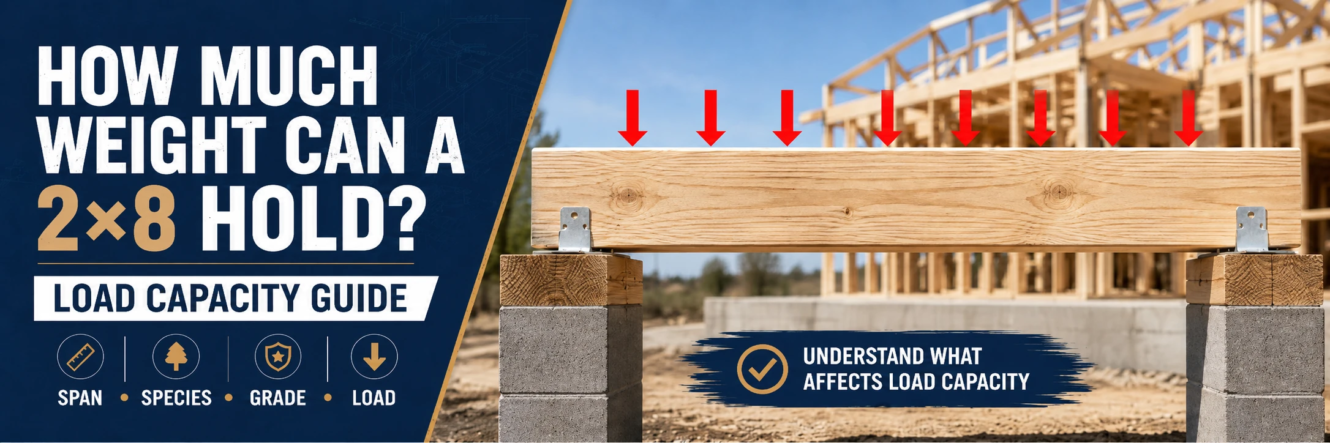
How Much Weight Can a 2×8 Hold? Load Capacity Guide
A 2×8 is commonly used for floor joists, deck framing, rafters, headers, and other structural applications. But if you are planning to use one to support weight, the most important question is: how much weight can a 2×8 actually hold?
There is no single safe weight limit that applies to every 2×8 board.
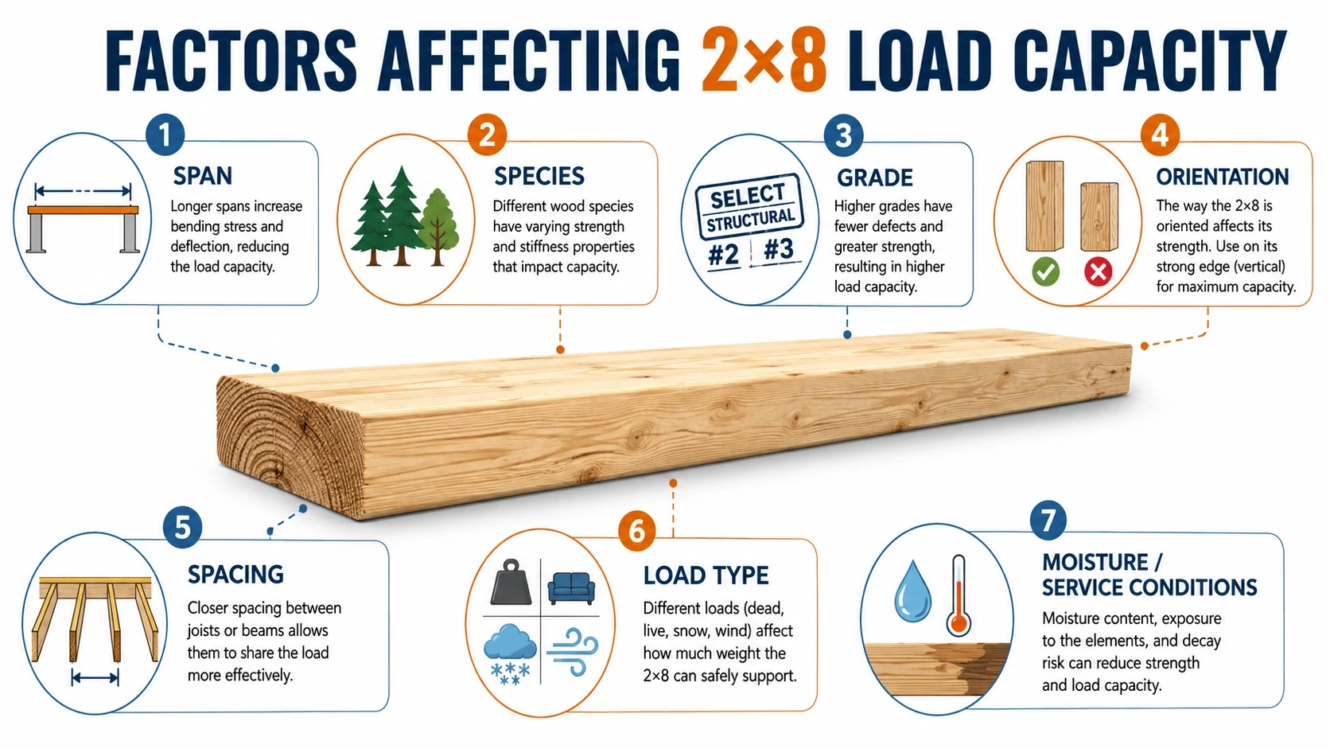
The load capacity of a 2×8 depends on its span, wood species, lumber grade, orientation, spacing, support conditions, moisture condition, and whether the load is concentrated at one point or distributed over the board.
A short, high-grade 2×8 installed vertically on its edge can support substantially more load than the same board spanning a much greater distance. Likewise, a 2×8 used as one member in a properly designed floor system behaves differently from a single isolated board supporting a heavy point load.
This guide explains how 2×8 load capacity works, why simple “X pounds” answers can be misleading, and what you need to know before using a 2×8 as a structural member.
Quick Answer: How Much Weight Can a 2×8 Hold?
A 2×8 does not have one universal load capacity in pounds.
Its safe capacity must be determined from the actual design conditions.
For example, you need to know:
- Wood species
- Lumber grade
- Clear span between supports
- Joist or beam spacing
- Whether the 2×8 is installed flat or on edge
- Dead load
- Live load
- Concentrated versus uniformly distributed load
- Number of members being used
- Moisture/service conditions
- Bearing at the supports
- Applicable building-code requirements
This is why statements such as “a 2×8 can hold 1,000 pounds” are incomplete unless the span, load location, grade, species, orientation, and support conditions are also specified.
The American Wood Council (AWC) uses several structural properties when evaluating lumber, including bending strength (Fb), modulus of elasticity (E), shear strength (Fv), and compression perpendicular to grain (Fc⊥). Allowable spans can also be affected by factors such as load duration, wet-service conditions and lumber size.
2×8 Load Capacity at a Glance
| Factor | Effect on Capacity |
|---|---|
| Shorter span | Generally increases capacity |
| Longer span | Generally reduces capacity |
| Higher lumber grade | Usually increases allowable capacity |
| Stronger/stiffer species | Can increase allowable span or load |
| 2×8 installed on edge | Much stronger in bending than flat |
| Closer joist spacing | Reduces load carried by each joist |
| Wider joist spacing | Increases tributary load per joist |
| Concentrated point load | Can be more demanding than an equivalent distributed load |
| Excessive moisture/deterioration | Can reduce structural performance |
| Multiple properly connected members | Can provide greater capacity than one member, but must be designed as an assembly |
The key point is simple:
The question should not only be “How many pounds can a 2×8 hold?” but “How much load can this specific 2×8 safely support under these specific conditions?”
What Is the Actual Size of a 2×8?
Despite its name, a standard surfaced 2×8 does not normally measure a full 2 inches by 8 inches.
Its commonly used actual dimensions are approximately:
1.5 inches × 7.25 inches
The 2×8 designation is its nominal size.
The difference exists because lumber is initially identified by its nominal dimensions and becomes smaller after drying and surfacing.
This distinction matters in structural calculations because bending, stiffness, shear, and other properties are based on the board’s actual cross-section, not simply the nominal “2×8” label.
Why There Is No Single 2×8 Weight Capacity
Two boards sold as “2×8 lumber” can have very different structural capabilities.
Consider these examples:
A No. 2 grade board and a Select Structural board of the same species do not necessarily have the same design values.
A Southern Pine 2×8 and a Spruce-Pine-Fir 2×8 may have different bending and stiffness properties.
A 2×8 spanning 6 feet behaves differently from the same lumber spanning 12 feet.
A board laid flat behaves very differently from a board standing on its narrow edge.
And a 500-pound object placed in the middle of a span does not create the same structural condition as 500 pounds distributed uniformly along the entire member.
This is why professional wood design uses engineering properties and span/load tables rather than assigning a universal pound rating to a lumber size.
The AWC’s current design-value resources provide different Fb and E values according to species, grade, and lumber size, illustrating why the label “2×8” alone is not enough to establish capacity.
How Much Weight Can a 2×8 Hold Horizontally?
This is one of the most common questions about 2×8 lumber.
A horizontally spanning 2×8 can carry substantial load when properly selected and supported, but its capacity cannot be determined safely without knowing the span and loading arrangement.
The most important distinction is whether the load is:
Uniformly distributed across the member,
or
Concentrated at one point, such as a heavy object placed near the center.
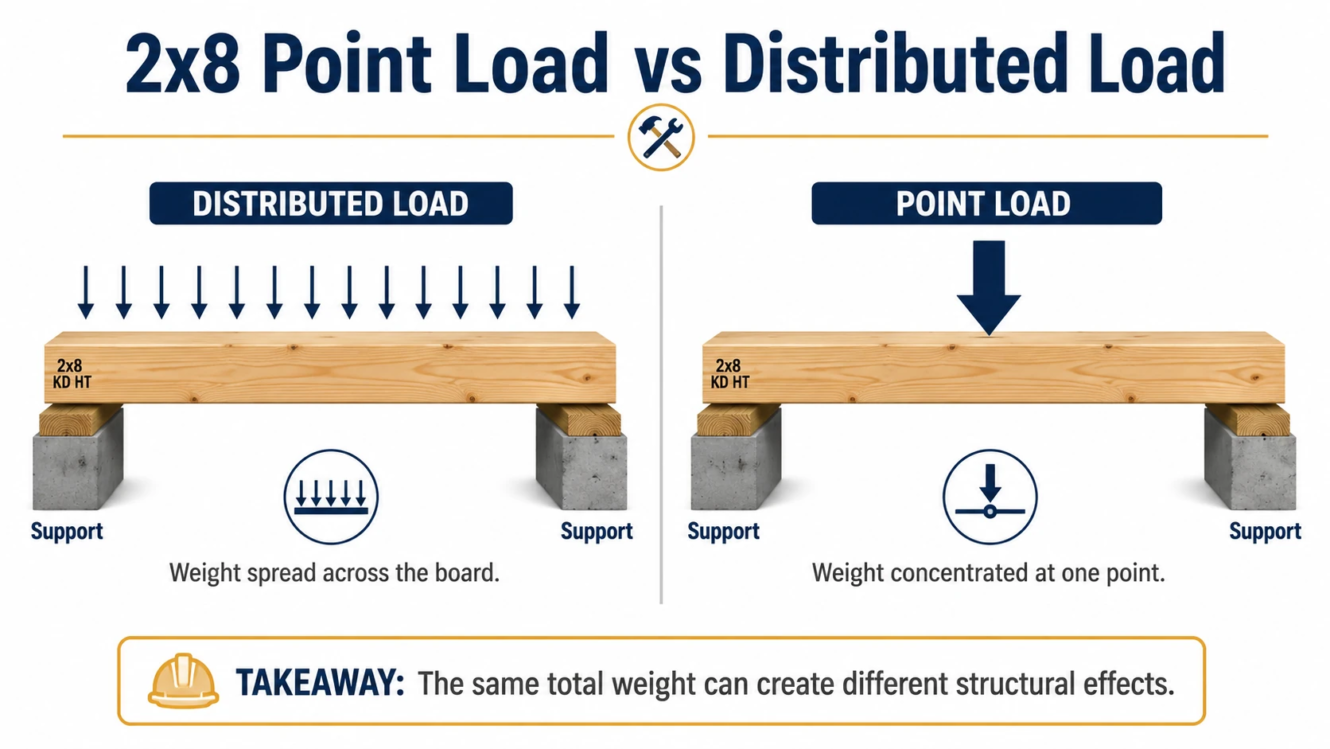
Imagine two identical 2×8 boards spanning between two supports.
On the first board, weight is spread relatively evenly across the entire span.
On the second board, the same total weight is concentrated near the middle.
Those are not equivalent structural situations.
A concentrated load near midspan can produce significant bending demand, while a uniformly distributed load spreads the load along the member.
Therefore, a search for:
“How much weight can a 2×8 support horizontally?”
cannot be answered accurately from board dimensions alone.
At minimum, you need:
span + species + grade + orientation + load location/distribution + support conditions.
2×8 Point Load vs Distributed Load
Understanding this distinction is essential when determining how much weight a 2×8 can support.
Uniformly Distributed Load
A uniformly distributed load, often abbreviated as UDL, spreads weight along the length of the member.
Examples include:
- Floor loads transferred through sheathing
- Some roof loads
- Multiple smaller objects distributed across a floor
- Dead load from building materials
In structural design, distributed loads are commonly expressed as pounds per linear foot (plf) for an individual member or pounds per square foot (psf) for an area such as a floor.
These two units should not be confused.
If a floor is designed for a particular psf loading, the load carried by an individual joist depends partly on the joist spacing or tributary width.
Concentrated or Point Load
A concentrated load acts over a much smaller area.
Examples might include:
- A heavy piece of equipment
- A support post bearing on a beam
- A large safe
- A concentrated reaction from another structural member
The location of the point load matters.
A heavy load near a support can affect a member differently from the same load near the center of the span.
This is one reason a simple online statement saying “a 2×8 holds X pounds” should not be used as a structural design value.
The 7 Main Factors That Determine 2×8 Load Capacity
1. Span Between Supports
Span is one of the biggest factors affecting a 2×8.
Span means the clear horizontal distance between supports.
As span increases, bending and deflection demands generally increase. Therefore, a 2×8 that works over a relatively short span may not be suitable for a substantially longer one under the same loading conditions.
This corrects a common misconception: the board’s geometric moment of inertia does not simply decrease because the span becomes longer. If its cross-section remains the same, that cross-sectional property remains the same; what changes substantially is the structural demand created by the longer span.
The AWC specifically defines joist span from support to support and uses span, spacing, bending strength and stiffness when determining whether a particular lumber member is suitable.
2. Wood Species
Not every species of lumber has the same strength and stiffness.
Common structural lumber species or species groups in the United States include:
- Southern Pine
- Douglas Fir-Larch
- Hem-Fir
- Spruce-Pine-Fir
- Other locally available structural species
Different species can have different bending strength and modulus-of-elasticity values.
Therefore, two 2×8 boards of identical dimensions can perform differently.
3. Lumber Grade
Look at the grade stamp on structural lumber.
Depending on the species and product, you may encounter grades such as:
- Select Structural
- No. 1
- No. 2
- No. 3
Grade reflects characteristics such as knots and other permitted features that affect structural design values.
A higher grade can have higher bending design values than a lower grade of the same species.
AWC design-value tables explicitly differentiate lumber according to species, grade and size.
4. Orientation — Flat vs On Edge
This is one of the most important practical considerations.
A 2×8 used structurally as a joist is normally oriented with its 7.25-inch dimension vertical.
This is often described as placing the board on edge.
If the same board is rotated so that the 7.25-inch dimension is horizontal and only the 1.5-inch dimension is vertical, its resistance to bending about that axis is dramatically different.
So:
2×8 on edge ≠ 2×8 laid flat
for bending performance.
This is why floor joists and rafters are installed on edge rather than flat.
5. Joist Spacing
When multiple 2×8s form a floor or roof system, spacing matters.
Common framing layouts may use members at:
- 12 inches on center
- 16 inches on center
- 19.2 inches on center
- 24 inches on center
depending on the design.
Closer spacing generally means each member is responsible for a narrower tributary width.
Wider spacing generally means each member carries load from a wider area.
AWC span tables account for spacing when determining acceptable joist and rafter spans.
6. Dead Load and Live Load
Structural loads are not all the same.
Dead load is the relatively permanent weight of construction materials and fixed components.
Examples include:
- Subfloor
- Flooring
- Ceiling materials
- Framing
- Permanently attached building components
Live load is load associated with use and occupancy or other variable loading conditions.
For residential floor-joist span tables, AWC notes live-load cases ranging from 30 psf for sleeping areas to 40 psf for other occupancies, with floor-joist deflection commonly limited to L/360 in those tables.
Those figures are design loading conditions, not a statement that every individual 2×8 automatically supports a particular total number of pounds.
7. Moisture and Service Conditions
Wood properties can also be affected by service conditions.
Wet-service conditions, incising and other factors can require adjustments to lumber design values. AWC’s span-calculation methodology specifically incorporates applicable adjustment factors for these conditions.
For exterior decks or other exposed construction, this can be particularly important.
Strength Is Not the Same as Stiffness
A structural member does not have to break to perform poorly.
A joist might have adequate bending strength but deflect enough to produce:
- A bouncy floor
- Cracked finishes
- Uncomfortable vibration
- Excessive sagging
- Serviceability problems
Structural design therefore checks both strength and stiffness.
AWC explains that modulus of elasticity (E) relates to stiffness, while bending design value (Fb) relates to bending strength. A member must satisfy the relevant requirements rather than merely avoid breaking.
This distinction is especially important when people ask:
“What is the maximum weight a 2×8 can hold before it breaks?”
For construction, the goal is not to find the breaking point.
The goal is to establish an allowable design condition with an appropriate margin of safety and acceptable deflection.
2×8 Floor Joist Load Capacity
One of the most common structural uses of a 2×8 is as a floor joist.
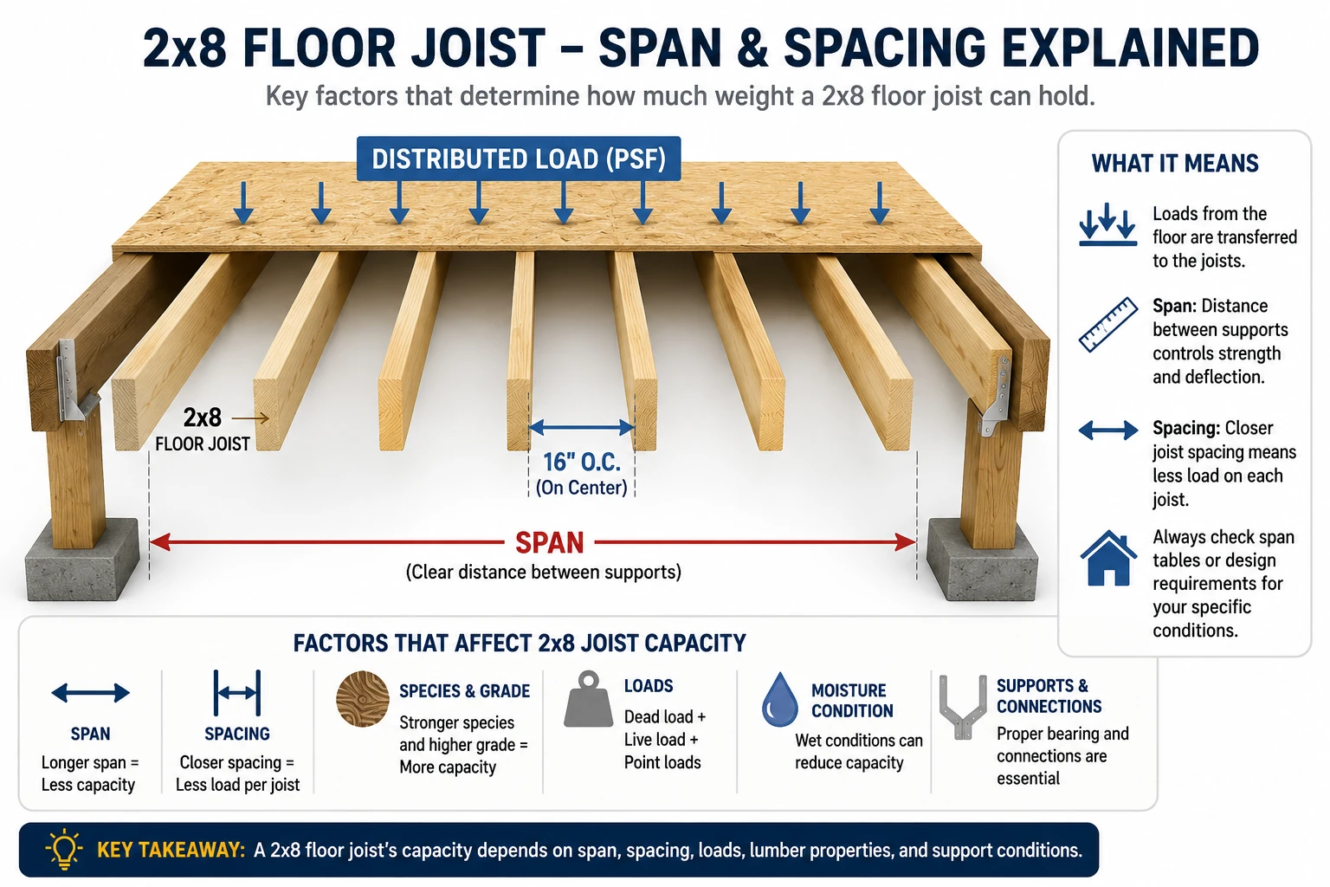
A floor joist does not carry only one isolated object. Instead, it usually forms part of a complete floor system in which multiple joists work together to support the subfloor, flooring, furniture, occupants, partitions, and other loads.
This is why floor joist capacity is usually evaluated as part of a framing system rather than by asking how many total pounds one individual 2×8 can hold.
The most important factors include:
- Joist span
- Joist spacing
- Lumber species
- Lumber grade
- Support conditions
- Dead load
- Live load
- Deflection requirements
- Condition of the lumber
A shorter 2×8 floor joist generally has more capacity than the same board spanning a greater distance.
Likewise, joists installed closer together generally carry less tributary load per member than joists installed farther apart.
For example, a floor system using 2×8 joists at 12 inches on center behaves differently from a system using the same joists at 24 inches on center.
This is why a proper floor design considers the complete system rather than only the dimensions of one board.
How Much Weight Can a 2×8 Floor Joist Hold?
There is no single safe answer in total pounds.
A floor joist is normally evaluated according to the area of floor it supports.
The load carried by each joist depends partly on its tributary width.
For example, a joist spaced 16 inches on center supports a strip of floor approximately 16 inches wide.
As the joist spacing increases, each joist is responsible for a greater portion of the floor.
This means that:
closer spacing generally reduces the load carried by each joist, while wider spacing generally increases it.
The span also matters significantly.
A 2×8 joist spanning a relatively short distance may perform well under conditions where the same joist would experience excessive bending or deflection at a longer span.
This is why floor joist design should be based on approved span tables, engineered calculations, or applicable local requirements.
2×8 Floor Joist Capacity vs Span
Span has a major effect on both strength and stiffness.
Consider the same species and grade of 2×8 lumber under the same general loading conditions.
As the span increases:
- Bending demand increases
- Deflection increases
- Vibration can increase
- The allowable load may decrease
- The floor may feel less stiff
This means a 2×8 that works at one span may not be acceptable at a longer span.
Homeowners sometimes make the mistake of assuming that because a board is physically strong enough not to break, it is automatically suitable as a joist.
That is not necessarily true.
A floor system can become uncomfortable or unsuitable because of excessive deflection long before the lumber reaches its ultimate failure strength.
2×8 Floor Joist Spacing
Common joist spacing can include:
- 12 inches on center
- 16 inches on center
- 19.2 inches on center
- 24 inches on center
The appropriate spacing depends on the complete design.
When joists are installed closer together, each member generally supports a smaller tributary area.
When joists are installed farther apart, each member supports a larger tributary area.
For this reason, a 2×8 floor system should always be evaluated using both:
joist span + joist spacing
rather than considering either factor alone.
Can a 2×8 Hold a Heavy Concentrated Load?
Possibly, but a concentrated load requires special attention.
Examples include:
- A large safe
- Heavy machinery
- A large aquarium
- A masonry feature
- A post supporting another structural member
- Heavy mechanical equipment
These loads may place significant demand on only one or a few joists.
A floor designed for normal distributed residential loading does not automatically mean that any heavy concentrated object can be placed anywhere on the floor.
The location also matters.
A concentrated load near a bearing wall or beam may affect the floor differently from the same load near the middle of a long joist span.
When unusually heavy objects are involved, the framing should be evaluated specifically for that load.
How Much Weight Can a 2×8 Hold as a Beam?
A 2×8 can be used as part of a beam in some construction applications, but beam capacity is different from joist capacity.
A beam may support:
- Floor joists
- Deck joists
- Roof framing
- Wall loads
- Concentrated reactions
The load on a beam can therefore be significantly different from the load on an individual joist.
Several factors determine whether a 2×8 is suitable as a beam:
- Number of plies
- Species
- Grade
- Beam span
- Supported joist span
- Connection between plies
- Bearing length
- Type of load
- Support conditions
A single 2×8 should not automatically be treated as equivalent to a double or triple 2×8 beam.
Single 2×8 vs Double 2×8
A double 2×8 consists of two 2×8 boards properly connected to act together.
When designed and fastened correctly, a double member can provide more capacity than a single member.
However, simply placing two boards next to each other does not automatically create a properly functioning built-up beam.
The connection between the members matters.
Fasteners must allow the two boards to transfer forces and act as a structural assembly.
Other important considerations include:
- Nail or bolt pattern
- End bearing
- Splices
- Load transfer
- Member alignment
- Lumber grade and species
If one board ends at a location where the second board continues without an appropriate engineered splice, the assembly may not perform as expected.
Triple 2×8 Beam Capacity
A triple 2×8 beam uses three members together.
Like a double beam, a triple beam may provide significantly greater capacity than a single 2×8 when properly designed and connected.
But its safe span and capacity still depend on:
- Supported load
- Beam span
- Lumber species
- Lumber grade
- Fastener schedule
- Bearing
- Load location
- Moisture and service conditions
The phrase “triple 2×8 beam” describes the size of the assembly, not its safe load by itself.
How Much Weight Can a 2×8 Hold Vertically?
A 2×8 used vertically in compression behaves very differently from the same board spanning horizontally.
A short vertical member may support substantial compressive load, but its capacity depends on more than the cross-sectional area.
Important factors include:
- Member length
- Bracing
- Species
- Grade
- End bearing
- Load eccentricity
- Connection details
- Buckling potential
A very short, properly supported compression member behaves differently from a tall, slender member.
This is why vertical capacity should not be estimated using the same assumptions as horizontal beam capacity.
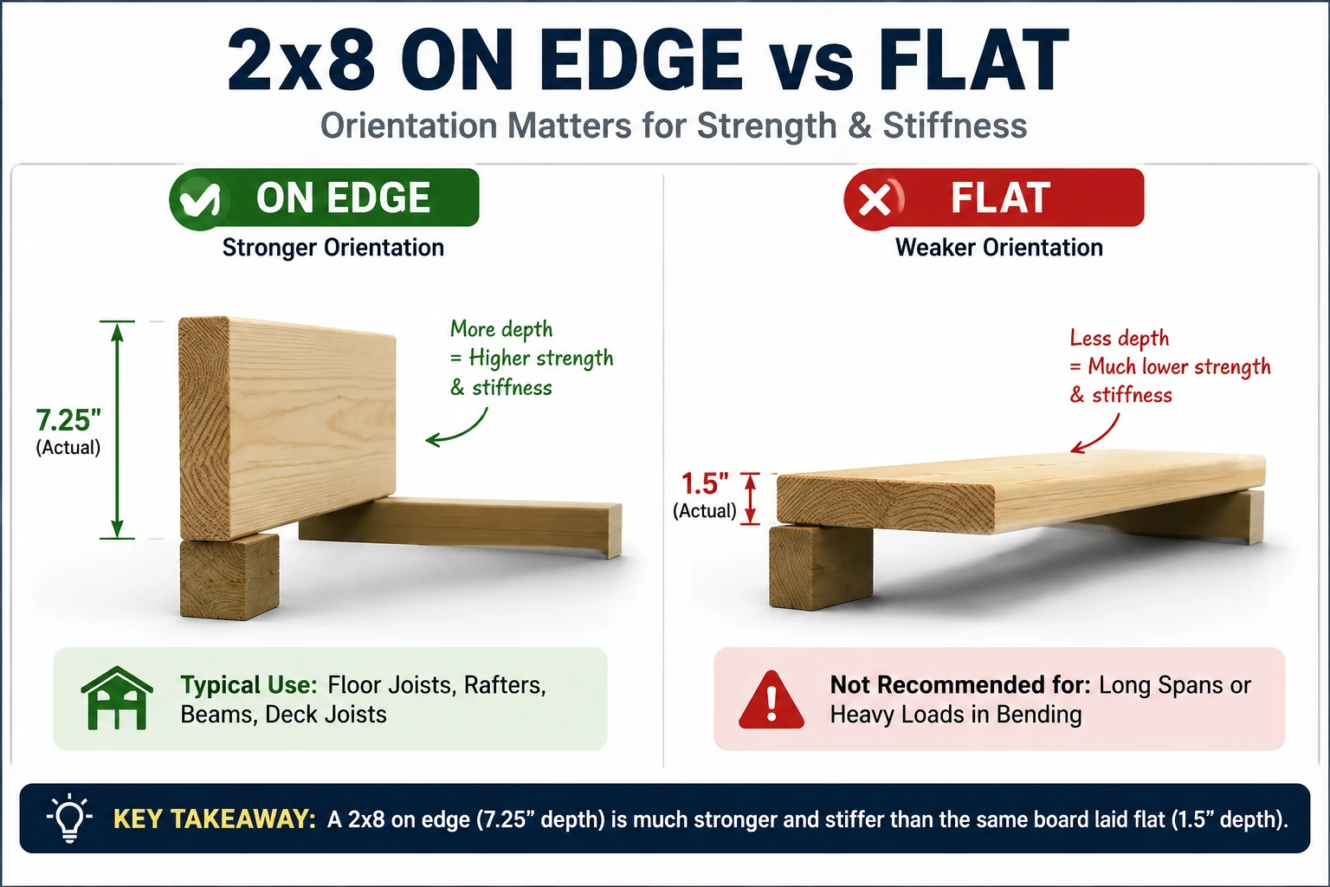
2×8 On Edge vs Flat
The orientation of a 2×8 has a major effect on bending performance.
On Edge
When installed on edge, the 7.25-inch dimension is vertical.
This is the typical orientation for:
- Floor joists
- Rafters
- Many beams
- Deck joists
This orientation provides much greater bending stiffness about the primary bending axis.
Flat
When installed flat, the 1.5-inch dimension is vertical.
The board becomes much less stiff in that direction.
This is why a 2×8 laid flat should not be assumed to have the same spanning capability as a 2×8 installed on edge.
This is one of the most important concepts to understand when evaluating 2×8 load capacity.
2×8 Deck Joist Load Capacity
2×8 lumber is commonly used in deck construction.
A 2×8 deck joist may support:
- Decking
- People
- Furniture
- Outdoor equipment
- Snow in some climates
- Other temporary loads
The allowable span depends on:
- Species
- Grade
- Joist spacing
- Deck configuration
- Design loads
- Wet-service conditions
- Local requirements
Exterior deck lumber may also be pressure treated, and moisture exposure can affect design assumptions.
A deck joist should therefore be selected using appropriate deck span information rather than a general pound rating.
Can a 2×8 Be Used for a Deck Beam?
A 2×8 can be used as part of a built-up deck beam in some designs.
However, deck beam sizing depends on:
- Beam span between posts
- Joist span supported by the beam
- Number of beam plies
- Species
- Grade
- Connection details
- Post spacing
- Deck loads
This is why two decks using the same 2×8 lumber can require very different beam configurations.
A small deck with short joist and beam spans may require less structural capacity than a large deck with long spans.
2×8 Rafter Load Capacity
2×8 lumber is also commonly used for roof rafters.
Roof loads can include:
- Roof sheathing
- Roofing material
- Ceiling loads
- Insulation
- Snow
- Wind-related effects
- Maintenance loads
Rafter capacity depends on:
- Span
- Spacing
- Species
- Grade
- Roof slope
- Snow load
- Dead load
- Support configuration
Because climate varies significantly across the United States, a 2×8 rafter suitable for one location may not automatically be suitable for another.
For example, areas with high snow loads may require different framing than regions with minimal snow.
2×8 Ceiling Joist Capacity
Ceiling joists generally support different loads than floor joists.
Depending on the building design, ceiling joists may support:
- Ceiling drywall
- Insulation
- Limited attic loads
- Structural tie forces
- Other components
A ceiling joist designed only for ceiling loads should not automatically be treated as a floor joist suitable for occupied attic space.
If an attic is converted into storage or living space, the required loading conditions can change substantially.
2×8 Header Load Capacity
A 2×8 may also be used in header construction above doors, windows, or other openings.
Header sizing depends on:
- Opening width
- Roof load
- Floor load
- Number of stories
- Building width
- Wall type
- Lumber species
- Grade
- Number of header plies
A 2×8 header over a small opening in a lightly loaded wall is a very different structural condition from a header supporting multiple floors over a wide opening.
This is why header selection should follow the applicable structural requirements rather than a universal 2×8 capacity number.
2×8 Weight Capacity by Wood Species
Wood species matters because different species have different design properties.
Common structural lumber groups include:
Southern Pine
Southern Pine is commonly associated with relatively high structural design values and is widely used in framing and deck construction.
Douglas Fir-Larch
Douglas Fir-Larch is another common structural lumber group known for good strength and stiffness characteristics.
Hem-Fir
Hem-Fir is widely used in framing and has its own design values depending on grade.
Spruce-Pine-Fir
Spruce-Pine-Fir is commonly available in many regions and may have different allowable values from Southern Pine or Douglas Fir-Larch.
The important point is:
Do not assume all 2×8 boards have the same capacity simply because their dimensions are identical.
2×8 Lumber Grade and Strength
Lumber grade can significantly influence structural capacity.
A grade stamp may identify information such as:
- Species or species group
- Grade
- Grading agency
- Moisture condition
- Mill identification
Common structural grades may include:
- Select Structural
- No. 1
- No. 2
- No. 3
A higher grade generally has fewer or more tightly controlled defects and may have higher allowable design values.
For structural applications, the grade should be considered along with species and size.
What Can Reduce the Capacity of a 2×8?
Several conditions can reduce the structural performance of lumber.
Excessive Knots
Knots can interrupt the wood grain and affect strength.
Splits and Cracks
Significant splits can reduce structural integrity depending on their location and severity.
Notches
Improper notching can significantly weaken a joist or beam.
Holes
Large or poorly located holes can reduce the effective cross-section.
Rot
Decay can dramatically reduce wood strength.
Insect Damage
Termites or other wood-destroying insects can reduce usable structural material.
Excessive Moisture
Long-term moisture exposure can contribute to deterioration.
Poor Bearing
Insufficient bearing at supports can create local crushing or instability.
Improper Fastening
Built-up members depend on proper connections to function together.
Holes and Notches in a 2×8
Plumbing, electrical, and HVAC work sometimes requires holes or notches in framing.
These modifications should not be made randomly.
A poorly located notch or oversized hole can significantly reduce the structural capacity of a 2×8.
The allowable size and location of holes or notches depend on the structural application and applicable requirements.
Extra caution is particularly important near supports and other high-stress regions.
How to Determine How Much Weight Your 2×8 Can Safely Hold
If you need a reliable answer for a specific project, collect the following information first:
- Actual lumber size
- Wood species
- Lumber grade
- Span between supports
- Spacing
- Member orientation
- Number of members
- Dead load
- Live load
- Point loads
- Support and connection details
- Service conditions
Once these variables are known, capacity can be evaluated using:
- Approved span tables
- Building-code tables
- Structural lumber design values
- Engineering calculations
- Manufacturer data where applicable
This approach is much more reliable than using a generic internet answer.
Example: Why Span Changes the Answer
Imagine two identical 2×8 boards of the same species and grade.
Board A spans a short distance.
Board B spans a much longer distance.
Both boards have the same:
- Width
- Thickness
- Species
- Grade
But Board B experiences greater bending and deflection demand because of the longer span.
Therefore, the amount of load each board can safely support is not the same.
This simple example demonstrates why a capacity number without a span is incomplete.
Example: Why Load Location Matters
Consider two 2×8 beams carrying the same total load.
On Beam A, the load is spread along the length.
On Beam B, the entire load is concentrated near the middle.
Even though the total weight is the same, the structural effect is different.
This is why a heavy point load may require special evaluation.
2×8 vs 2×6 Load Capacity
A 2×8 has greater depth than a 2×6.
Typical actual dimensions are approximately:
| Lumber Size | Typical Actual Size |
|---|---|
| 2×6 | 1.5 × 5.5 in |
| 2×8 | 1.5 × 7.25 in |
The additional depth can provide significantly greater bending stiffness and capacity in many structural applications.
However, the exact difference depends on:
- Species
- Grade
- Span
- Load
- Spacing
- Orientation
A 2×8 is not automatically required wherever a 2×6 is used, and a 2×6 should not automatically replace a required 2×8.
2×8 vs 2×10 Load Capacity
A 2×10 is deeper than a 2×8.
Typical actual dimensions are:
| Lumber Size | Typical Actual Size |
|---|---|
| 2×8 | 1.5 × 7.25 in |
| 2×10 | 1.5 × 9.25 in |
In many bending applications, the additional depth of a 2×10 can allow longer spans or greater loads under appropriate design conditions.
However, lumber selection should be based on actual structural requirements rather than simply choosing the largest available board.
2×8 vs 2×12
A 2×12 has a typical actual depth of approximately 11.25 inches.
This greater depth can make it suitable for more demanding spans or loads in certain designs.
But larger lumber also:
- Costs more
- Weighs more
- Requires more space
- May not be necessary
The correct size should match the structural requirements.
Common Mistakes When Estimating 2×8 Capacity
Searching for One Universal Pound Number
This is the most common mistake.
There is no single safe pound rating for every 2×8.
Ignoring Span
Capacity changes substantially as span changes.
Ignoring Grade
Different grades have different allowable design values.
Ignoring Species
Different species groups can have different structural properties.
Ignoring Orientation
A 2×8 on edge performs differently from a 2×8 laid flat.
Confusing PSF With Total Pounds
Pounds per square foot describes an area load.
It is not the same as saying an individual joist can support that total number of pounds.
Ignoring Point Loads
A concentrated load can create a more demanding condition than the same weight spread across a large area.
Using Damaged Lumber
Cracks, rot, excessive notches, or other damage can reduce capacity.
Frequently Asked Questions
How much weight can a 2×8 hold horizontally?
There is no universal number. Horizontal capacity depends on span, species, grade, orientation, support conditions, and whether the load is concentrated or distributed.
How much weight can a 2×8 floor joist hold?
A 2×8 floor joist should be evaluated as part of a floor system. Capacity depends on joist spacing, span, lumber species, grade, dead load, live load, and deflection requirements.
How much weight can a 2×8 hold on edge?
A 2×8 installed on edge generally has much greater bending stiffness than the same board laid flat. The actual allowable load still depends on span, species, grade, and loading conditions.
Is a 2×8 strong enough for floor joists?
A 2×8 can be suitable for floor joists in many residential applications, but the allowable span and spacing must match the species, grade, loads, and applicable requirements.
Can a 2×8 support 1,000 pounds?
Possibly under some configurations, but the statement cannot be evaluated without knowing the span, load location, species, grade, orientation, and support conditions. Do not use a generic 1,000-pound assumption for structural design.
Can a 2×8 hold more weight than a 2×6?
In many bending applications, a 2×8 can provide greater stiffness and capacity because of its greater depth. However, actual capacity depends on the complete design conditions.
Is a double 2×8 twice as strong as a single 2×8?
Not automatically in every practical situation. A properly designed and connected built-up member can provide significantly greater capacity, but connection details, bearing, splices, load transfer, and member properties all matter.
How much weight can a 2×8 deck joist hold?
Deck joist capacity depends on span, spacing, species, grade, deck loads, moisture conditions, and local requirements. A general total-pound rating should not be used.
Can I use a 2×8 as a beam?
Yes, 2×8 lumber can be used as part of beam assemblies in appropriate designs. Beam size, number of plies, span, supported loads, bearing, and connection details must be evaluated.
How far can a 2×8 span?
There is no universal span for every 2×8. Floor joists, rafters, deck joists, and beams all have different design requirements.
Does pressure-treated 2×8 have the same strength as untreated lumber?
Not necessarily. Species, grade, treatment process, moisture conditions, and other adjustment factors can affect structural design values.
Does a knot weaken a 2×8?
Knots can affect strength because they interrupt the wood grain. Lumber grading accounts for permitted defects such as knots.
Final Answer: How Much Weight Can a 2×8 Hold?
A 2×8 can be a strong and versatile structural member, but there is no single safe weight capacity that applies to every 2×8 board.
Its capacity depends on:
- Span
- Species
- Grade
- Orientation
- Joist spacing
- Load type
- Load location
- Number of members
- Support conditions
- Moisture conditions
- Connections
- Deflection requirements
A short, high-grade 2×8 installed on edge can perform very differently from a long-span board of a weaker species or lower grade.
Likewise, a uniformly distributed floor load is structurally different from a concentrated heavy object placed at midspan.
For construction planning, the safest approach is to use appropriate span tables, structural design information, and applicable building requirements rather than relying on a generic pound number.
The most important takeaway is:
A 2×8 does not have one universal weight limit. Its safe capacity must always be evaluated for the specific way it is being used.


