
How to Calculate Running Feet Measurement: A Complete Step-by-Step Guide
Knowing how to calculate running feet measurement is essential when purchasing materials for construction, home improvement, landscaping, or manufacturing projects. Whether you’re installing fencing, buying lumber, measuring pipes, or estimating trim, calculating running feet helps ensure you order the correct amount of material while minimizing waste and unnecessary costs.
In this guide, we’ll explain what running feet are, how to calculate them correctly, provide real-world examples, discuss common mistakes, and answer frequently asked questions.
What Is Running Feet Measurement?
A running foot, also known as a linear foot, is a measurement of length only. It does not take width, height, or thickness into account. Running feet are commonly used when measuring long materials such as pipes, wooden boards, fencing, electrical wiring, molding, and fabric rolls.
For example:
- A wooden plank that is 12 feet long equals 12 running feet.
- A pipe measuring 25 feet equals 25 running feet.
- A fence line that is 150 feet long equals 150 running feet.
The measurement is based solely on the total length.
Why Is Calculating Running Feet Important?
Accurate running foot measurements help you:
- Purchase the correct amount of material.
- Avoid unnecessary material waste.
- Reduce project costs.
- Prepare accurate construction estimates.
- Complete projects more efficiently.
- Prevent delays caused by ordering insufficient materials.
Professionals in construction and manufacturing rely on running foot calculations every day because even small measurement errors can lead to expensive mistakes.
Running Feet Formula
The calculation is very simple.
Running Feet = Length 1 + Length 2 + Length 3 + … + Length n
If you have only one continuous piece, the running feet equal its total length.
If you have multiple sections, simply add all individual lengths together.
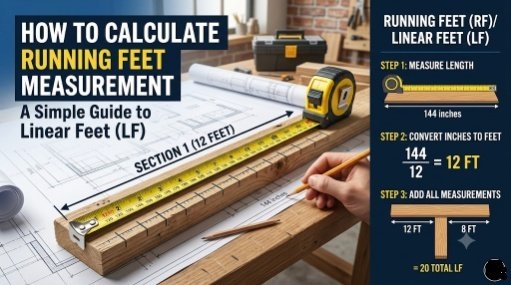
Step-by-Step Guide to Calculate Running Feet Measurement
Step 1: Measure Each Individual Length
Use a measuring tape or laser measuring tool to determine the length of every piece.
For example:
- Board A = 8 feet
- Board B = 14 feet
- Board C = 18 feet
- Board D = 20 feet
Write down each measurement carefully to avoid forgetting any section.
Step 2: Convert Measurements to the Same Unit
Before adding measurements, make sure they are all in the same unit.
For example:
- 8 feet
- 120 inches
Since:
1 foot = 12 inches
120 inches ÷ 12 = 10 feet
Now your measurements become:
- 8 feet
- 10 feet
Using consistent units prevents calculation errors.
Step 3: Add All Measurements Together
Now simply total every measured length.
Example:
8 + 14 + 18 + 20
Total Running Feet = 60 feet
This is the total amount of material required.
Example 1: Calculating Running Feet for Lumber
Suppose you need lumber for a deck.
Measurements:
- 12 ft
- 16 ft
- 18 ft
- 24 ft
Calculation:
12 + 16 + 18 + 24 = 70 Running Feet
You should purchase approximately 70 running feet of lumber.
Example 2: Fence Installation
A property has four sides.
- Front = 50 ft
- Back = 50 ft
- Left = 30 ft
- Right = 30 ft
Calculation:
50 + 50 + 30 + 30
= 160 Running Feet
The project requires 160 running feet of fencing.
Example 3: Plumbing Project
Pipe lengths:
- 10 ft
- 8 ft
- 15 ft
- 12 ft
Calculation:
10 + 8 + 15 + 12
= 45 Running Feet
You’ll need at least 45 running feet of pipe.
Example 4: Electrical Wiring
Cable lengths:
- 25 ft
- 40 ft
- 18 ft
- 22 ft
Calculation:
25 + 40 + 18 + 22
= 105 Running Feet
The electrician should purchase approximately 105 running feet of cable.
Running Feet vs Square Feet
Many people confuse these two measurements, but they serve different purposes.
| Running Feet | Square Feet |
|---|---|
| Measures length only | Measures total surface area |
| One-dimensional measurement | Two-dimensional measurement |
| Used for pipes, fencing, trim, lumber | Used for flooring, tiles, carpet, paint |
| Width is ignored | Width is included |
If you’re measuring long materials, use running feet. If you’re covering an area, use square feet.
How to Convert Running Feet to Square Feet
If you know the material’s width, converting running feet into square feet is simple.
Formula:
Square Feet = Running Feet × Width (in feet)
Example
Running Feet = 120 ft
Material Width = 2 ft
Calculation:
120 × 2 = 240 Square Feet
This conversion is useful when estimating flooring, wall panels, fabric, or roofing materials.
Common Materials Measured in Running Feet
Running foot measurements are widely used for:
- Lumber
- PVC pipes
- Copper pipes
- Steel rods
- Aluminum profiles
- Electrical cables
- Water lines
- Fencing
- Baseboards
- Crown molding
- Trim
- Skirting boards
- Fabric rolls
- Curtains
- Roofing flashing
- Garden edging
Common Mistakes When Calculating Running Feet
Avoid these common errors to ensure accurate measurements.
Mixing Different Units
Always convert inches, centimeters, or meters into the same unit before adding measurements.
Forgetting Small Sections
Even short pieces contribute to the total running feet. Missing a few measurements can result in ordering insufficient materials.
Confusing Running Feet with Square Feet
Remember that running feet measure only length, while square feet measure area.
Rounding Too Early
Keep exact measurements until your final calculation to maintain accuracy.
Not Double-Checking Measurements
Measure twice before purchasing expensive materials. This simple habit can prevent costly mistakes.
Tips for Accurate Running Foot Measurements
To achieve the best results:
- Use a quality measuring tape or laser distance meter.
- Measure each section carefully.
- Write measurements down immediately.
- Keep all units consistent.
- Double-check every measurement before calculating.
- Add a small allowance for cutting waste if recommended for your project.
Benefits of Calculating Running Feet Correctly
Accurate running foot calculations provide several advantages:
- Helps avoid buying excess material.
- Reduces unnecessary project expenses.
- Improves budgeting accuracy.
- Saves time during material estimation.
- Minimizes waste.
- Simplifies project planning.
- Ensures enough material is available before work begins.
- Supports efficient construction and installation.
Frequently Asked Questions
What is a running foot?
A running foot is a measurement of length only. It is commonly used for materials such as pipes, lumber, fencing, electrical wiring, molding, and fabric.
Is a running foot the same as a linear foot?
Yes. The terms running foot and linear foot are generally used interchangeably and both refer to measuring length only.
How do I calculate running feet?
Measure the length of each individual section and add all measurements together. The total equals your running feet measurement.
Can I calculate running feet using inches?
Yes. First convert inches into feet by dividing by 12, then add the measurements together.
Why is running feet measurement important?
Running foot measurements help you estimate material quantities accurately, reduce waste, control costs, and improve project planning.
Final Thoughts
Learning to calculate running feet measurement is a valuable skill for homeowners, contractors, builders, and DIY enthusiasts. By measuring each section carefully, converting all measurements into the same unit, and adding the lengths together, you can accurately determine the amount of material required for your project. Whether you’re installing fencing, purchasing lumber, laying pipes, or measuring trim, accurate running foot calculations help save time, reduce costs, and ensure your project is completed successfully.


