
What Is Marine Construction?
Marine construction is the planning and building of structures in, on, or immediately beside water. It includes docks, piers, wharves, seawalls, marinas, bridge foundations, breakwaters, navigation structures, underwater utilities, and some offshore facilities. The work differs from ordinary land construction because water levels, currents, waves, vessels, submerged ground, corrosion, environmental controls, and access all affect the design and construction sequence.
The term describes a broad field rather than one construction method. A small floating dock, a deep-water port terminal, and a bridge pier all involve water, but their loads, foundations, permits, equipment, and risks are very different. This guide explains the work’s major parts and what project teams evaluate before choosing a marine construction approach.
What projects fall under marine construction
Shoreline and waterfront projects include docks, piers, marinas, boat launches, bulkheads, seawalls, revetments, and shoreline restoration. These structures support access, mooring, cargo handling, erosion protection, or recreation. A dock project may be small in footprint but still require careful foundation, anchoring, environmental, and access planning.
Port and navigation work includes wharves, berths, terminals, breakwaters, jetties, locks, navigation channels, and maintenance dredging. These projects must accommodate commercial vessels, cargo operations, navigation clearances, and sometimes continuous public or industrial activity. A project may require phased construction so existing operations can continue.
Transportation and utility projects include bridge foundations, immersed or underwater utility crossings, outfalls, intakes, pipelines, cables, and flood-control structures. Offshore energy and coastal protection projects can involve foundations and platforms in more exposed waters. The project’s location determines whether the work is classified as marine, coastal, inland-water, or offshore construction, but the engineering issues overlap.
Site investigation and design conditions
Marine design begins with a survey of shorelines, depths, tides or river stages, current, waves, vessel routes, utilities, and existing structures. Bathymetry maps the bottom surface; geotechnical investigation identifies soil and rock layers, bearing conditions, sediment, and groundwater. Designers also evaluate erosion, scour, flood levels, ice where relevant, and possible debris impacts.
Water chemistry affects material selection. Saltwater and brackish water can accelerate corrosion; freshwater can still expose components to moisture, biological growth, freezing, ultraviolet light, and abrasion. Chlorides, sulfates, oxygen, temperature, and wet-dry cycling influence durability. Materials, coatings, fasteners, concrete cover, and inspection intervals are selected for the actual environment.
The project also studies operations: vessel size, berthing loads, traffic, cranes, cargo equipment, public access, and maintenance needs. A wharf supporting container cranes has different load demands from a pedestrian pier. An existing port may constrain work windows, temporary closures, or equipment placement. The design is coordinated with the people who will operate and maintain the structure.
Foundations and construction methods
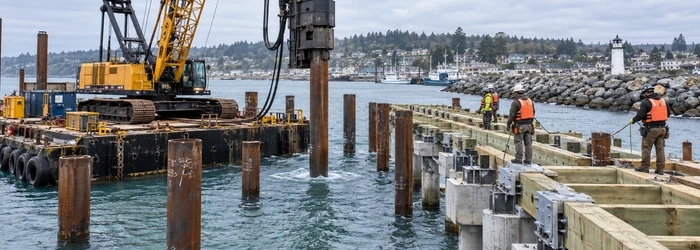
Marine foundations can use driven piles, drilled shafts, caissons, spread footings, anchors, or combinations. Piles may be installed from barges or temporary trestles; drilled shafts may need casing or slurry to stabilize the excavation. The foundation type depends on loads, bottom material, water depth, access, scour, and installation equipment. A method that works in a protected harbor may be unsuitable in a surf zone.
Cofferdams can create a temporarily isolated work area for dry excavation or concrete work. They may use sheet piles, bracing, cells, fill, and pumps. Their design considers water and soil pressure, seepage, excavation stages, currents, and emergency conditions. The cofferdam guide explains why this temporary structure needs its own engineering and inspection plan.
Some marine projects use precast segments, floating cranes, barges, modular units, or launch systems to reduce assembly over water. These techniques require lifting and transport plans, temporary stability, weather windows, vessel coordination, and precise connections. A bridge foundation may combine piles installed from a barge with a cap cast inside a cofferdam; a dock may use floating modules tied to shore.
Dredging, fill, and shoreline protection
Dredging removes or relocates sediment to achieve a channel, berth, foundation level, or utility route. The design and permit review consider sediment quality, disposal location, turbidity, navigation, aquatic habitat, and changes in flow. Dredging is not simply excavation with a floating machine; the material and its destination affect project planning.
Fill or reclamation may create land or support structures, but it alters the waterway footprint and can affect flow, habitat, navigation, and neighboring properties. The project may use containment, turbidity controls, monitoring, and staged placement. A shoreline protection system can use a seawall, revetment, bulkhead, or nature-based approach. Each responds differently to waves, overtopping, erosion, and sea-level or flood conditions.
Construction teams coordinate the permanent structure with temporary controls. Barriers, silt curtains, work floats, mooring systems, and access trestles may be required. Storms and high flows can damage those systems. The contractor documents inspections and repairs and follows the permitted work window.
Equipment and access on water
Marine contractors may use barges, tugboats, cranes, pile drivers, drilling rigs, jack-up platforms, workboats, dredges, divers, remotely operated vehicles, and floating concrete equipment. The equipment is selected for depth, draft, load, current, and access. A barge must be positioned and secured for the lift or installation; its mooring and stability are part of the work plan.
Transport routes and staging areas affect cost and schedule. Large components may be fabricated ashore and brought by barge, while smaller work may use land equipment near the bank. Tides and water levels can control when a barge can enter a site. Weather forecasts are monitored because wind and waves can stop crane lifts or damage temporary moorings.
Diver work is used for specific inspection, installation, or repair tasks, but underwater visibility, current, depth, temperature, and communication affect safety and productivity. Remotely operated equipment can inspect some submerged components without placing a diver in the water. The method is selected based on the task and acceptance requirements.
| Marine project factor | Why it affects the construction plan |
|---|---|
| Water depth and bottom | Determines foundation equipment, barge draft, and access |
| Waves and current | Affect stability, mooring, work windows, and temporary works |
| Vessel traffic | Requires navigation coordination and exclusion zones |
| Water chemistry | Influences material, coatings, and inspection needs |
| Environmental limits | Can restrict season, method, discharge, and work footprint |
Permits and environmental responsibilities
Approvals vary with the site and activity. In the United States, work may involve federal, state, tribal, local, shoreline, navigation, water-quality, wetlands, or floodplain review. Dredging, fill, pile placement, shoreline alteration, discharges, and work in navigable waters may be treated differently. The project team confirms the responsible authorities and written conditions before mobilization.
Environmental controls may address turbidity, sediment, noise, aquatic species, fish passage, vegetation, water quality, vessel strikes, and spill prevention. Seasonal windows can limit work to protect spawning or migration. Discharge water may require treatment. Fuel and hydraulic systems need spill prevention and response materials. Monitoring results are recorded and acted on when limits are approached.
Public and worker safety overlap with environmental management. Navigation lanes may be temporarily narrowed, and floating plant can pose collision hazards. The contractor coordinates markers and notices with the relevant authority and other users. A spill, uncontrolled discharge, or damaged barrier requires immediate action under the plan.
Safety, quality, and risk management
Marine construction includes fall hazards, drowning, heavy lifts, moving vessels, unstable platforms, changing weather, confined spaces, pressure systems, and electrical equipment near water. The site plan covers access, flotation, fall protection, rescue capability, communication, emergency medical response, weather limits, and equipment inspection. Rescue plans must match water depth, current, temperature, and distance from shore.
Quality assurance tracks materials, pile records, concrete placement, welds, coatings, anchor systems, underwater connections, and as-built locations. Inspection may be difficult once components are submerged, so hold points and photographs are planned before concealment. The owner keeps as-built documents to support future underwater inspection and repair.
A risk register helps the team plan for storms, barge movement, unexpected subsurface conditions, equipment failure, permit delays, supply interruptions, and changes to vessel operations. The plan assigns responsibility for monitoring and response. A risk review is updated when the construction method or water conditions change.
Maintenance after construction
Marine structures face repeated exposure to water, salt or chemicals, wave action, biological growth, corrosion, scour, impact, and settlement. Maintenance includes checking piles, caps, bearings, anchors, fenders, deck connections, coatings, joints, and shoreline erosion. Inspect after major storms, floods, vessel impact, or unexpected movement.
Underwater inspection may use divers, sonar, cameras, or remotely operated vehicles. The owner compares findings with baseline records to identify loss of section, cracking, displacement, undermining, or exposed reinforcement. The inspection method depends on visibility, depth, current, access, and the defect being evaluated.
Repairs need to restore the intended load path and durability. A surface patch may not address a corroded pile, failed anchor, scour hole, or leaking joint. Maintenance plans should budget for access equipment and planned replacement of consumable parts such as fenders and coatings.
Common questions
What is marine construction in simple terms?
It is construction in or beside water, including docks, ports, bridge foundations, seawalls, dredging, utilities, and related structures. The methods depend on the site and project purpose.
Is marine construction the same as underwater construction?
Underwater construction is one part of marine work. Many marine structures are built from barges or shore platforms above the water, while underwater work may involve foundations, inspection, repair, or utilities below the surface.
What equipment is used in marine construction?
Common equipment includes barges, cranes, pile drivers, drilling rigs, workboats, dredges, divers, and remotely operated inspection systems. The equipment is selected for water depth, loads, access, and environmental limits.
Why is marine construction more complex?
Water changes access, foundation conditions, temporary works, weather, material durability, navigation, and emergency response. Environmental permits and submerged inspection add coordination beyond an ordinary land site.
How are marine structures protected from corrosion?
Designers select materials, coatings, fasteners, concrete details, and inspection intervals for the water chemistry and exposure. Protection may combine several measures; maintenance is still required.
A field defined by its interfaces
Marine construction connects land, water, geotechnical conditions, structural design, equipment, navigation, and environmental obligations. Its success depends on understanding those interfaces before work begins and monitoring them as water and site conditions change. Whether the project is a dock, bridge, port, or coastal barrier, the permanent structure and temporary marine operation must be planned as one system.



Leave a Reply
Want to join the discussion?Feel free to contribute!