
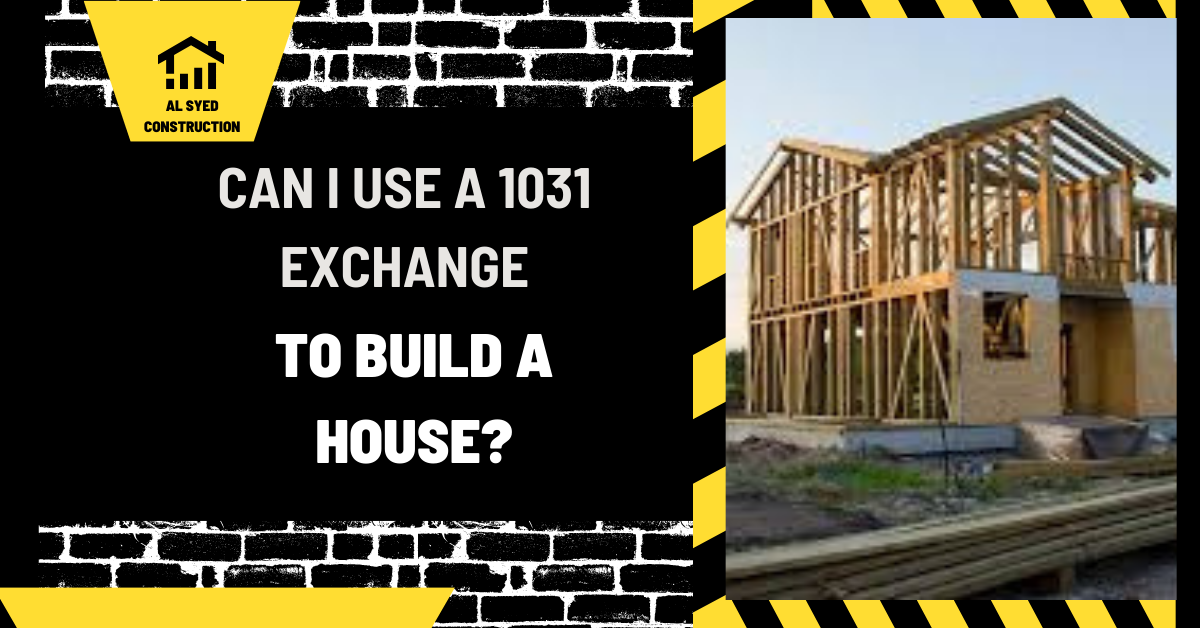
Using a 1031 Exchange to Build a House?
Using a 1031 Exchange to Build a House?: what to check
This guide explains 1031 exchange to build a house for owners, buyers, developers, tenants, and construction teams who need a practical starting point. The answer depends on property facts, project documents, and local requirements, so the discussion separates general planning from decisions that require parcel-specific or contract-specific review.
The useful question is not only what 1031 exchange to build a house means, but how it affects the next decision. Identify the property, intended use, measurement or contract involved, decision date, and person responsible for approval. Then verify the inputs before committing money, scheduling work, or relying on a legal or financial outcome.
A Section 1031 exchange generally concerns qualifying real property held for business or investment, not a personal residence. Buying land and building on it raises timing, ownership, replacement-property, improvement, and exchange-structure questions. Do not assume construction costs automatically qualify; consult a qualified tax adviser and exchange professional before transferring property.
Key project considerations
Separate project value from project cost
Land price, hard construction costs, professional services, approvals, financing, carrying costs, contingencies, sales costs, and operating expenses are different inputs. A forecast should show them separately and identify when each is paid. Gross development value describes a projected value at a stated completion or sale point; it is not cash profit. Comparing value with total cost requires consistent timing, scope, and assumptions.
Test financing against the entire timeline
Construction financing may release funds in stages and impose inspections, equity requirements, draw documentation, interest charges, completion deadlines, and conversion or payoff conditions. A project can be economically attractive but still face a cash-flow gap if payments arrive before loan proceeds or sale funds. Obtain written term sheets, model draw timing, and include delay scenarios instead of treating the headline loan amount as available cash.
Build contingencies from identified uncertainty
A contingency should respond to known unknowns such as incomplete design, concealed conditions, utility upgrades, price escalation, or permit comments. Label its basis and owner. Do not bury a vague reserve inside the hard-cost total, because that hides how much of the budget is committed and what events it is intended to cover. Update the estimate as surveys, bids, and approvals replace early assumptions.
Use comparable evidence carefully
A valuation or feasibility model is only as useful as the properties, transactions, and project assumptions behind it. Record the date, location, property type, condition, size basis, occupancy, concessions, and source for each comparison. New homes, stabilized rentals, vacant land, and partially complete developments are not interchangeable just because a headline price per square foot looks similar.
Model downside cases before committing
Test lower sale prices or rents, slower absorption, higher financing costs, delayed completion, and additional site work. Show which input creates the largest change in the result. If a project only works under one optimistic combination, the model should make that dependence visible. A sensitivity table supports a better discussion, but it cannot replace lender underwriting, professional cost estimating, or legal review.
Match the metric to the question
Return on cost, loan-to-cost, loan-to-value, capitalization rate, equity multiple, and gross development value describe different relationships. State the formula, included costs, timing, leverage, and whether values are before or after tax. A metric without these definitions can invite a false comparison. Use a short written definition beside each calculation so another reviewer can reproduce it.
Keep tax and legal conclusions with qualified advisers
A construction budget can estimate taxes, but eligibility and reporting depend on facts, ownership, use, timing, and current rules. Distinguish a planning assumption from a tax conclusion. For a transaction involving like-kind exchange treatment, rental-property depreciation, sales tax, or a business entity, collect the relevant records and consult a qualified tax professional before signing or transferring property.
The specific issue to resolve
Federal rules restrict Section 1031 treatment to qualifying real property held for productive use in a trade or business or for investment. Personal-use property and property held primarily for sale raise different issues. The investor's purpose, ownership, and intended use need to be evaluated on the actual facts.
Inputs and documents that change the answer
Deferred exchanges have strict identification and completion deadlines. The IRS describes a 45-day identification period and an exchange period generally ending by 180 days or the tax-return due date if earlier. Construction and improvement exchanges have additional structural requirements, so obtain professional advice before closing on the relinquished property.
Practical steps
- Write down the decision involving 1031 exchange to build a house, the property address or parcel, the intended use, the responsible parties, and the date by which an answer is needed. A clear question keeps the review focused and makes missing information easier to spot.
- Gather the current documents that control 1031 exchange to build a house: the survey, title materials, zoning information, contract or lease, plans, estimates, permits, lender instructions, or records that apply to this case. Mark the version and date so the team does not work from a superseded document.
- Separate verified facts from estimates and assumptions. For every measurement, price, deadline, or permission, record its source and who confirmed it. If a value is not known, show it as an open item instead of filling the gap with a convenient guess.
- Ask the relevant professional or public authority a narrow, written question. Include the address, drawing or clause reference, proposed action, and alternative interpretation. Request the rule, approval, scope, or next step that applies to the specific project.
- Compare feasible options using the same cost, schedule, area, and responsibility basis. Include foreseeable site work, coordination, approvals, carrying costs, and contingency rather than comparing one headline figure with another.
- Save the final response, approval, calculation, and revised plan with the project file. Update the schedule and budget when the confirmed answer changes scope, access, funding, or timing.
Example decision
An investor plans to sell a rental parcel, buy vacant land, and build a rental home. The investor should discuss the ownership structure, qualified intermediary, deadlines, construction schedule, value of qualifying replacement property, and permitted use before the sale closes. A personal home plan would raise a different analysis.
Costs, risks, and trade-offs
Cost and schedule effects should be assessed against the actual scope, not an isolated label. Include professional review, permits, site preparation, access, utility work, insurance, inspection, documentation, and close-out when they apply. A lower initial estimate can shift cost into later changes, delay, or restoration if assumptions are incomplete. Record contingencies and exclusions explicitly so decision-makers can see what remains uncertain.
Risk is easier to manage when the person responsible for each approval, payment, inspection, and maintenance task is named. Confirm who can authorize a change and how that decision is recorded. If the project involves property rights, a signed contract, tax treatment, or a potential legal remedy, ask a qualified local professional to review the actual documents before acting.
Use the findings in a project decision
Write down every major input in the model: source, date, measurement basis, timing, and owner. Distinguish a quote from a budget allowance, a broker estimate from an appraisal, and a lender indication from a committed loan. This makes it possible to replace assumptions with verified values as design and due diligence progress.
Run a base case and a downside case that reflects realistic delay, cost, price, rent, or financing changes for the project. Show which assumptions move the result most and what cash is required if that outcome occurs. A sensitivity analysis does not predict the future, but it reveals where the plan is most exposed before a decision is difficult to reverse.
Keep tax, legal, valuation, and lending conclusions within the scope of qualified professionals. Give each adviser the same current facts and documents, then record the assumptions that their advice depends on. If the ownership structure, intended use, or timeline changes, revisit the analysis rather than assuming an earlier conclusion still applies.
Common mistakes to avoid
- Using a generic rule for 1031 exchange to build a house without checking the property, document, or jurisdiction that controls this case.
- Treating a map, advertisement, verbal statement, or early estimate as final approval or a binding measurement.
- Comparing costs or areas that use different scopes, units, exclusions, dates, or assumptions.
- Starting work or sending funds before confirming authority, notice, access, insurance, and written approval.
- Failing to save the survey, plan revision, receipt, notice, inspection, or written decision that explains what was agreed.
Frequently asked questions
Can a 1031 exchange be used for a personal home?
Section 1031 is generally for qualifying real property held for business or investment, not property used solely as a personal residence.
Can I exchange a rental property for land and then build?
It may involve complex exchange and construction requirements. The structure, deadlines, ownership, and qualifying property must be reviewed by tax and exchange professionals.
What are the main deferred-exchange deadlines?
The general framework includes identifying replacement property within 45 days and receiving it within 180 days or the earlier tax-return deadline, subject to the rules and facts.
Can I decide after the sale closes?
Do not wait. Exchange structure and intermediary arrangements usually need to be addressed before the relinquished property transfer.
Related guides
For more detail on connected topics, review Gross Development Value (GDV) Explained, Buy Land and Build vs. Buy a House, What Is a Construction Lending Agency?. These guides cover related property, surveying, lease, finance, and construction questions that can arise during a project.
Final checklist
Before acting on 1031 exchange to build a house, verify that the information is current, the correct property and document are being reviewed, every measurement uses a stated method, and all approvals and responsibilities are in writing. Confirm the next milestone and keep the supporting records together. This process gives owners and project teams a clearer basis for comparing options, communicating with professionals, and updating a construction or real-estate plan when new facts emerge.
Revisit the conclusion if the site condition, proposed use, contract term, lender requirement, work method, or applicable rule changes. An answer based on an early sketch may need another review after a survey, revised bid, inspection, or signed change. Date the update, tell affected parties, and keep the earlier version with the project record so the decision path remains clear.









Leave a Reply
Want to join the discussion?Feel free to contribute!