
Megalithic Structures: How Huge Stones Were Built
Introduction
Throughout history, various civilizations have constructed awe-inspiring structures using enormous stones, known as megaliths. These megalithic constructions, ranging from tombs and temples to fortresses and monuments, stand as a testament to the ingenuity and perseverance of ancient builders. This article delves into the world of megalithic architecture, exploring its significance, examples, and the mysteries that surround these colossal stone structures.
Understanding Megalithic Constructions
Definition and Characteristics
- Megalith: Derived from the Greek words ‘mega,’ meaning ‘large,’ and ‘lithos,’ meaning ‘stone.’
- Characteristics: Megalithic constructions are characterized by the use of massive stones, often weighing several tons, meticulously placed without the use of mortar.
Historical Significance
- Cultural Importance: These structures were often built for religious, ceremonial, or astronomical purposes, reflecting the beliefs and technological capabilities of their creators.
- Archaeological Value: Megaliths provide valuable insights into the engineering techniques, social organization, and cultural practices of ancient societies.
Examples of Megalithic Constructions
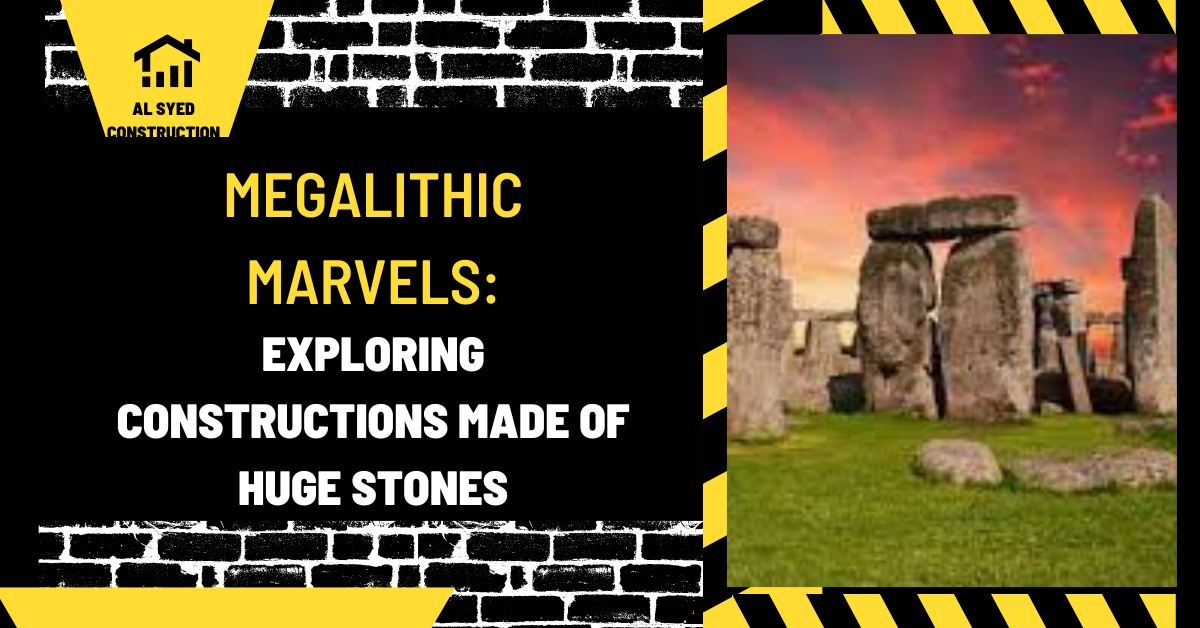
Stonehenge, England
- Description: A prehistoric monument consisting of a ring of standing stones, each weighing around 25 tons.
- Purpose: Believed to have been used for ceremonial or astronomical purposes, with alignments corresponding to solar and lunar events.
The Great Pyramid of Giza, Egypt
- Description: The largest of the Egyptian pyramids, constructed with massive limestone and granite blocks, some weighing over 80 tons.
- Purpose: Built as a tomb for the Pharaoh Khufu, showcasing the advanced engineering skills of ancient Egyptians.
Carnac Stones, France
- Description: A collection of over 3,000 prehistoric standing stones, arranged in rows and patterns.
- Purpose: The exact purpose is unknown, but it is speculated to have religious or astronomical significance.
Easter Island Moai, Chile
- Description: Monolithic human figures carved from volcanic rock, with some statues weighing over 80 tons.
- Purpose: Believed to represent the ancestors of the Rapa Nui people, serving as symbols of authority and spiritual power.
Sacsayhuamán, Peru
- Description: A fortress with walls made of massive stones, some weighing over 100 tons, fitted together with incredible precision.
- Purpose: Served as a military and ceremonial site for the Inca Empire, showcasing their architectural prowess.
Construction Techniques and Challenges
Stone Quarrying and Shaping
- Techniques: Ancient builders used tools made of harder stones, metal chisels, and wooden wedges to extract and shape the megaliths.
- Challenges: Transporting these massive stones from quarries to construction sites required innovative methods, such as sledges, rollers, and ramps.
Alignment and Placement
- Precision: Many megalithic constructions exhibit remarkable precision in alignment, with stones fitting together seamlessly.
- Challenges: Achieving this level of accuracy required sophisticated knowledge of geometry, engineering, and possibly astronomy.
The Mysteries of Megalithic Constructions
Unanswered Questions
- Construction Methods: Despite various theories, the exact methods used to transport and erect these massive stones remain a subject of debate among archaeologists.
- Purpose: The true purpose and significance of many megalithic structures are still shrouded in mystery, with ongoing research and discoveries shedding light on their origins.
What counts as a megalithic structure?
Megalithic architecture uses very large stones as principal structural or symbolic elements. The word comes from roots meaning “large stone,” but it does not describe one culture, date, or building method. A megalithic structure might be a burial chamber, standing-stone arrangement, stone circle, passage tomb, enclosure, or monumental wall. The purpose must be established case by case through archaeology, landscape evidence, human remains, artifacts, and historical context.
Examples occur in many regions and periods, including prehistoric Europe, the Mediterranean, Africa, Asia, and the Americas. Some familiar monuments use single upright stones; others use carefully fitted blocks or chambers. “Huge stones” is a visual description, not a reliable guide to who built a monument or why. The site’s chronology, surrounding settlement, construction sequence, and ritual or burial evidence offer stronger clues.
Quarrying, shaping, and moving stone
Megalith construction began with selecting stone suitable for a purpose. Builders may have used nearby outcrops, river deposits, or distant quarries. The choice affected size, shape, durability, and transport. Evidence of quarry marks and unfinished blocks can reveal how a stone was detached and shaped. Tool traces should be interpreted cautiously because weathering, later reuse, and modern disturbance can alter the visible surface.
Moving a large block requires coordinated force, a prepared route, and a method for keeping the load stable. Archaeological and experimental studies examine sledges, rollers, levers, ropes, earthen ramps, water transport, and seasonal ground conditions. No one technique explains every site. The distance, slope, stone geometry, available timber, workforce organization, and construction phase matter. A sound account explains what evidence supports a proposed method and what remains a reasoned reconstruction.
How stones stand and fit together
A standing stone must resist overturning, sliding, and uneven settlement. Builders could prepare a socket or foundation pit, lower the stone into position, pack the surrounding space, and backfill with smaller stones or soil. The stability depends on embedment depth, base shape, center of gravity, and ground conditions. A row or circle also requires surveying and repeated measurement so the stones align with intended axes or intervals.
Chambered structures use combinations of upright supports and horizontal capstones. The capstone weight transfers through contact areas into the supports and down into the ground. Builders may use corbeling, where each course projects slightly inward, or a true lintel spanning between supports. These structural distinctions matter: the [corbelled construction guide](https://alsyedconstruction.com/corbelled-definition-in-construction-everything-you-need-to-know/) explains how successive projections create an opening, while megalithic sites vary in their exact methods.
Labor, planning, and community
A monumental stone project required more than physical labor. Communities needed to identify a site, organize food and tools, select materials, manage transport, and coordinate a construction sequence. Seasonal availability and the relationship to agricultural work may have influenced timing. Labor could have been communal, ritual, political, or some combination. Without written records, the social organization must be inferred from the scale of the project and evidence around the site, not asserted as certainty.
The workforce was not necessarily a large enslaved force, despite popular stories about ancient monuments. Some projects may have involved skilled specialists and periodic contributions from community members. Archaeologists look for settlements, food remains, burials, tool assemblages, and activity areas to learn how people participated. Comparisons with modern construction can illuminate logistics, but modern assumptions about wages, managers, and machines should not be projected directly onto prehistoric communities.
Meaning in the landscape
Many megalithic monuments were positioned in relation to hills, water, routes, settlements, or the horizon. Their orientation may correspond to a celestial event, but an alignment alone does not prove its purpose. Researchers test multiple possible explanations, account for the monument’s date and landscape changes, and ask whether the proposed alignment would have been visible or meaningful to its builders.
A megalith can mark a burial, territory, gathering place, memory, or ceremonial route. Some structures were reused or altered across generations, so the site may carry several meanings. Landscape context is therefore essential: a stone circle described only by its blocks loses the relationship between monument, approach, sky, and community. The same principle guides study of landmark architecture in later periods, from [Charminar’s urban setting](https://alsyedconstruction.com/construction-of-charminar/) to historic city monuments.
Preservation and responsible interpretation
Large stone monuments appear durable, but they remain vulnerable to weathering, plant growth, erosion, vibration, tourism, vandalism, and unauthorized excavation. Freeze-thaw cycles can widen cracks; water can wash out supporting soil; climbing can damage edges and destabilize stones. Conservation teams document condition, monitor movement, manage drainage, and set visitor routes that reduce pressure on fragile areas.
Interpretive signs should distinguish established evidence from hypotheses. They should name the people and communities associated with a site where the evidence permits, explain uncertainty without dismissing it, and avoid sensational accounts of lost technology or supernatural construction. Indigenous communities and local stakeholders should participate in decisions about access, research, and presentation, especially where sites remain culturally significant.
Questions readers ask
What is a megalith? It is a large stone used as a major part of a monument or structure. How did ancient people move large stones? Methods varied and may have included sledges, ropes, levers, ramps, rollers, prepared roads, or water transport; evidence differs by site. Were megaliths all tombs? No. Some are associated with burials, while others served as ceremonial, territorial, commemorative, or gathering places.
Can a stone circle be called a building? It may be better described as a monument or constructed place unless it forms an enclosed, roofed space. How do researchers date it? They combine stratigraphy, associated artifacts, radiocarbon samples from relevant contexts, and other archaeological methods. The most reliable explanation treats each site as a specific construction and social history rather than assuming every monument shares a single origin or purpose.
Related architectural context
For a related perspective, see stone megaliths in the United States and how it connects to this topic.
Conclusion
Megalithic constructions are a fascinating aspect of our architectural heritage, showcasing the remarkable capabilities of ancient builders. These structures, made of huge stones, continue to captivate our imagination and inspire awe with their sheer size, precision, and enduring presence. As we continue to unravel their secrets, megaliths remain a testament to the ingenuity and spirit of human civilization.
FAQs
- How were ancient builders able to move such massive stones?
- Various theories suggest the use of wooden rollers, sledges, and ramps, along with a large workforce, to transport and position the stones.
- Are there any megalithic constructions still being discovered?
- Yes, new megalithic sites and structures are occasionally discovered, providing further insights into ancient civilizations.
- Can modern technology replicate megalithic constructions?
- While modern technology could theoretically replicate megalithic constructions, the sheer scale and precision of the ancient techniques remain impressive.
- Do megalithic constructions exist outside of Europe and the Middle East?
- Yes, megalithic constructions can be found in various parts of the world, including Asia, Africa, and the Americas.
- Are all megalithic constructions related to astronomical phenomena?
- Not all, but many megalithic structures, such as Stonehenge, have alignments that suggest a connection to astronomical events or calendars.




Leave a Reply
Want to join the discussion?Feel free to contribute!