
Roman Concrete: History, Materials, and Innovation
Introduction
The Romans were renowned for their architectural innovations and engineering prowess, which have left a lasting legacy on the world of construction. One of their most significant contributions to the field was the invention of concrete, a building material that revolutionized construction and enabled the Romans to create structures of unprecedented scale and complexity. This article explores the history, composition, and impact of Roman concrete, highlighting its role in shaping the architectural landscape of the ancient world and beyond.
The Invention of Roman Concrete
Historical Context
Roman concrete, known as opus caementicium, was developed around the 3rd century BCE. Unlike modern concrete, which uses Portland cement as a binder, Roman concrete was made from a mixture of lime mortar, volcanic ash (pozzolana), and water. This blend created a chemical reaction that resulted in a strong and durable material.
Composition and Properties
The key ingredient in Roman concrete was pozzolana, a fine, sandy volcanic ash that, when mixed with lime and water, formed a strong binding agent. This binder was resistant to water and had self-healing properties, allowing the concrete to repair its own cracks over time. The addition of aggregates like stones or broken bricks enhanced the strength and durability of the concrete.
Impact of Roman Concrete on Construction
Architectural Innovations
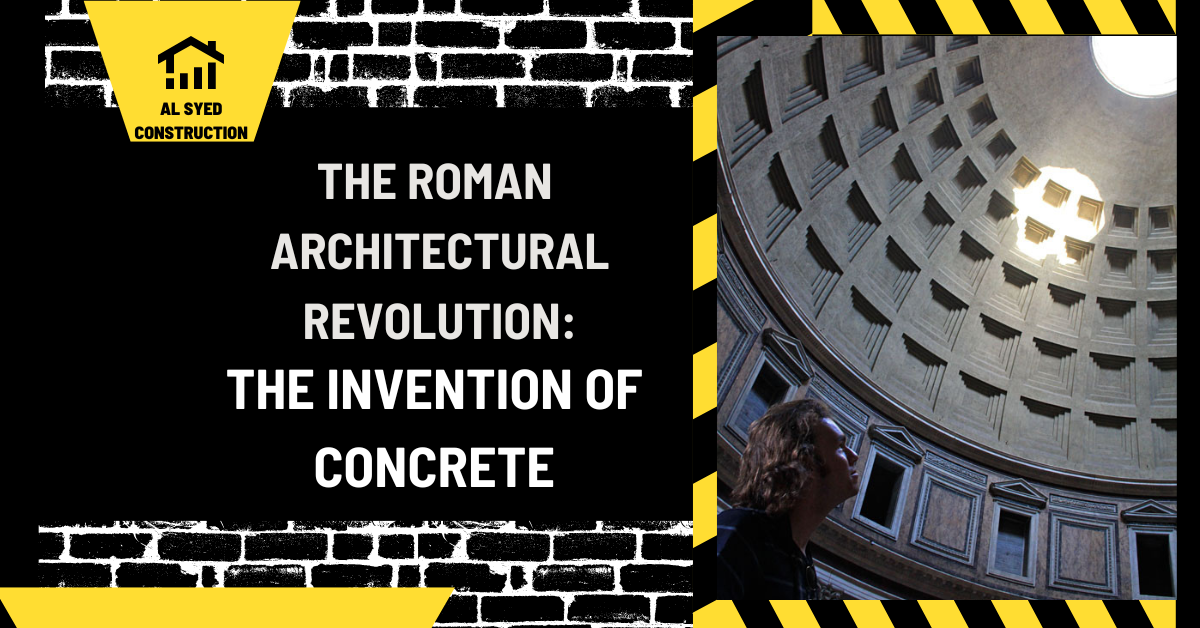
The invention of concrete allowed the Romans to push the boundaries of architecture and engineering. They were able to construct massive public buildings, aqueducts, and bridges that could withstand the test of time. The Pantheon in Rome, with its large concrete dome, remains one of the most iconic examples of Roman architectural ingenuity.
Durability and Longevity
Roman concrete structures have proven to be incredibly durable, with many still standing after two millennia. The material’s resistance to weathering, earthquakes, and other environmental factors has contributed to the longevity of Roman buildings and infrastructure.
The Legacy of Roman Concrete
Influence on Modern Construction
The principles of Roman concrete continue to influence modern construction. The use of pozzolanic materials in contemporary concrete mixtures is a direct legacy of Roman innovation. Researchers are also studying ancient Roman concrete to develop more sustainable and durable building materials for the future.
Enduring Impact on Architecture
The legacy of Roman concrete is evident in the enduring structures that continue to awe and inspire. The material’s versatility and durability have cemented its place in the history of architecture, showcasing the ingenuity and forward-thinking of Roman engineers and builders.
What Romans changed about concrete
Concrete as a general building material existed before Rome, but Roman builders developed and used concrete extensively in ways that transformed the scale and shape of architecture. Roman concrete typically combined a lime-based binder, aggregates, and in many contexts volcanic ash known as pozzolana. The exact composition varied with place, date, and intended use. It is more accurate to discuss Roman innovation in recipes, construction practice, and architectural application than to say the Romans invented concrete outright.
The material’s value was that it could be placed in forms and used to create thick walls, vaults, domes, foundations, and other forms that were difficult to build from cut stone alone. In some structures, concrete cores were faced with brick, stone, or other masonry. The facing could provide a finished surface and help contain the core, while the interior mass provided structural volume. This composite approach opened architectural possibilities, but performance still depended on workmanship, aggregate, binder, curing, geometry, and maintenance.
Ingredients and material behavior
Lime binder was produced by heating limestone and preparing the resulting material for use. Pozzolanic materials could react with lime in the presence of water and contribute to hardened binder properties. Aggregates created the bulk of the mass and varied according to local geology and project needs. The combination did not behave exactly like modern Portland-cement concrete. Roman recipes were not uniform, and a structure built near volcanic deposits could use different materials from one built elsewhere.
Modern scientific studies examine Roman concrete samples using mineralogical and microscopic methods. The findings can explain particular samples, but they should not be generalized to every Roman building. Some celebrated examples may have unusual material conditions or exposure histories. The fact that a historic structure survives does not prove that all ancient concrete was exceptionally durable or that the same recipe would work in a modern project.
| Construction element | Roman concrete’s contribution | Important qualification |
|---|---|---|
| Thick wall or core | Could form a substantial mass behind facing material | Recipe and workmanship varied by site |
| Vault | Enabled curved roof forms with continuous material | Geometry and temporary support remained critical |
| Dome | Supported large interior volumes in selected designs | Material alone did not determine success |
| Harbor or water structure | Some mixes performed in wet environments | Not every mix had the same exposure resistance |
Form, space, and building technique
Concrete made it practical to create massive curved interiors and complex spatial sequences. Builders could combine a concrete core with brick or stone facings, adjust thickness, and use forms to establish vaults or domes. The result was a different relationship between structure and surface than in a building made entirely from individually cut stone blocks. The interior could feel continuous, while the exterior could be articulated with facades and orders that expressed civic or religious meaning.
The Colosseum is an example of a Roman structure that combined multiple materials and structural strategies, including arches, vaults, concrete, masonry, and stone elements. It should not be reduced to “concrete made the building.” The architecture depends on a system of repeated bays, circulation, seating, foundations, and load transfer. The separate article on the Colosseum’s Roman arches focuses on that element, while this guide addresses concrete’s broader architectural role.
Construction logistics and quality
Concrete construction requires gathering and preparing ingredients, transporting them, building forms or backing, placing material, and allowing it to harden. Roman projects also required organized labor, supply chains, lifting, scaffolding, and quality judgment. A large pour or layered placement can fail if the material is inconsistent or the sequence is poorly managed. Ancient builders worked without modern laboratory testing and reinforcement standards, but they still developed practical methods through experience and observation.
Temporary works matter because fresh concrete cannot immediately act like the finished structure. Forms must resist the placed material, and arches or vaults may need centering until the assembly can carry itself. Builders must plan transitions, construction joints, and the sequence of work. These issues remain relevant today even though current materials, equipment, codes, and test methods are different. An ancient building tradition can inform design thinking but cannot substitute for modern engineering.
Lessons for modern construction
Roman concrete invites research into material durability, local aggregates, and the long-term behavior of mineral binders. Modern engineers may study old materials to understand why certain structures have endured and how repairs can remain compatible. But a historical binder is not automatically sustainable or fit for a current building. Contemporary construction must meet requirements for strength, reinforcement bond, fire resistance, environmental exposure, quality control, and code compliance. Any modern adaptation needs testing for its actual application.
Historic repair is a separate challenge. Hard cement patches may be incompatible with softer ancient masonry, and moisture can migrate in ways that damage adjacent stone or brick. Conservators should evaluate the original material and the cause of deterioration before selecting a repair. The discussion of Great Pyramid mortar offers a comparison with a distinct ancient masonry context; different cultures, materials, and construction systems should not be merged under one “ancient concrete” label.
Questions readers ask
Did the Romans invent concrete? Concrete-like materials existed earlier. Roman builders made major advances in its use and architectural application.
Was all Roman concrete made from the same recipe? No. Materials and proportions varied by location, period, and use.
Why could concrete create large domes and vaults? It could be placed in continuous forms and shaped into curved structures, subject to careful geometry, support, and construction sequence.
Can Roman concrete be copied for modern buildings? Historical research can inform material science, but a modern structure requires engineered testing and approval for its intended use.
Roman concrete: ingredients, structures, and evidence
Roman concrete was not one fixed recipe. Builders combined lime-based binder with aggregates and, in some contexts, volcanic materials that could react with lime in the presence of water. The aggregate might include stone, brick fragments, or other locally available material. The mixture and placement method varied with the structure, region, and period. “Roman concrete” is therefore a family of practices, not a single formula that can be copied from a generic description.
Concrete enabled forms that were difficult to construct with cut stone alone, including thick walls, vaults, and large domed spaces. Builders used timber centering and temporary support where needed, and the formwork and sequence mattered as much as the mixture. Some walls were faced with brick or stone while the concrete mass filled the interior. The visible surface may therefore conceal a composite construction system.
Archaeologists learn about Roman concrete from cores, exposed sections, tool marks, aggregate, and the relation between concrete and facing materials. Laboratory analysis can identify mineral phases, but it must be paired with the building’s context. The material’s longevity is impressive in some structures, yet Roman concrete also cracked, weathered, and required repair. Its history shows that durability depends on recipe, exposure, geometry, workmanship, and maintenance—not on a mysterious universal additive.
Conclusion
The invention of concrete by the ancient Romans was a pivotal moment in the history of construction. It enabled the creation of monumental structures that have endured for centuries, showcasing the ingenuity and skill of Roman engineers. The legacy of Roman concrete is still evident in modern construction practices, underscoring the lasting impact of this ancient building material on the world of architecture and engineering.





Leave a Reply
Want to join the discussion?Feel free to contribute!