
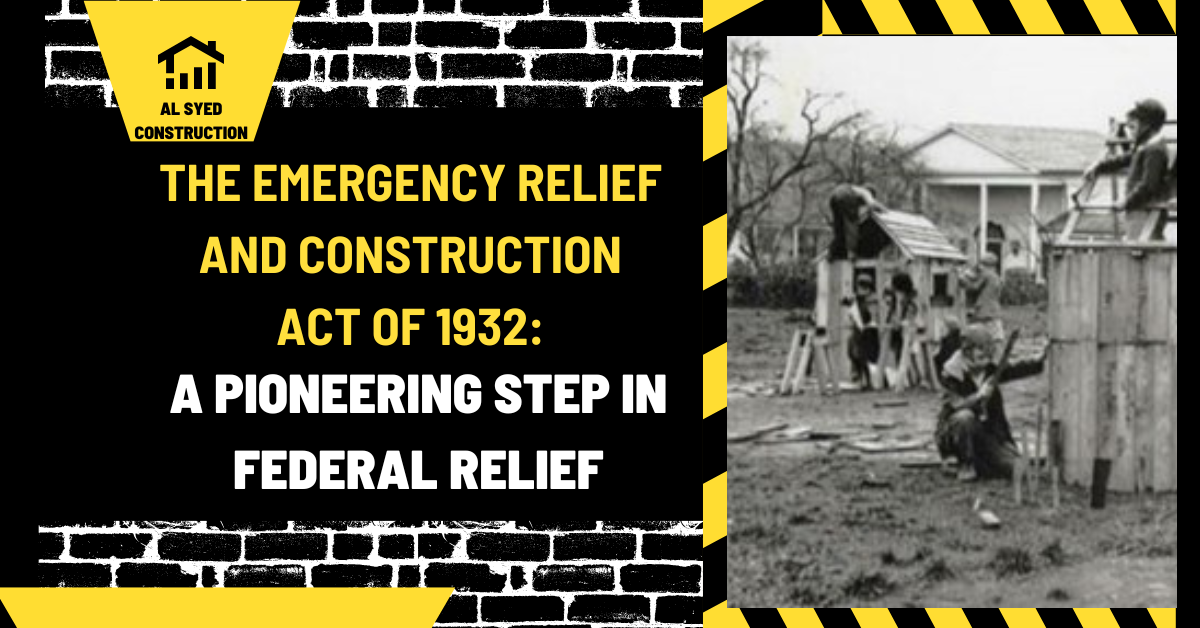
Emergency Relief and Construction Act of 1932
The Emergency Relief and Construction Act, enacted on July 21, 1932, marked a significant moment in the history of the United States, as it was the nation’s first major-relief legislation. Signed into law by President Herbert Hoover during the depths of the Great Depression, this act aimed to provide immediate relief to the destitute, broaden the lending powers of the Reconstruction Finance Corporation (RFC), and create employment through a public-works program.
Key Components of the Act
The act had several key features:
Direct Relief: It provided $300 million in loans to states for direct relief efforts. This funding was critical in supporting large urban relief organizations and expanding relief in smaller communities and rural areas that had previously received little aid.
Public Works Projects: An additional $1.5 billion was allocated for public works projects, such as the construction and repair of roads, bridges, and public buildings. This initiative aimed to stimulate employment and provide a much-needed boost to the economy.
Reconstruction Finance Corporation: The act expanded the RFC’s role, allowing it to make loans to private corporations for low-income housing and support various state and local public works projects.
Agricultural Aid: The scope of the RFC was also broadened to include aid to agriculture, providing much-needed support to the struggling farming sector.
Impact and Legacy
The Emergency Relief and Construction Act represented a shift in the federal government’s approach to dealing with economic crises. By providing direct federal aid and financing public works projects, the act laid the groundwork for future New Deal programs under Franklin D. Roosevelt’s administration. It also marked the federal government’s first major involvement in housing and set a precedent for future federal assistance in times of economic distress.
The act’s emphasis on public works projects and direct relief to states reflected an understanding of the need for immediate action to alleviate suffering and stimulate economic activity. While not all aspects of the act were fully successful, it was a crucial step in the evolution of federal intervention in the economy and set the stage for more comprehensive relief efforts in the years to come.
What the 1932 act addressed
The Emergency Relief and Construction Act of 1932 was federal legislation passed during the Great Depression, when unemployment and economic hardship were severe. The law expanded federal activity connected with relief and public works, including a greater role for the Reconstruction Finance Corporation in supporting construction-related projects and relief measures. It was part of President Herbert Hoover’s response to economic crisis before the later New Deal programs under Franklin D. Roosevelt. The act’s significance is best understood within that evolving federal response, not as a modern building code or a single nationwide construction contract.
In the early 1930s, policymakers debated how public credit, infrastructure investment, and relief could stabilize the economy. The act sought to direct federal resources through existing institutions and authorize support for public works and relief needs. Different provisions served different purposes, and the results depended on how loans and funds were administered. A reliable summary should distinguish the law’s statutory mechanisms from broader outcomes attributed to the era’s public construction.
Why construction appeared in an economic relief law
Construction projects could create paid work while producing infrastructure or public facilities. Roads, utilities, public buildings, and other works required labor and materials, so investment in such projects had the potential to support both immediate employment and long-term public capacity. However, the timing and effects were not automatic. Projects needed approval, finance, planning, contractors, materials, and workers. A financing measure could enable activity without instantly putting every unemployed person to work.
Public works also raised questions about which projects should receive support, whether they could repay loans, and how quickly they could begin. A bridge or utility project might have a clear public purpose but require extensive design and land acquisition. An emergency relief measure had to balance speed with accountability. These tensions between rapid employment, project readiness, and durable infrastructure remain familiar in public construction debates, though the institutional and economic context today is different.
| Issue | Why it mattered in 1932 | How to describe it carefully |
|---|---|---|
| Federal credit | Public agencies needed financing during a financial crisis | Explain the authorized lending channel |
| Public works | Projects could employ workers and create lasting assets | Separate project approval from completed construction |
| Relief | Families and state governments faced urgent needs | Distinguish relief provisions from infrastructure loans |
| Economic effect | Results depended on timing and implementation | Avoid claiming one law ended the Depression |
How the act fits into the Depression timeline
The law followed earlier efforts to stabilize credit and support institutions as the economic crisis deepened. It preceded the major expansion of federal relief and public works associated with the New Deal after 1933. Hoover’s administration favored forms of cooperation, loans, and assistance through public and private institutions; subsequent programs under Roosevelt used a different and broader federal approach. The 1932 act is therefore a transition point in U.S. policy debates about what role the federal government should play in relief and employment.
Legislation should be read in its own terms. The title alone does not reveal every provision, and modern shorthand can blur the difference between a loan program, direct relief, and a public works appropriation. Researchers should consult the act text, congressional materials, and contemporary government records. The Library of Congress describes the act as part of the summer 1932 response to the crisis; that primary context helps avoid substituting later New Deal programs for what the 1932 law actually authorized.
Construction outcomes and limits
To evaluate the construction impact, ask which projects received funding, where they were located, how many workers they employed, and whether the assets were completed and maintained. Aggregate statements such as “the act built infrastructure across America” require evidence about actual projects. Public works finance can help a project proceed, but the path from legislation to a completed bridge includes design, procurement, construction, inspection, and operation.
Construction activity can also distribute benefits unevenly. A project may create work in one community while leaving other groups without relief. Decisions about location, contractors, labor conditions, and local access shape who benefits. Historical accounts should consider those choices alongside the federal policy. The act’s construction dimension is important, but it should not be separated from the broader questions of economic relief, governance, and public accountability.
Why this act is not a construction specification
The word construction in the law refers to public works and project activity, not technical requirements for how a building should be designed. It does not establish current standards for materials, safety, building permits, or procurement. A reader researching a building project today should consult applicable codes, contract documents, and current agency requirements. This article is historical and explains the policy context behind the act’s use of construction as one tool of relief.
The page belongs alongside other histories of the built environment because public policy shapes what is built and who pays for it. The site’s broader article on how the construction industry developed provides a long view of changing institutions and technology. This specific law, however, belongs to 1932’s federal response to economic collapse and should be read within that timeline.
Questions readers ask
When was the act passed? It was enacted in July 1932 during the Hoover administration.
Was it part of the New Deal? It preceded Roosevelt’s New Deal and belonged to the earlier federal response to the Depression.
Did it create construction jobs? It supported relief and public works mechanisms, but project-specific employment should be established from records rather than assumed from the law’s title.
Did the act end the Great Depression? No single act ended the Depression. Economic recovery involved many later policies and broader conditions.
The 1932 Act in the Great Depression context
The Emergency Relief and Construction Act of 1932 was enacted during the Great Depression, when unemployment and financial distress were severe. It expanded federal support for public works and relief-related lending, reflecting the view that construction could address urgent needs while putting people to work. It belonged to a broader period of debate over federal responsibility and should be understood alongside other relief measures rather than treated as the single origin of the later New Deal.
Public construction can create immediate jobs and longer-lived assets, but the effects depend on project selection, procurement, timing, wages, and local need. Roads, public buildings, and utilities can support economic activity beyond the construction phase. The 1932 law’s importance therefore lies both in its specific mechanisms and in the policy shift it represented during a crisis.
When assessing the Act, distinguish legislation from projects funded under it and later programs with similar aims. Contemporary summaries can blur those categories. A reliable account should identify the law’s provisions, the agencies responsible, and the historical circumstances that shaped implementation. This keeps the discussion precise and avoids attributing every Depression-era public works project to one statute.
Conclusion
In conclusion, the Emergency Relief and Construction Act of 1932 was a pivotal piece of legislation that addressed the urgent needs of a nation in crisis. It demonstrated the federal government’s commitment to providing relief, supporting public works, and aiding economic recovery during one of the most challenging periods in American history.




Leave a Reply
Want to join the discussion?Feel free to contribute!