
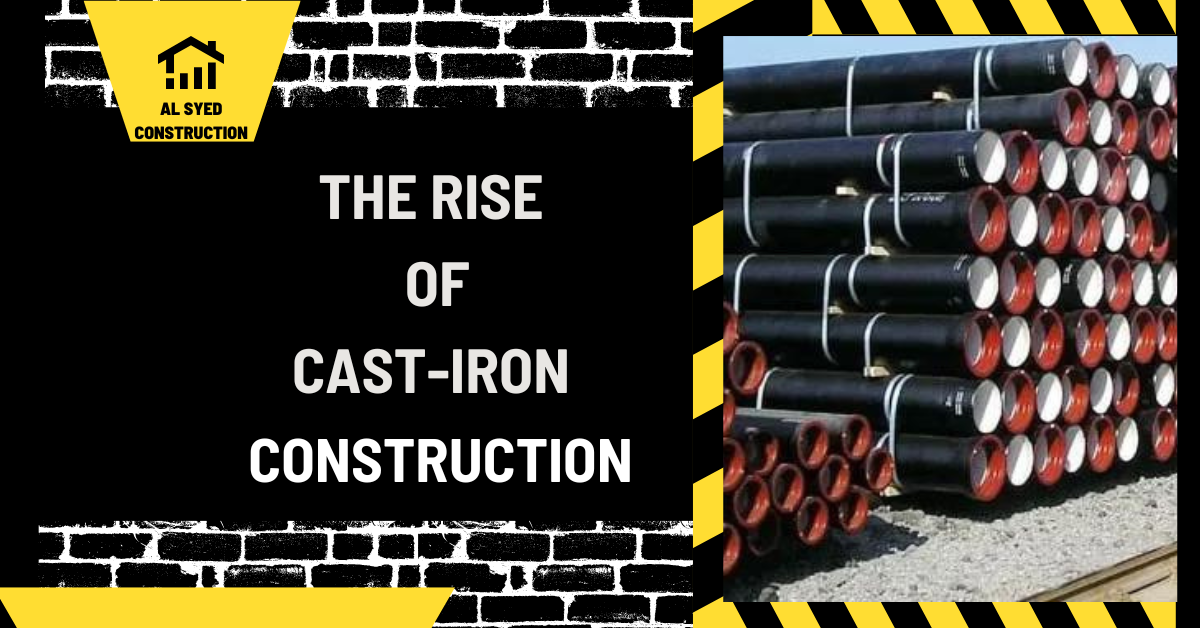
Cast Iron in Construction: History and Impact
Introduction
Cast-iron construction marked a significant era in architectural and engineering history, revolutionizing the way buildings were designed and constructed. This building style became widespread during the Industrial Revolution, a period characterized by rapid technological advancements and industrial growth. This article explores the timeline and impact of cast-iron construction on the architectural landscape.
The Advent of Cast-Iron Construction
Early Use in the 18th Century
The use of cast iron in construction can be traced back to the 18th century, with early applications in bridges and small-scale structures. However, it was not until the 19th century that cast-iron construction gained widespread popularity.
Boom in the 19th Century
The Industrial Revolution, spanning from the late 18th century to the mid-19th century, saw the mass production of cast iron. This period marked the widespread adoption of cast-iron construction, particularly in the early to mid-1800s.
Impact on Architectural Design
Innovations in Building Structures
Cast-iron construction allowed for the creation of large, open interior spaces, as the material’s strength supported greater spans. This led to innovations in building structures, including the development of the skeletal frame and the curtain wall.
Influence on Architectural Styles
The versatility of cast iron influenced various architectural styles, including the Gothic Revival and Second Empire styles. Ornate cast-iron facades became a hallmark of commercial buildings and warehouses during this time.
Challenges and Decline
Susceptibility to Fire
Despite its strengths, cast-iron construction had its drawbacks, notably its susceptibility to fire. High temperatures could cause cast iron to crack and fail, leading to catastrophic collapses.
Transition to Steel
By the late 19th and early 20th centuries, the advent of steel as a construction material led to the decline of cast-iron construction. Steel offered greater strength and resistance to fire, making it a preferred choice for modern structures.
Why cast iron changed building design
Cast iron is iron melted and poured into molds, allowing builders to make shaped columns, brackets, beams, and decorative components. Its use expanded during the Industrial Revolution as foundries improved production and transport networks moved heavy components farther. Cast iron helped create new structural possibilities and architectural expression, especially where repeated columns or standardized parts could be manufactured. It is not the same as wrought iron or modern structural steel, and those materials should not be treated as interchangeable.
Cast iron performs well under compression but is comparatively brittle and less forgiving in tension or impact than wrought iron and steel. That distinction matters in evaluating historic structures. A cast-iron column can carry compressive load effectively when properly designed, but a flaw, sudden impact, or poorly detailed connection may lead to brittle failure. The member’s shape, casting quality, loading, and condition all influence its performance.
From foundry to building site
Mold-based production allowed components to be repeated and decorated. Columns could be made slender relative to some masonry supports, opening interior floor space in factories, markets, and commercial buildings. Cast-iron fronts and storefront elements could also incorporate ornamental patterns and large openings. This blend of structure and decoration became associated with nineteenth-century urban architecture, though applications differed by place and project.
Industrialized production changed construction sequencing. Components were fabricated off-site, transported, lifted, aligned, and connected on site. The building team needed accurate dimensions, matching castings, reliable foundations, and connections that transferred the intended loads. Tolerances mattered because a casting that did not fit could require costly field adjustment. Cast iron enabled new methods but did not remove the need for skilled assembly and inspection.
| Material | Typical historical role | Key behavior to consider |
|---|---|---|
| Cast iron | Columns, brackets, storefronts, and decorative members | Strong in compression but brittle under impact or tension |
| Wrought iron | Bars, ties, rails, and shaped metalwork | More ductile behavior than cast iron |
| Structural steel | Frames and long-span members | Engineered grades, connections, and fire protection are central |
Cast-iron architecture and fire risk
Cast iron became associated with industrial and commercial building types, including multistory structures that used metal columns and masonry or timber elements. Some buildings were promoted as fire-resistant because the metal did not burn, but that description can be misleading. Cast iron can lose strength under heat and may crack or fail when rapidly heated or cooled. Floors, partitions, contents, and timber framing can remain combustible even if columns are metal. Fire performance depends on the complete assembly and protection, not a single member’s material.
Historic cast-iron facades often combine thin metal elements with masonry backing and internal framing. Inspectors should understand how the facade attaches to the building and whether corrosion, movement, or failed connections are present. A painted exterior can hide cracks or corrosion at joints. Loose or damaged components above sidewalks create public-safety concerns and may require temporary protection while the structure is assessed.
Why cast iron gave way to steel in many roles
As steelmaking developed, structural steel offered greater ductility and the ability to form members suited to tension and bending. Engineering calculations, standardized products, and fabrication methods expanded its use in frames and long spans. Cast iron continued in some decorative, architectural, and specialized roles, but it was gradually displaced in many primary structural applications. The change was not instantaneous; buildings and infrastructure reflect overlapping technologies and different local markets.
Studying this transition helps explain that material history is more than a sequence of inventions. Cost, supply, fire experience, engineering knowledge, building codes, labor, and architectural fashion all shaped adoption. A new material becomes influential when industries learn how to make it, test it, transport it, connect it, and maintain it.
Inspecting and preserving historic cast iron
Before repair, identify the component and its load path. Look for cracks, corrosion, deformation, missing connections, water entry, and prior repairs. Nondestructive testing or targeted investigation may be needed to assess hidden conditions. Because cast iron can fail brittlely, do not drill, weld, heat, or load a historic member without specialist review. A patch that appears simple can introduce concentrated stresses or damage the original casting.
Conservation balances safety with retention of historic fabric. Cleaning should not remove protective coatings or surface evidence unnecessarily. Replacement pieces should match the structural function and appearance, but the chosen repair may use a different material if properly designed and documented. The site’s article on construction industry’s development places this shift within a wider history of technology, while the guide to Roman arches in the Colosseum offers an earlier example of structural form shaping building practice.
Questions readers ask
Is cast iron the same as steel? No. Their production and mechanical behavior differ; cast iron is generally more brittle.
Why was cast iron used for columns? It could be molded into repeated forms and performed well under compression in suitable designs.
Is cast iron fireproof? No. It does not burn, but high heat can weaken or damage it, and the surrounding building may contain combustible materials.
Can a historic cast-iron column be welded? Not without specialist assessment. Welding or heating can damage cast iron and create failure risk.
Cast iron and the transformation of building
Cast iron became important in architecture during industrialization because it could be produced in repeatable shapes and used for columns, beams, façades, bridges, and decorative components. Casting allowed intricate profiles and relatively slender members, supporting new building types such as markets, railway stations, factories, and arcades. The material’s rise depended on foundries, fuel, transport networks, design knowledge, and skilled installation.
Cast iron performs well in compression but is brittle compared with wrought iron and modern steel. A column can carry substantial vertical loads, while a cast-iron beam is more vulnerable to tension, impact, and sudden fracture. Historical designers sometimes used the material beyond its ideal behavior, so preservation engineers inspect for cracks, corrosion, hidden connections, and load changes before adapting a building.
Cast iron also transformed the appearance of urban architecture. Repeated columns opened interiors for light and flexible retail layouts; ornamental façades could imitate stone while relying on prefabricated components. Fire performance is complex: iron does not burn, but high heat can weaken it, and unprotected metal may lose capacity quickly. Historic claims of “fireproof” construction should be examined against the full assembly and actual fire history.
Conservation may involve cleaning, coating, localized repair, or replacement of a damaged component. Each choice must consider original fabrication, structural duty, connection details, and architectural significance. A replacement cast to match a historic profile may preserve the appearance but should be clearly documented. Understanding the material’s industrial context explains why cast iron was revolutionary and why it needs specialized care today.
Cast iron in adaptive reuse
Adaptive reuse of cast-iron buildings should begin by identifying every member and connection, including hidden bearing points and later reinforcements. New floor loads, vibration, service penetrations, and fire protection can change performance. Engineers should compare existing capacity with the proposed use and make only the openings needed for new services. Record any member that is repaired or strengthened so future teams can understand the intervention.
The original modular logic can support reuse: repeated bays may permit flexible layouts, and tall windows may bring daylight deep into a former industrial space. But successful reuse depends on safe egress, accessibility, environmental control, and a maintenance budget. Preserving the frame while adapting the building can retain both embodied material and a legible record of industrial construction.
Conclusion
Cast-iron construction became a widespread building style during the Industrial Revolution, particularly in the 19th century. It played a pivotal role in shaping architectural design and engineering practices of the time. However, the material’s limitations and the rise of steel construction eventually led to the decline of cast-iron as a dominant building style. Despite this, the era of cast-iron construction remains a significant chapter in the history of architecture and construction.





Leave a Reply
Want to join the discussion?Feel free to contribute!