
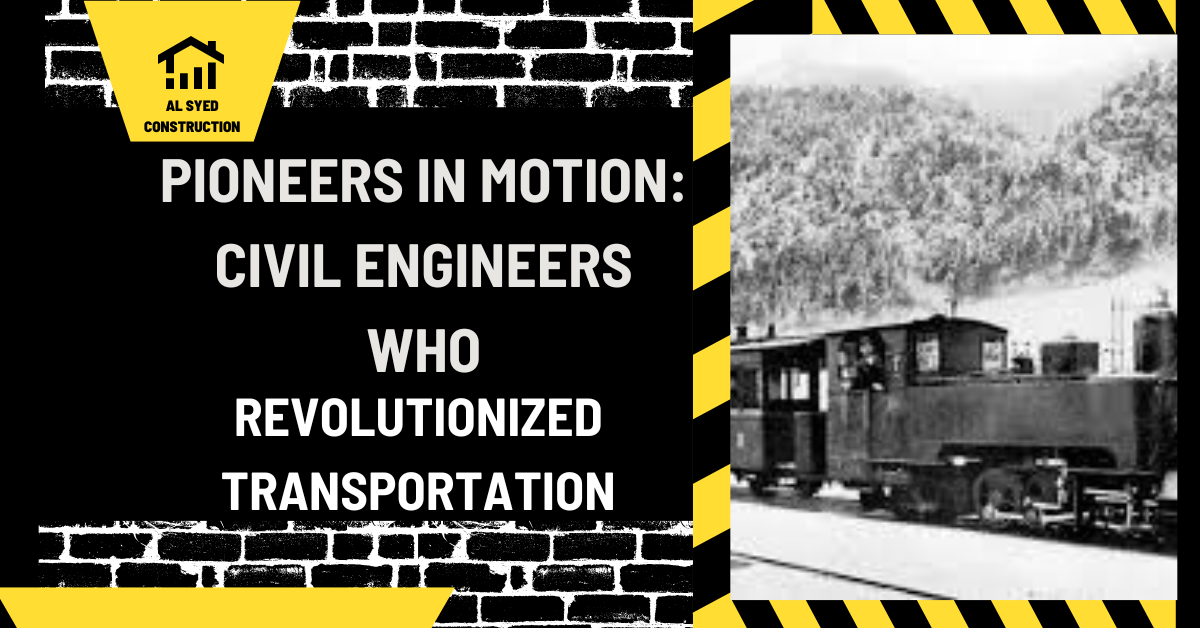
Civil Engineers Who Changed Transportation
Transportation changes when engineering makes routes safer, faster, more reliable, or possible in places that were once difficult to cross. Civil engineers helped create those changes through roads, canals, railways, bridges, and urban networks. Their influence came from more than a single famous structure: it included new materials, better calculations, construction methods, and systems that connected communities.
The engineers below represent different parts of that history. Some worked in the United States; others developed methods that influenced American transportation. Their achievements depended on crews, fabricators, surveyors, financiers, public agencies, and communities as well as individual design skill. Understanding that wider context gives a more accurate picture of how transportation infrastructure evolved.
John B. Jervis and the early American canal and railway era
John B. Jervis was one of the early American civil engineers whose work helped shape canals, railways, and water infrastructure. In the nineteenth century, engineers had to survey routes, manage grades, design structures, and organize construction across long distances. Canals and early railways expanded movement beyond local roads and connected inland communities to larger markets.
Jervis’s career illustrates that transportation engineering was a systems problem. A canal needed not only a channel but also locks, aqueducts, embankments, water control, and reliable maintenance. A railway needed a workable route, bridges, drainage, track support, and operating connections. Engineers worked across these elements so a transportation network functioned as a whole.
The canal era also created new expectations for public works: projects had to be surveyed, financed, built, and maintained over large territories. Those lessons carried into later roads, railways, and bridges. The engineering contribution was not limited to a single span; it included methods for coordinating complex linear infrastructure.
John Loudon McAdam and the engineered road surface
John Loudon McAdam, a Scottish engineer, became associated with a road-building method that used layers of broken stone placed and compacted to create a durable surface. The approach emphasized drainage, a shaped roadbed, and controlled stone size rather than relying on deep muddy tracks. The term “macadam” later became part of road engineering vocabulary.
The method influenced road construction beyond Britain, including U.S. road development. Better surfaces supported more dependable travel and freight movement, especially before widespread motor vehicles. The idea that drainage and foundation preparation determine road performance remains important: a road surface fails quickly if water weakens the layers beneath it.
McAdam’s legacy is a reminder that transportation innovation is not only about spectacular bridges. An improved road section can connect a rural route, reduce travel disruption, and support commerce. Later paving methods changed materials and construction, but the engineering focus on subgrade, drainage, and load distribution still underlies roadway design.
Squire Whipple and bridge analysis
Squire Whipple was an American engineer associated with early analytical approaches to iron bridge design. As iron bridges became possible, designers needed ways to understand how loads moved through trusses and members. Whipple’s writing and bridge work helped bring mathematical analysis into a field that had often relied heavily on rules of thumb and craft knowledge.
Truss bridges distribute loads through connected members that experience tension or compression. An engineer must understand geometry, member forces, connections, material behavior, and support conditions. More systematic analysis helped designers compare arrangements and make bridges for rail and road routes more predictable. It did not eliminate the need for careful fabrication and inspection; it gave builders a stronger basis for design decisions.
Whipple’s influence sits within a wider shift toward professional engineering education, calculation, and standards. Bridge design became more explainable and reviewable. Today, modern structural analysis uses advanced tools, but engineers still need to understand the load path and validate assumptions. The bridge construction guide explains how that structural design fits into foundations, erection, and deck construction.
John and Washington Roebling, with Emily Warren Roebling
John A. Roebling advanced the use of wire rope and suspension-bridge engineering in the nineteenth century. Wire cables could support long spans where masonry or short iron bridges would be impractical. His work influenced major crossings and helped establish suspension bridges as a powerful transportation form.
John Roebling died before construction of the Brooklyn Bridge began. His son Washington Roebling led the project, overseeing its engineering and construction under difficult conditions. Pneumatic caissons were used in foundation work, and Washington suffered severe illness associated with compressed-air exposure. His wife, Emily Warren Roebling, became a crucial liaison between him, the project team, and public officials and developed substantial working knowledge of the bridge. The project is more accurately described as a major engineering and construction effort involving a family and many workers than as the achievement of one person alone.
The Brooklyn Bridge joined communities across the East River and demonstrated how long-span structures could support both transportation and pedestrian movement. Its construction involved cables, towers, anchorages, foundations, deck framing, and a complex urban worksite. The Roeblings’ work showed how material innovation and construction planning can expand the scale of feasible crossings.
James B. Eads and the Mississippi River crossing
James B. Eads is associated with the St. Louis bridge across the Mississippi River, a major crossing that had to address the river’s width, navigation, foundations, and changing conditions. A bridge over a major navigable river cannot be designed by looking only at the roadway: support locations, vessel clearance, riverbed conditions, and construction access all affect the structure.
Eads’s bridge used steel in a period when the material was relatively new for large structural work. The project required confidence in material testing, structural behavior, fabrication, and erection. Its foundation work in the river also illustrated the importance of engineering below the visible superstructure. Deep foundations and underwater construction are often the hardest parts to inspect and maintain after a bridge opens.
The St. Louis crossing helped show that steel could play a major role in large bridge construction. It also connected a growing urban region to rail and road routes. Its broader significance is how a bridge can reorganize the movement of goods and people across a natural barrier.
Othmar Ammann and metropolitan bridge networks
Othmar Ammann designed several important bridges in the New York region, including long-span crossings that served a growing metropolitan network. His work responded to the challenge of moving large volumes of traffic across waterways while fitting bridges into dense urban routes. Long spans, towers, cables, approach structures, and traffic connections had to be considered together.
Ammann’s career shows that a bridge is often part of a wider transportation system. Approaches, interchanges, road capacity, public access, and maintenance influence whether a crossing serves its purpose. A bridge may be structurally successful yet fail to solve transportation congestion if its network connections are poorly planned.
Long-span design also requires choices about stiffness, wind behavior, traffic loading, cable systems, and construction sequence. The finished bridge represents a combination of structural theory, materials, surveying, fabrication, and construction organization. Ammann’s bridges became landmarks, but their engineering function was to connect a region and support daily movement.
What these pioneers changed in transportation
These engineers contributed through different kinds of change: improved road construction, canal and railway planning, mathematical bridge analysis, wire-rope suspension systems, steel bridge applications, and metropolitan crossings. The effect was cumulative. A reliable road could feed traffic to a bridge; a bridge could connect to rail; a canal could move bulk freight; and a network could make regional travel more predictable.
Transportation innovation also depends on institutions. Public agencies, engineering societies, universities, standards bodies, contractors, and manufacturers help turn a successful prototype into a repeatable practice. Materials testing, design calculations, construction inspection, maintenance programs, and public investment all influence whether a new idea spreads.
The history should include the workers who excavated foundations, fabricated steel, built forms, placed concrete, assembled cables, and maintained the routes. Engineering records often foreground designers, but infrastructure is a collective accomplishment. Recognizing the labor and public decisions behind a bridge gives readers a fuller account of how transportation systems were built.
| Engineering contribution | Transportation effect |
|---|---|
| Improved road-base and drainage methods | More dependable overland travel |
| Canal and railway route planning | Connected inland towns and markets |
| Analytical truss design | More systematic bridge-member design |
| Wire-rope suspension systems | Enabled longer crossings |
| Steel bridge applications | Expanded structural options for major rivers |
| Metropolitan long-span planning | Connected dense urban regions across waterways |
How innovation continues today
Modern civil engineers work with materials and tools unavailable to nineteenth-century designers, including high-performance steels, advanced concrete, digital models, sensors, and prefabricated bridge elements. The core questions remain familiar: what route must be connected, what loads will the structure carry, what ground supports it, how will it be built safely, and how will it be maintained?
Climate resilience has become a more visible design concern. Engineers evaluate flooding, heat, sea-level change, scour, wildfire access, and extreme storms. Rehabilitation and replacement may be more practical than building a new route. An innovation can therefore be a new material or a better way to inspect, strengthen, or operate an existing bridge.
Accelerated construction moves more work off-site and shortens traffic closures. Digital monitoring can identify movement or deterioration. These methods build on older lessons about standardization, logistics, and maintenance. The most valuable innovation is the one that improves the whole route and remains safe and serviceable over time.
Common questions
Who was the most influential civil engineer in transportation?
There is no single answer. Different engineers shaped roads, canals, railways, and bridges. Their influence depends on whether the focus is a specific technology, structure, region, or transportation network.
What did John Roebling contribute?
John A. Roebling advanced wire-rope and suspension-bridge engineering. His son Washington led construction of the Brooklyn Bridge, while Emily Warren Roebling became an important technical and project liaison during the work.
Why is Squire Whipple important?
Whipple helped advance analytical approaches to iron bridge design. His work reflects the shift toward using calculations to understand truss forces and improve structural design.
Did engineers work alone on famous bridges?
No. Large bridges relied on workers, contractors, fabricators, surveyors, public officials, financiers, and communities. A named engineer may lead design, but the structure is a collective effort.
How do historical engineers influence modern bridges?
They established materials, forms, analytical methods, and construction practices that later engineers improved. Modern design still relies on understanding load paths, foundations, erection, inspection, and maintenance.
A connected history of movement
Transportation engineering advanced through many linked ideas rather than one invention. Roads improved the approach to canals and bridges; analytical design made structures more predictable; wire and steel enabled longer crossings; and regional planning connected individual structures into networks. The pioneers named here helped move people and goods across terrain and water, while their projects also taught later engineers how to design, construct, and maintain infrastructure at greater scale.




Leave a Reply
Want to join the discussion?Feel free to contribute!