
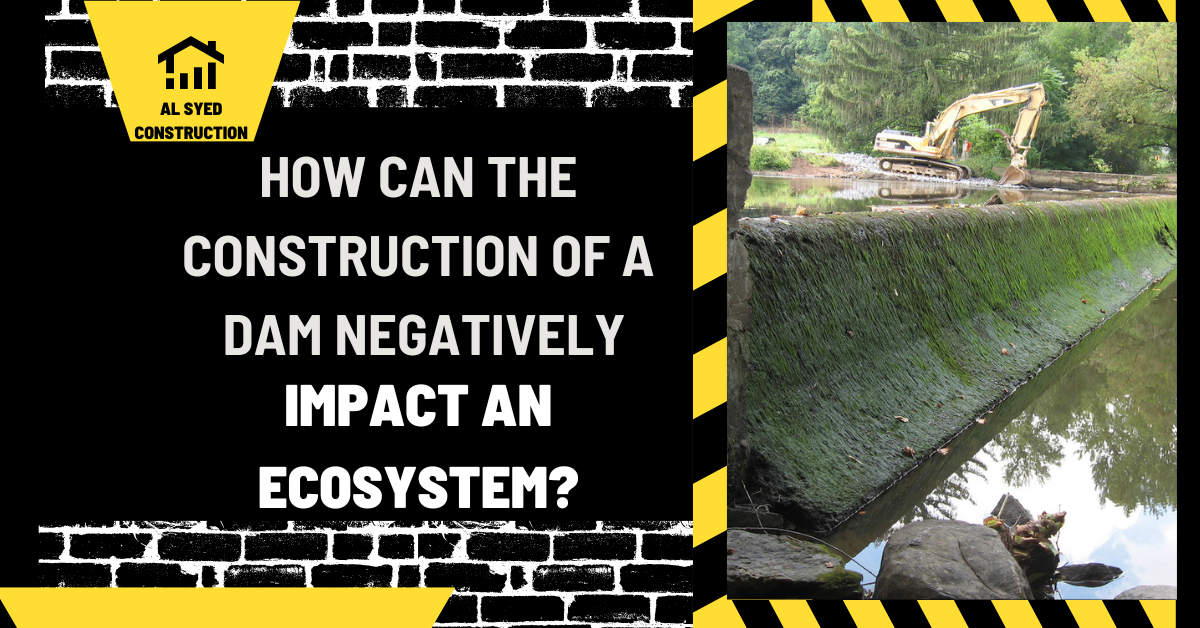
How Dams Can Harm Ecosystems
Dam construction can change an ecosystem by altering when, where, and how water moves through a river. A dam may inundate land upstream, block or delay fish movement, trap sediment, change downstream temperatures, and reshape floodplain and wetland habitats. The effects vary by dam type, river, operating rules, species, season, and mitigation measures; no single impact list applies equally to every project.
Understanding these effects requires looking beyond the dam wall. Reservoir filling, water releases, diversion, power generation, sediment management, construction access, and long-term operations can all influence the watershed. This guide explains the main ecological pathways, what environmental review studies, and how design and operation can reduce—but not always eliminate—harm.
Reservoir flooding and habitat conversion
Creating a reservoir usually inundates some land upstream of the dam. Forest, grassland, farmland, wetlands, riparian corridors, or cultural sites may be submerged or fragmented. Species that rely on those habitats can lose nesting areas, feeding grounds, migration routes, or cover. The amount and significance of change depend on the reservoir footprint, existing land use, seasonal water levels, and the landscape around it.
Reservoir margins can become a new habitat for some species while eliminating habitat for others. A fluctuating shoreline may expose or flood vegetation repeatedly. Shallow coves, tributary arms, and drawdown zones can support different plant and animal communities than a flowing river. Those changes are not automatically beneficial or harmful in the same way; ecologists assess the species and functions affected.
Construction roads, staging areas, borrow sites, and transmission lines can expand the disturbed footprint beyond the reservoir itself. Fragmentation may continue after the dam is complete if traffic, recreation, or utility corridors cut through sensitive areas. Environmental review maps the full project and associated infrastructure, not only the water surface behind the dam.
Barriers to fish movement and river connectivity
A dam can block upstream and downstream movement for fish and other aquatic organisms. Migratory species may be unable to reach spawning or rearing habitat. Downstream-moving juveniles can be delayed or injured at intakes, turbines, spillways, or screens. A structure that does not physically block a species may still change flow cues, water temperature, or passage timing enough to disrupt its life cycle.
Fish ladders, lifts, bypass channels, screens, and operational changes can reduce some passage impacts. Their success depends on the species, swimming ability, water velocity, attraction flow, entrance placement, seasonal operation, maintenance, and monitoring. A passage structure designed for one fish is not necessarily effective for another. The environmental plan should define performance criteria and adaptive responses when monitoring shows that the system is not working as intended.
Connectivity extends beyond fish. Sediment, nutrients, wood, invertebrates, and other materials also move through rivers. A dam can interrupt these movements and alter the ecological relationships that depend on them. A river may have multiple dams and diversions, so cumulative effects along the full route can be more important than one structure considered alone.
Sediment trapping and downstream channel change
Rivers carry sediment from upstream landscapes. When flow slows in a reservoir, some sediment settles rather than continuing downstream. Over time, sediment accumulation can reduce storage or alter reservoir habitat. Downstream, a sediment-starved river may erode its bed or banks, change channel shape, expose infrastructure, or reduce the gravel and sand habitats used by fish and invertebrates.
Sediment also carries nutrients and helps build bars, floodplains, and wetlands. The ecological role depends on grain size, chemistry, timing, and where material is deposited. Releasing sediment in a large pulse can be harmful if it increases turbidity or buries habitat, so management strategies need site-specific analysis. Options may include bypasses, sluicing, dredging, flushing, or sediment augmentation, but each has operational, environmental, and cost limits.
Construction itself can add sediment through clearing, excavation, roads, and exposed soil. Erosion controls and construction sequencing reduce this risk, but they must be maintained during storms and changing flows. The project should distinguish temporary construction sediment from the long-term sediment-trapping effect of the reservoir.
Changes to flow, flooding, and floodplain habitat
Dams regulate the timing and magnitude of downstream releases. A reservoir may reduce some flood peaks, but it can also change seasonal high flows that naturally inundate floodplains. Those pulses replenish wetlands, move sediment, support fish spawning, and maintain riparian vegetation. If releases remain too low or arrive at a different time, ecological processes can be disrupted even when annual water volume appears similar.
Rapid changes in releases can create fluctuating flows sometimes called hydropeaking. Water levels may rise and fall on a daily or hourly schedule as power generation or demand changes. Organisms can be stranded along the banks, nests may be exposed, and aquatic habitat can shift quickly. Minimum flows, ramping-rate limits, seasonal releases, and environmental flow targets can moderate some effects.
A dam can also affect groundwater and downstream wetlands by changing river stage and seepage. Where communities or ecosystems depend on periodic floods, changes to flow timing may alter vegetation and wildlife even without inundating the area. Environmental reviews examine river hydrographs and seasonal ecological needs rather than only average annual flow.
Water temperature, oxygen, and water quality
Reservoirs can stratify into layers with different temperatures. Water released from deep outlets may be colder than the natural river in summer and warmer in winter, depending on reservoir design and conditions. Temperature changes can affect fish development, spawning cues, metabolism, and the distribution of aquatic species.
Deep water can have lower dissolved oxygen than surface water, particularly when organic material decomposes. If low-oxygen water is released downstream, it can stress aquatic life. Nutrients and organic matter entering the reservoir may also influence algal growth and water quality. Some reservoirs experience harmful algal blooms, but occurrence depends on nutrient inputs, temperature, circulation, light, and other conditions.
Selective withdrawal structures, aeration, changed release timing, watershed nutrient controls, and reservoir management may help address certain water-quality issues. The design must monitor actual conditions. A mitigation feature that works under one season or reservoir level may not perform the same way under another.
Greenhouse gases and climate considerations
Reservoirs can emit greenhouse gases when flooded vegetation and organic matter decompose, producing carbon dioxide and methane. Emissions vary widely with climate, reservoir age, depth, nutrient load, vegetation, and water-level management. Some reservoirs have relatively low emissions; others can be significant. Claims about a universal “zero-emission” or “high-emission” dam are too broad without site-specific measurement.
The project’s climate assessment should consider construction materials, land inundation, reservoir emissions, operational energy benefits if hydropower is included, and alternatives. Hydropower can provide low-carbon electricity, but the climate balance depends on the location and design. A water-storage reservoir without generation has a different energy profile from a hydropower facility.
Climate change can alter inflows, drought, flood risk, evaporation, water temperature, and the reliability of ecological mitigation. Operating rules designed around historical hydrology may need adjustment. Long-term monitoring and adaptive management help identify when conditions depart from design assumptions.
Construction-phase impacts and mitigation
Construction can affect wildlife through noise, vibration, lighting, traffic, blasting, vegetation clearing, and disturbance during breeding or migration seasons. Water work can increase turbidity, disturb fish, or release contaminants from sediment. The construction plan may schedule work windows, isolate work areas, use fish exclusion or rescue measures, control noise, restore disturbed ground, and monitor water quality.
Mitigation begins with avoiding impacts where practical, then minimizing and restoring those that cannot be avoided. A project may shift access roads, reduce the reservoir footprint, preserve habitat corridors, restore wetlands, provide fish passage, or fund conservation. A mitigation measure should have measurable goals, a responsible party, a timeline, and monitoring. Merely listing a measure does not show that it compensates for ecological loss.
Construction controls require inspection and enforcement. Turbidity barriers can fail during storms; erosion measures can be damaged by equipment; timing restrictions can be missed if schedules change. The environmental team needs authority to stop or modify work when permit conditions are at risk.
Environmental review and adaptive operations
Environmental review identifies species, habitats, water quality, cultural resources, flows, sediment, and cumulative watershed effects. It compares alternatives, assesses direct and indirect effects, and defines permit conditions. Public and tribal consultation may add local knowledge about seasonal resource use, access, and cultural values.
Monitoring determines whether predictions were accurate. Teams can track fish passage, temperature, dissolved oxygen, sediment, channel morphology, wetland response, and reservoir emissions. Results should be compared with established criteria. If the project misses targets, adaptive management may change release schedules, adjust structures, improve habitat, or modify operations.
Dam removal or modification can also be considered in some watersheds. Such decisions involve benefits and risks, including sediment release, habitat reconnection, infrastructure, water supply, and cultural values. The fact that a dam exists does not make one management choice universally correct; alternatives are evaluated for the specific river and communities.
| Ecological pathway | Potential effect | Common assessment or response |
|---|---|---|
| Reservoir inundation | Habitat loss or conversion | Map habitat, avoid sensitive areas, restore or protect habitat |
| Blocked movement | Reduced fish access and survival | Passage, screens, bypasses, seasonal operations |
| Sediment trapping | Channel erosion or habitat change downstream | Sediment budget, bypass or augmentation strategy |
| Altered releases | Changed flood pulses or rapid level shifts | Environmental flows, ramping limits, monitoring |
| Thermal or oxygen change | Stress to aquatic organisms | Selective withdrawal, aeration, temperature monitoring |
Common questions
What is the biggest environmental impact of a dam?
It depends on the river and dam. Habitat inundation, blocked fish movement, sediment trapping, altered flow, and water-quality changes can each be significant. Cumulative effects across a watershed may matter more than a single impact.
Do fish ladders solve fish-passage problems?
They can help some species where design and operations fit their behavior, but performance varies. Passage for upstream movement does not automatically protect downstream migrants. Monitoring is needed to evaluate actual outcomes.
Does every reservoir emit methane?
Reservoir greenhouse-gas emissions vary with site conditions, organic material, climate, depth, and operation. They should be measured or estimated for the specific project rather than assumed to be zero or uniformly high.
Can a dam help ecosystems?
Some projects provide managed environmental flows, flood reduction, wetlands, or water storage for wildlife. Those benefits depend on design and operation and do not erase other effects. The full watershed outcome must be assessed.
Are construction impacts temporary?
Some noise, access, and turbidity impacts end after construction, but habitat conversion, flow changes, sediment trapping, and barriers can continue for decades. Restoration and long-term operations determine how much can be reduced.
Assess the dam as a watershed intervention
The ecological consequences of a dam come from its footprint, foundation work, reservoir, operating rules, and place in the wider river system. Good assessment identifies how water, sediment, organisms, and energy move before and after construction. Mitigation is most credible when it is measurable, monitored, and adjusted as evidence emerges. That whole-system view is also necessary when evaluating proposed projects such as Sites Reservoir, whose benefits and impacts depend on final approvals and future operations.



Leave a Reply
Want to join the discussion?Feel free to contribute!