2×4 Load Capacity: How Much Weight Can a 2×4 Hold?
A 2×4 is one of the most widely used pieces of dimensional lumber in U.S. construction. It is commonly used for wall framing, partitions, roof framing, blocking, bracing, shelving, and many other applications. However, one question causes considerable confusion: How much weight can a 2×4 actually hold?
There is no single weight rating that applies to every 2×4.
The load capacity of a 2×4 depends on its wood species, lumber grade, span, orientation, actual dimensions, support conditions, moisture condition, and whether the load is concentrated or distributed.
A short 2×4 supported at both ends can behave very differently from the same board spanning several feet. Similarly, a vertical wall stud and a horizontal 2×4 beam resist loads in completely different ways.
This guide explains the major factors affecting 2×4 load capacity and why a simple universal pound rating should not be used for structural design.
Quick Answer: How Much Weight Can a 2×4 Hold?
A 2×4 can support substantial weight under the right conditions, but its safe load capacity cannot be determined from the lumber size alone.
For example, changing any of the following can change the allowable load:
| Factor | Effect on 2×4 Capacity |
|---|---|
| Span | Longer spans generally reduce capacity |
| Orientation | A 2×4 on edge is much stiffer in bending than one laid flat |
| Species | Different wood species have different design values |
| Grade | Higher structural grades may provide higher design values |
| Load location | A center point load can be more demanding than a distributed load |
| Support conditions | Additional or better-positioned supports can reduce demand |
| Moisture | Wet-service conditions may require design adjustments |
| Deflection limit | Excessive bending may control before structural failure |
Therefore, a statement such as “a 2×4 can hold 1,000 pounds” is incomplete unless the span, orientation, species, grade, supports, and loading arrangement are also known.
What Is the Actual Size of a 2×4?
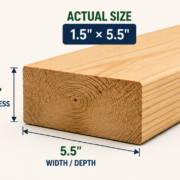
A nominal 2×4 used in modern U.S. construction typically measures approximately 1.5 inches × 3.5 inches after drying and surfacing.
That difference matters.
Structural calculations use the actual cross-sectional dimensions of the lumber rather than assuming that a 2×4 measures a full 2 inches by 4 inches.
If you want a detailed explanation of nominal versus finished lumber dimensions, see our guide to the actual size of a 2×4 stud.Understanding actual dimensions is especially important when comparing the bending performance of different dimensional lumber sizes.
What Determines 2×4 Load Capacity?
Several variables determine how much load a 2×4 can safely support. No single factor should be considered in isolation.
1. Wood Species
Not every 2×4 has the same structural properties.
Common framing lumber in the United States may include species or species groups such as:
- Southern Pine
- Douglas Fir-Larch
- Hem-Fir
- Spruce-Pine-Fir
- other regionally available structural species
Different species have different reference design values for bending, shear, compression, tension, and stiffness.
This means two 2×4 boards with exactly the same dimensions may not have the same structural capacity.
For a broader comparison of common lumber properties, see our lumber strength chart.2. Lumber Grade
The grade of a 2×4 also affects its structural performance.
Structural lumber is graded according to characteristics that can affect strength, including knots, slope of grain, and other permitted characteristics.
Common grade designations can include:
- Select Structural
- No. 1
- No. 2
- No. 3
- Stud
The grade stamp on structural lumber provides important information used when selecting appropriate design values.
A visually similar piece of lumber should not automatically be assumed to have the same capacity as another 2×4 of a different species or grade.
3. Span Length
Span is one of the most important factors affecting horizontal 2×4 load capacity.
In general:
Shorter unsupported span = better load-carrying potential and less deflection
Longer unsupported span = greater bending demand and greater deflection
For example, a 2×4 spanning a short distance between two supports behaves very differently from the same member spanning a much greater distance.
This is why the question “How much weight can a 2×4 hold?” cannot be answered reliably without knowing the span.
For a dedicated explanation of this relationship, see how far a 2×4 can span horizontally.4. On Edge vs. Laid Flat
The orientation of a 2×4 makes a major difference when it is subjected to horizontal bending.
A standard 2×4 has an actual cross section of approximately 1.5 × 3.5 inches.
2×4 on Edge
When the 3.5-inch dimension is vertical, the board resists bending about its stronger axis.
This orientation provides substantially greater bending stiffness than laying the board flat.
2×4 Laid Flat
When the 1.5-inch dimension is vertical, the board becomes much less stiff in bending.
It can therefore deflect considerably more under the same loading and span.
This difference is important for applications such as:
- shelving
- workbenches
- platforms
- framing
- small beams
- temporary supports
Whenever horizontal load capacity is discussed, the orientation of the 2×4 should also be specified.
5. Point Load vs. Distributed Load
The location of the weight is another major consideration.
Point Load
A point load concentrates weight at one location.
For a simply supported member, placing a heavy object around the middle of the span can create a demanding bending condition.
Uniformly Distributed Load
A uniformly distributed load spreads weight over a larger portion of the member.
Therefore, the same total weight can produce different structural effects depending on how that weight is applied.
For example, a 500-pound load distributed through a framing system is not equivalent to placing a single 500-pound object at the center of one unsupported 2×4.
This distinction should always be considered when estimating 2×4 capacity.
Horizontal 2×4 Load Capacity
When a 2×4 is installed horizontally, it primarily acts as a bending member.
Its performance can depend on:
- unsupported span
- wood species
- lumber grade
- orientation
- load location
- load distribution
- bearing at supports
- moisture condition
- duration of load
- deflection requirements
A short horizontal 2×4 may carry considerably more load than the same board over a long unsupported span.
For a detailed discussion specifically focused on this configuration, read our guide explaining how much weight a 2×4 can hold horizontally.That article covers the horizontal condition separately so that this broader load-capacity guide does not confuse horizontal bending with vertical compression.
Vertical 2×4 Load Capacity
A vertical 2×4 behaves differently from a horizontal member.
A wall stud primarily carries compression along its length rather than bending across a span.
Its performance can depend on:
- species
- grade
- stud length
- bracing
- end conditions
- eccentricity of loading
- sheathing
- stud spacing
- connections
- buckling
A short wood member loaded directly in compression can resist significant force. However, an actual wall stud cannot be evaluated from compressive strength alone.
As the unsupported height increases, stability and buckling become increasingly important.
If your application involves studs or columns, see our dedicated guide explaining how much weight a 2×4 can hold vertically.2×4 Load Capacity vs. 2×4 Strength
The terms strength and load capacity are related, but they do not mean exactly the same thing.
Lumber Strength
Lumber strength refers to material properties used in structural design, such as:
- bending
- shear
- compression parallel to grain
- compression perpendicular to grain
- tension parallel to grain
- stiffness
Load Capacity
Load capacity refers to how much load a particular member or assembly can safely resist under defined conditions.
A species may have known structural design values, but the capacity of a particular 2×4 still depends on span, supports, orientation, loading, and other design conditions.
For more detail about the material properties themselves, read our guide to the strength of a 2×4.Why Deflection Matters
A common mistake is to focus only on the amount of weight required to break a 2×4.
In actual construction, failure is not the only concern.
A structural member may become unsuitable because it bends too much even though it has not broken.
Excessive deflection can contribute to:
- sagging surfaces
- cracked finishes
- movement in assemblies
- uneven floors or platforms
- misalignment
- vibration
- poor serviceability
For this reason, structural design commonly checks both strength and deflection.
A DIY test showing how much weight a board can hold before breaking should therefore not be interpreted as its safe allowable construction load.
Bending Strength of a 2×4
A horizontal 2×4 develops bending stresses when loads are applied perpendicular to its length.
The amount of bending depends heavily on the span and load arrangement.
The member must have adequate bending resistance for the resulting bending moment.
This is also why increasing member depth can produce a major improvement in structural performance.
A 2×6, for example, is not simply a slightly larger 2×4. Its greater depth significantly changes its geometric resistance to bending.
Shear Strength of a 2×4
Shear is another structural consideration, particularly near supports.
Depending on the span and loading arrangement, a designer may need to verify that the lumber has adequate shear capacity in addition to adequate bending capacity.
For a closer look at this property, see our guide to the shear strength of a 2×4.Shear should not be confused with bending or deflection. They are separate structural checks.
Stiffness and Modulus of Elasticity
The modulus of elasticity, commonly represented by E, is a measure of stiffness.
A member with greater stiffness generally deflects less under comparable loading and geometry.
This matters because a 2×4 may have sufficient strength to resist a particular load while still bending too much for the intended application.
For floors, roofs, shelves, platforms, and other applications where movement matters, stiffness can be just as important as strength.
Why Generic 2×4 Load Capacity Charts Can Be Misleading
Many people search online for a simple chart like this:
| 2×4 Span | Maximum Weight |
|---|---|
| 4 ft | X lb |
| 6 ft | X lb |
| 8 ft | X lb |
| 10 ft | X lb |
Such a table may look useful, but it is incomplete unless all design assumptions are stated.
A meaningful load-capacity chart would need to identify:
- species
- grade
- actual dimensions
- moisture condition
- orientation
- support arrangement
- load type
- load location
- load duration
- applicable adjustment factors
- deflection limit
If any of these variables change, the allowable load may also change.
Therefore, a technically useful chart should describe a specific structural condition, not merely the length of a 2×4.
How 2×4 Load Capacity Is Evaluated
For structural construction, the evaluation process generally starts by defining the actual member and loading conditions.
A typical process includes:
- Identify the lumber species or species group.
- Identify the lumber grade.
- Confirm the actual member dimensions.
- Determine the unsupported span or length.
- Determine the design loads.
- Identify point loads and distributed loads.
- Establish support conditions.
- Determine whether the member is wet or dry in service.
- Apply applicable design-value adjustments.
- Check bending, shear, bearing, or compression as required.
- Check deflection and stability.
- Verify connections and the complete load path.
- Confirm applicable building-code requirements.
This approach is much more reliable than assigning every 2×4 the same maximum weight.
Example: Why Span Changes 2×4 Capacity
Consider two identical 2×4 boards.
Both have:
- the same species
- the same grade
- the same orientation
- the same support type
- the same load arrangement
The only difference is span.
One board spans a short distance, while the second spans a much greater distance.
The longer member will generally experience greater bending effects and substantially greater deflection under the same load.
Now imagine adding an intermediate support to the longer board.
Its effective unsupported span becomes shorter, changing its structural behavior significantly.
This simple example demonstrates why span must always be included when discussing horizontal 2×4 load capacity.
Does Doubling a 2×4 Double Its Load Capacity?
Not automatically.
Using two 2×4 members together can increase the capacity of an assembly, but simply placing two boards beside each other does not guarantee that they will function as one properly designed structural member.
Performance depends on factors such as:
- how the members are connected
- fastener type
- fastener spacing
- bearing
- load transfer
- support conditions
- whether the load reaches both members
- condition of the lumber
Built-up wood members should be detailed so that the individual pieces work together as intended.
Does Pressure Treatment Change 2×4 Load Capacity?
Pressure treatment protects lumber against specific durability hazards, but pressure-treated is not a structural grade.
A treated 2×4 still needs to be evaluated based on:
- species
- grade
- dimensions
- moisture/service condition
- treatment or incising conditions where applicable
- structural application
- applicable adjustment factors
Do not assume that pressure-treated lumber is stronger simply because it has been treated.
Can a 2×4 Be Used as a Floor Joist?
A 2×4 should not automatically be assumed suitable as a conventional floor joist.
Floor framing needs to account for:
- dead load
- live load
- span
- spacing
- bending
- shear
- bearing
- deflection
As spans or loads increase, deeper dimensional lumber is commonly required.
Whether a 2×4 can be used in a specific floor system depends on the exact design conditions and applicable code or span-table requirements.
Can a 2×4 Be Used as a Roof Rafter?
A 2×4 may be suitable for certain roof-framing conditions, particularly where spans and loads are relatively limited.
However, allowable rafter span can depend on:
- species
- grade
- spacing
- horizontal projected span
- roof dead load
- snow or roof live load
- ceiling condition
- deflection criteria
This is another example of why lumber size alone cannot determine structural capacity.
Comparing a 2×4 With Larger Lumber
When structural demands increase, builders often move to deeper dimensional lumber such as:
- 2×6
- 2×8
- 2×10
- 2×12
Greater member depth can substantially improve bending performance and stiffness.
If you need to compare nominal and finished dimensions across common lumber sizes, use our standard lumber size chart.However, choosing a larger board does not eliminate the need to verify species, grade, span, spacing, supports, and design loads.
Common Mistakes When Estimating 2×4 Load Capacity
Assuming Every 2×4 Has the Same Capacity
Two pieces of 2×4 lumber may have different species, grades, moisture conditions, and defects.
Their structural properties should not automatically be assumed identical.
Ignoring Span
A weight rating without a span is of limited value for a horizontal member.
Ignoring Orientation
A 2×4 laid flat and a 2×4 placed on edge have very different bending stiffness.
Confusing Breaking Load With Safe Load
The amount of weight required to physically break a board is not the same as an allowable structural design load.
Ignoring Deflection
Excessive bending can make a member unsuitable before material failure occurs.
Ignoring Connections
Fasteners, hangers, bearing surfaces, and other connections are part of the structural load path.
A strong piece of lumber cannot compensate for an inadequate connection.
Using Generic Internet Estimates for Structural Work
Approximate values can help explain structural concepts, but they should not replace code-compliant calculations for safety-critical construction.
How to Improve the Capacity of a 2×4 Assembly
Depending on the application, several design changes may improve performance.
Reduce the Unsupported Span
Adding properly designed support can significantly reduce bending and deflection.
Place the Member on Edge
For horizontal bending applications, orienting the deeper dimension vertically makes much better use of the cross section.
Use an Appropriate Species and Grade
The lumber grade stamp should correspond to the design values used in the structural evaluation.
Use a Deeper Member
If a 2×4 does not provide adequate strength or stiffness, a deeper dimensional lumber size may be more appropriate.
Reduce Member Spacing
In repetitive framing systems, reducing spacing can decrease the tributary load assigned to each member.
Use Properly Designed Built-Up Members
Multiple lumber members can sometimes be combined, but connections and load transfer must be designed correctly.
Frequently Asked Questions
How much weight can a 2×4 support?
There is no universal safe pound rating for a 2×4. Its capacity depends on span, species, grade, orientation, load type, supports, moisture conditions, and structural application.
Is a 2×4 stronger vertically or horizontally?
A vertical stud and a horizontal beam resist loads differently. A properly braced vertical stud primarily carries axial compression, while a horizontal 2×4 generally resists bending and shear.
Is a 2×4 stronger on edge or flat?
For horizontal bending, a 2×4 is substantially stiffer when its 3.5-inch dimension is vertical. Laying it flat greatly reduces its bending stiffness.
Does a shorter 2×4 hold more weight?
For otherwise identical horizontal members, reducing the unsupported span generally increases load-carrying potential and reduces deflection.
Can a 2×4 hold 1,000 pounds?
It may be possible under some configurations and unsafe under others. Without knowing the span, orientation, species, grade, support conditions, and load distribution, “1,000 pounds” is not a meaningful universal capacity rating.
Can two 2×4s hold more than one?
Properly designed multiple-member assemblies can provide greater capacity, but their performance depends on connections, supports, and load distribution. Simply placing two boards together should not automatically be assumed to double the allowable load.
What is the strongest 2×4?
The dimensions alone do not determine which 2×4 is strongest. Species, grade, moisture condition, design values, and loading conditions all influence structural performance.
How far can a 2×4 span?
There is no universal span for every application. The allowable distance depends on species, grade, loading, spacing, orientation, and deflection requirements. For horizontal applications, see our guide on 2×4 horizontal span.Final Takeaway
The most important thing to understand about 2×4 load capacity is that a 2×4 does not have one universal maximum weight.
Before determining whether a 2×4 can safely carry a particular load, you need to know its:
- species
- grade
- actual dimensions
- span or unsupported length
- orientation
- support conditions
- load location
- load distribution
- moisture/service condition
- structural application
For horizontal members, bending, shear, and deflection can control the design. For vertical studs, compression, buckling, bracing, and the complete wall system become important.
Generic weight estimates should therefore be treated cautiously. For load-bearing construction, use applicable building-code requirements, recognized lumber design values and span tables, and professional structural design when required.