2×10 Strength Chart: Lumber Strength, Species, Grade & Structural Use
A 2×10 is a substantial piece of dimensional lumber commonly used for floor joists, deck joists, rafters, headers, and other structural framing applications in the United States.
But how strong is a 2×10?
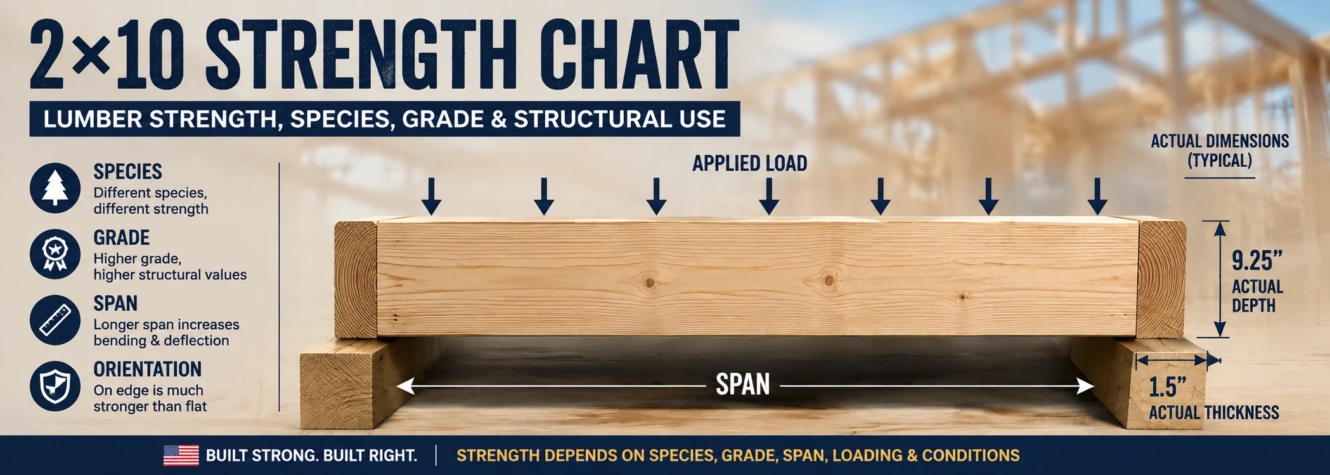
There is no single strength or weight-capacity number that applies to every 2×10. Its structural performance changes significantly depending on wood species, lumber grade, span, orientation, spacing, moisture conditions, loading, and support conditions.
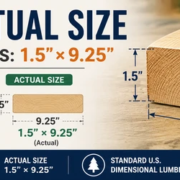
A standard modern surfaced 2×10 typically measures approximately 1.5 inches × 9.25 inches, but two boards with exactly the same dimensions can have different structural properties.
This guide explains 2×10 lumber strength, common species and grades, bending strength, stiffness, orientation, span effects, and the factors that determine how a 2×10 performs structurally.
Quick Answer: How Strong Is a 2×10?
A 2×10 can be a strong structural framing member, particularly when installed on edge, but its strength cannot be determined from its dimensions alone.
The most important factors are:
| Factor | Effect on 2×10 Performance |
|---|---|
| Species | Different species have different structural properties |
| Grade | Higher structural grades generally have better design values |
| Orientation | A 2×10 is much more effective in bending on edge than laid flat |
| Span | Longer spans generally increase bending stress and deflection |
| Spacing | Changes the tributary load carried by each member |
| Load type | Uniform and concentrated loads affect members differently |
| Moisture | Service conditions can affect allowable design values |
| Duration of load | Some wood design values depend on how long loads act |
| Connections | Fasteners and bearing can control an assembly |
| Lateral support | Helps prevent instability and unwanted movement |
Therefore, a proper 2×10 strength chart must consider more than the board size.
2×10 Actual Dimensions
A standard 2×10 is a nominal lumber size.
Its nominal dimensions are:
2″ × 10″
Its typical modern surfaced dimensions are approximately:
1.5″ × 9.25″
Or approximately:
38 × 235 mm
| Lumber Size | Nominal Dimensions | Typical Actual Dimensions |
|---|---|---|
| 2×10 | 2″ × 10″ | 1.5″ × 9.25″ |
The difference between nominal and actual dimensions is important in structural calculations because bending, stiffness, bearing, and connection geometry depend on the member’s actual dimensions.
2×10 Strength Chart by Species
The term 2×10 describes the lumber’s nominal size, not its species or structural grade.
Different species have different mechanical properties.
The following chart provides a useful general comparison of common structural lumber species groups. It should not be treated as a project-specific allowable-load chart.
| Species / Species Group | General Structural Character | Common Framing Applications |
|---|---|---|
| Douglas Fir-Larch | Relatively high strength and stiffness | Joists, rafters, beams, general framing |
| Southern Pine | Common structural lumber with strong design values in many grades | Floors, decks, roof framing, treated applications |
| Hem-Fir | Widely used structural framing group | Joists, rafters, walls and general framing |
| Spruce-Pine-Fir (SPF) | Common framing species group | Floors, walls, roofs and general framing |
The important point is that two No. 2 grade 2×10 boards from different species groups do not necessarily have identical design values.
Always identify both the species and grade when structural capacity matters.
2×10 Strength by Lumber Grade
Lumber grade is another major factor affecting structural performance.
Structural lumber is visually or mechanically evaluated for characteristics such as:
- knots
- slope of grain
- splits
- checks
- wane
- other strength-reducing characteristics
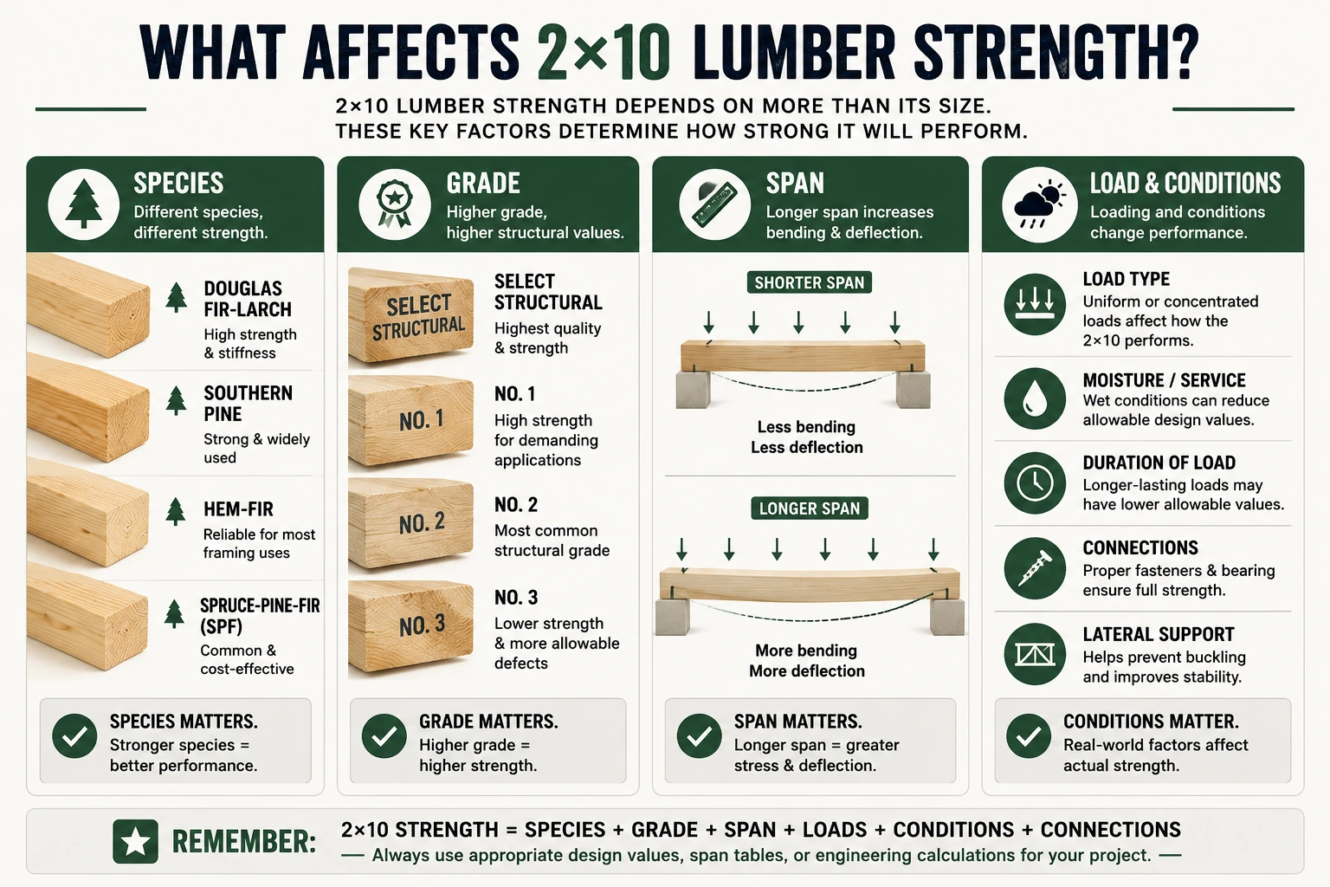
Common structural grades may include:
Select Structural
Generally associated with relatively high structural design values within a species and grading system.
No. 1
A structural grade commonly used where higher design values may be required.
No. 2
One of the most commonly encountered structural framing grades.
No. 3
May have lower allowable design values and greater permitted defects than higher grades.
A simplified relationship looks like this:
| Grade | Relative Structural Quality* |
|---|---|
| Select Structural | Higher |
| No. 1 | High |
| No. 2 | Common structural grade |
| No. 3 | Lower |
*This is a general comparison only. Actual design values must come from the applicable grading/species data.
A higher grade does not make the 2×10 physically larger.
Both boards may still measure:
1.5″ × 9.25″
What changes are the allowable structural properties associated with the lumber.
Understanding a 2×10 Grade Stamp
When structural lumber is graded, the board will commonly have a grade mark containing useful information.
Depending on the product and grading agency, it may identify:
- lumber species or species group
- structural grade
- grading agency
- mill identification
- moisture-related designation
This information is important when determining the structural properties of a 2×10.
Two pieces of lumber can look similar and have identical dimensions while carrying different design values.
What Determines the Strength of a 2×10?
Several properties and design conditions influence how a 2×10 performs.
The major ones include:
1. Bending Strength
When a 2×10 spans between supports and carries a transverse load, it experiences bending.
For example, a floor joist supporting a floor system bends under the applied dead and live loads.
The allowable bending performance depends partly on the lumber’s species and grade.
2. Stiffness
Strength and stiffness are related concepts, but they are not the same.
A member might theoretically resist a particular load without reaching its allowable bending limit while still deflecting too much for acceptable service performance.
Wood stiffness is commonly represented by the modulus of elasticity (E).
Greater stiffness generally means less deflection under otherwise comparable conditions.
For floors, stiffness can be particularly important because excessive deflection can contribute to:
- noticeable floor movement
- vibration
- finish problems
- poor serviceability
Therefore, structural design must consider both strength and deflection.
3. Shear
A loaded joist or beam also develops shear forces.
Shear can become particularly important near supports and in certain short-span or heavily loaded configurations.
A board should therefore not be evaluated using bending alone.
4. Bearing
The ends of joists, beams, and headers transfer loads into their supports.
Adequate bearing area is required so that the wood at the support is not overstressed.
This means a structurally adequate 2×10 must have more than sufficient bending strength—it also needs appropriate support and bearing conditions.
Why Orientation Changes 2×10 Strength
Orientation has a major effect on the bending performance of rectangular lumber.
A 2×10 can be positioned either on edge or laid flat.
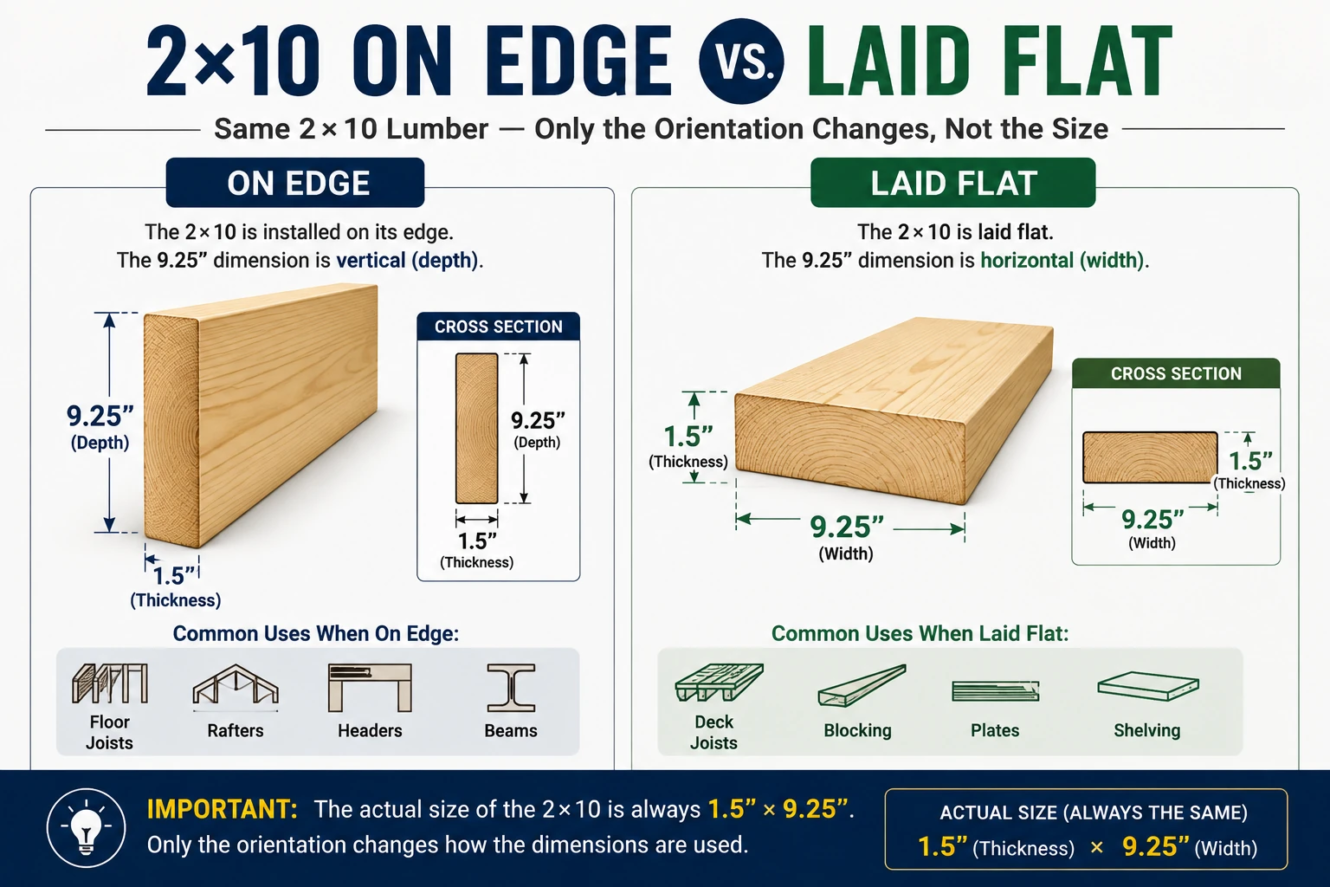
The actual dimensions remain approximately:
1.5″ × 9.25″
Only the orientation changes.
2×10 On Edge
When installed on edge:
- horizontal thickness ≈ 1.5″
- vertical depth ≈ 9.25″
This is the typical orientation for joists, rafters, and many beam-type applications.
The large vertical depth gives the member much greater resistance to bending.
2×10 Laid Flat
When laid flat:
- horizontal width ≈ 9.25″
- vertical depth ≈ 1.5″
Although the board contains the same amount of wood, its bending performance about the relevant axis is dramatically different.
Why Depth Matters So Much
For a rectangular section, bending behavior is strongly influenced by the member’s depth.
For a rectangle, the section modulus about its strong axis is:
S = bd² / 6
where:
- S = section modulus
- b = width
- d = depth
The second moment of area used in deflection calculations is:
I = bd³ / 12
where:
- I = second moment of area
- b = width
- d = depth
Notice that depth is squared in the section modulus and cubed in the second moment of area.
That is why changing a 2×10 from a 9.25-inch vertical depth to only a 1.5-inch vertical depth has such a dramatic effect.
2×10 On Edge vs Flat: Section Properties
Using typical actual dimensions of 1.5″ × 9.25″, we can compare the geometric section properties.
On Edge
Approximate section modulus:
S ≈ 21.39 in³
Approximate second moment of area:
I ≈ 98.94 in⁴
Laid Flat
Approximate section modulus:
S ≈ 3.47 in³
Approximate second moment of area:
I ≈ 2.60 in⁴
Approximate comparison:
| Orientation | Vertical Depth | Section Modulus | Moment of Inertia |
|---|---|---|---|
| On edge | 9.25″ | ≈ 21.39 in³ | ≈ 98.94 in⁴ |
| Laid flat | 1.5″ | ≈ 3.47 in³ | ≈ 2.60 in⁴ |
This geometric comparison helps explain why dimensional lumber intended to resist vertical bending loads is normally installed on edge.
These numbers describe cross-sectional geometry only; they are not allowable load capacities.
How Span Affects 2×10 Strength
Span is one of the most important variables when evaluating a 2×10.
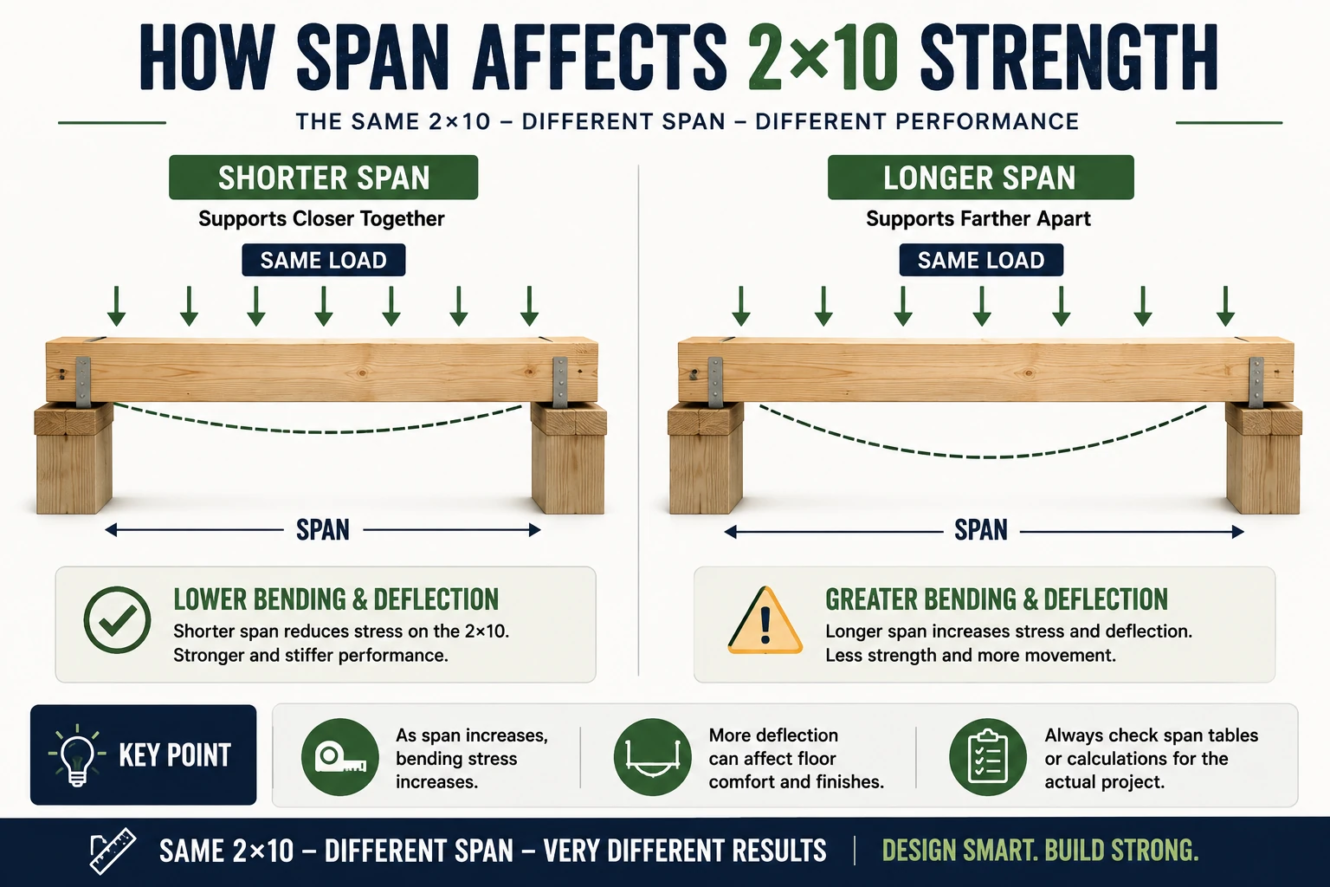
A board spanning a short distance can behave very differently from the same board spanning a much longer distance.
As span increases:
- bending demand generally increases
- deflection generally increases
- vibration can become more noticeable
- allowable loading may decrease
Therefore, asking:
“How strong is a 2×10?”
without specifying span does not provide enough information for a structural answer.
How Spacing Affects 2×10 Floor Joists
When 2×10 lumber is used as repetitive floor framing, joist spacing affects how much floor area contributes load to each joist.
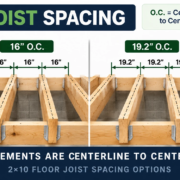
Common layouts include:
- 12″ O.C.
- 16″ O.C.
- 19.2″ O.C.
- 24″ O.C.
O.C. means on center, measured from the centerline of one joist to the centerline of the next.
Under otherwise comparable floor loading, closer joist spacing generally means each individual joist supports a narrower tributary width.
For example, a joist at 12″ O.C. supports a narrower strip of floor than a joist at 24″ O.C.
However, spacing is only one factor. Span, species, grade, loading, subfloor requirements, and deflection criteria must also be considered.
Uniform Loads vs Concentrated Loads
The type of load also matters.
Uniform Load
A uniform load is distributed along the member.
Examples may include portions of:
- floor dead load
- distributed floor live load
- roof loading
Concentrated Load
A concentrated load acts over a relatively small area or at a specific location.
Examples can include certain:
- posts
- equipment
- point reactions
- other localized loads
A 2×10 does not respond identically to a uniformly distributed load and a concentrated load.
This is one reason a simple statement such as “a 2×10 holds X pounds” can be misleading.
Dead Load vs Live Load
Structural framing commonly supports different categories of loads.
Dead Load
Dead load generally includes the permanent weight of the construction itself, such as:
- framing
- subfloor
- ceilings
- roofing
- permanent finishes
Live Load
Live load represents loads that can change over time, such as occupancy-related loading.
A floor joist must be evaluated for the applicable combination of loads rather than only one arbitrary weight.
How Moisture Affects 2×10 Lumber
Wood is affected by moisture.
Changes in moisture content can contribute to:
- shrinkage
- swelling
- checking
- twisting
- cupping
- dimensional movement
Structural design values can also require adjustments for certain service conditions.
This is particularly important when comparing lumber used in protected interior framing with lumber used in exterior or wet-service environments.
Pressure-Treated 2×10 Strength
A common misconception is that pressure-treated lumber is automatically stronger than untreated lumber.
That is not necessarily true.
Pressure treatment is primarily intended to improve resistance to biological deterioration such as decay and insect attack.
Structural performance still depends on factors such as:
- species
- grade
- treatment condition
- moisture/service condition
- applicable design-value adjustments
Therefore, “pressure treated” should not be treated as a structural grade.
Knots and Other Lumber Defects
Wood is a natural material, so individual boards can contain characteristics such as:
- knots
- checks
- splits
- wane
- grain deviations
These characteristics can influence structural performance.
That is one reason structural lumber grading exists.
A board with significant strength-reducing characteristics may receive a different grade than a visually cleaner board.
For structural work, the grade mark is more meaningful than simply choosing the board that looks strongest.
2×10 Strength vs 2×8
A standard surfaced 2×8 typically measures approximately:
1.5″ × 7.25″
A 2×10 typically measures:
1.5″ × 9.25″
Under otherwise identical material and loading conditions, the additional depth of the 2×10 provides a substantial geometric advantage in bending and stiffness.
| Lumber | Actual Thickness | Actual Depth |
|---|---|---|
| 2×8 | 1.5″ | 7.25″ |
| 2×10 | 1.5″ | 9.25″ |
However, it is not correct to assume that every 2×10 is stronger than every 2×8 without considering species and grade.
For example, comparing different species or grades can change the material properties involved.
2×10 Strength vs 2×12
A standard surfaced 2×12 typically measures approximately:
1.5″ × 11.25″
Compared with a 2×10:
| Lumber | Actual Thickness | Actual Depth |
|---|---|---|
| 2×10 | 1.5″ | 9.25″ |
| 2×12 | 1.5″ | 11.25″ |
The deeper 2×12 has a geometric advantage in bending when other conditions are comparable.
But again, member selection should be based on the required structural design rather than size alone.
Can a 2×10 Be Used as a Floor Joist?
Yes. 2×10 lumber is commonly used for floor joists when the selected species, grade, spacing, span, loads, and deflection requirements permit it.
However, there is no universal floor-joist span simply because the board is a 2×10.
A floor system must consider:
- joist span
- joist spacing
- lumber species
- grade
- live load
- dead load
- deflection
- bearing
- connections
- subfloor requirements
Applicable span tables or structural calculations should be used for the actual project.
Can a 2×10 Be Used as a Beam?
A 2×10 may be used as part of certain beam or girder configurations when properly designed.
Multiple 2×10 boards may also be connected to form a built-up beam.
For example:
- double 2×10
- triple 2×10
- other engineered configurations
But simply fastening several boards together does not automatically produce a beam with a known capacity.
Built-up beams require consideration of:
- number of plies
- species
- grade
- span
- loading
- fastening
- bearing
- lateral stability
The complete assembly must be designed for its intended load path.
Can a 2×10 Be Used as a Header?
Yes, 2×10 lumber can be incorporated into built-up headers in appropriate applications.
However, header capacity depends on much more than the depth of the lumber.
Important variables include:
- opening width
- loads above
- building width
- number of floors
- roof loads
- species
- grade
- number of plies
- bearing
- fastening
A double 2×10 should therefore not automatically be assumed to work for every opening.
Can You Drill or Notch a 2×10?
Holes and notches remove material from the member and can affect its structural performance.
Their impact depends on:
- size
- location
- member function
- applicable framing requirements
A hole or notch near a highly stressed region can be more significant than one in a permitted location.
Never assume that a hole or notch is acceptable simply because substantial wood remains around it.
For structural framing, follow the applicable requirements for drilling and notching.
2×10 Strength and Deflection
A useful structural distinction is:
Strength asks whether the member can safely resist the required forces.
Deflection asks how much the member bends under load.
A floor joist may satisfy a strength requirement but still be too flexible for the intended serviceability criteria.
This can result in:
- noticeable movement
- vibration
- finish cracking
- undesirable floor performance
Therefore, both strength and stiffness should be checked when selecting floor framing.
2×10 Strength vs Load Capacity
These two terms are related but should not be treated as identical.
Lumber strength refers to material and structural properties such as bending, shear, compression, and stiffness.
Load capacity describes how much load a specific member or assembly can safely support under defined conditions.
To determine the load capacity of a particular 2×10, you need information such as:
- span
- species
- grade
- orientation
- support conditions
- load location
- load distribution
- duration
- moisture/service conditions
- applicable design criteria
This is why a universal “2×10 holds X pounds” answer is not technically reliable.
Frequently Asked Questions
How strong is a 2×10?
A 2×10 can provide substantial structural strength when properly selected and installed, but there is no universal strength value. Species, grade, span, orientation, spacing, loading, and service conditions all affect performance.
Is a 2×10 strong enough for floor joists?
A 2×10 can be used for floor joists when its species, grade, spacing, span, loads, and deflection requirements satisfy the applicable design criteria.
Is a 2×10 stronger on edge or flat?
For typical vertical bending applications, a 2×10 is dramatically more effective when installed on edge, with its approximately 9.25-inch dimension vertical.
Does lumber species affect 2×10 strength?
Yes. Different species and species groups have different structural design values. Species should be considered together with lumber grade.
Does lumber grade affect 2×10 strength?
Yes. Grade accounts for characteristics that influence structural performance, and different grades can have different allowable design values.
Is a No. 1 2×10 stronger than a No. 2 2×10?
Within the same species and applicable grading system, No. 1 will generally have higher design values for certain properties than No. 2. Actual design values should still be checked for the specific lumber.
Is pressure-treated 2×10 stronger?
Not necessarily. Pressure treatment primarily provides protection against decay and insects. Structural strength still depends on species, grade, service conditions, and applicable adjustment factors.
How much weight can a 2×10 hold?
There is no universal pound value. The answer depends on span, species, grade, orientation, support conditions, loading pattern, connections, and other factors.
Is a 2×10 stronger than a 2×8?
Under otherwise comparable conditions, the deeper 2×10 has a significant geometric advantage in bending and stiffness. But species, grade, span, and other conditions must still be considered.
Is a 2×12 stronger than a 2×10?
Under otherwise identical material and loading conditions, the greater depth of a 2×12 generally provides greater bending strength and stiffness. The actual design comparison still depends on the complete structural conditions.
Final Takeaway
A 2×10 can be a strong and versatile structural framing member, but the words “2×10” alone do not establish its strength.
A typical modern surfaced 2×10 measures approximately 1.5″ × 9.25″, but structural performance depends heavily on:
- species
- lumber grade
- span
- orientation
- spacing
- load type
- moisture conditions
- bearing
- connections
- deflection requirements
One of the most important concepts is orientation: a 2×10 installed on edge uses its 9.25-inch depth efficiently for bending, while the same board laid flat has dramatically different structural behavior.
For an actual building project, use the appropriate lumber design values, span tables, manufacturer information, applicable building requirements, or structural engineering calculations rather than relying on a universal strength or pound-capacity number.