
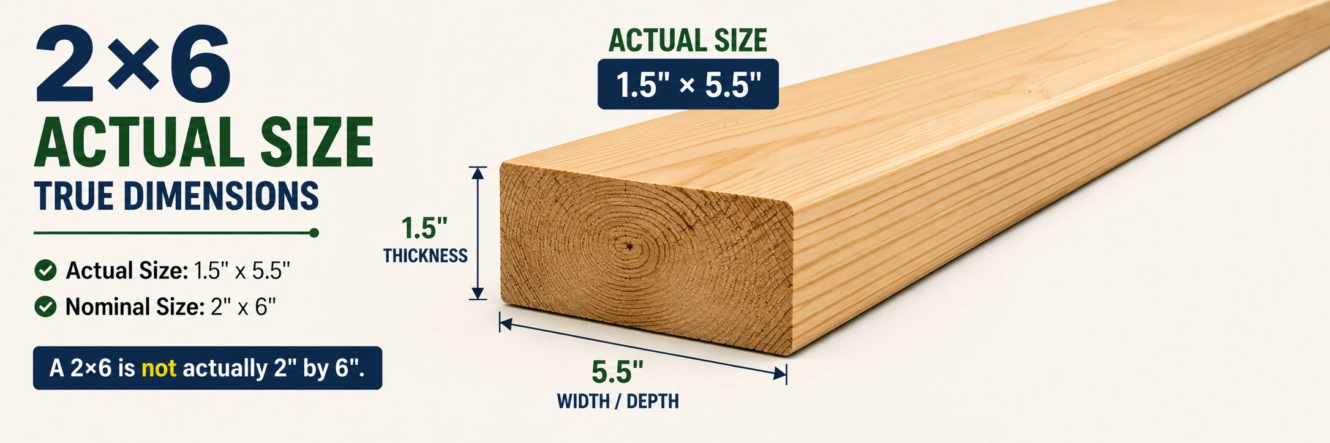
What Are the True Dimensions of a 2×6? Actual Size, Width & Thickness
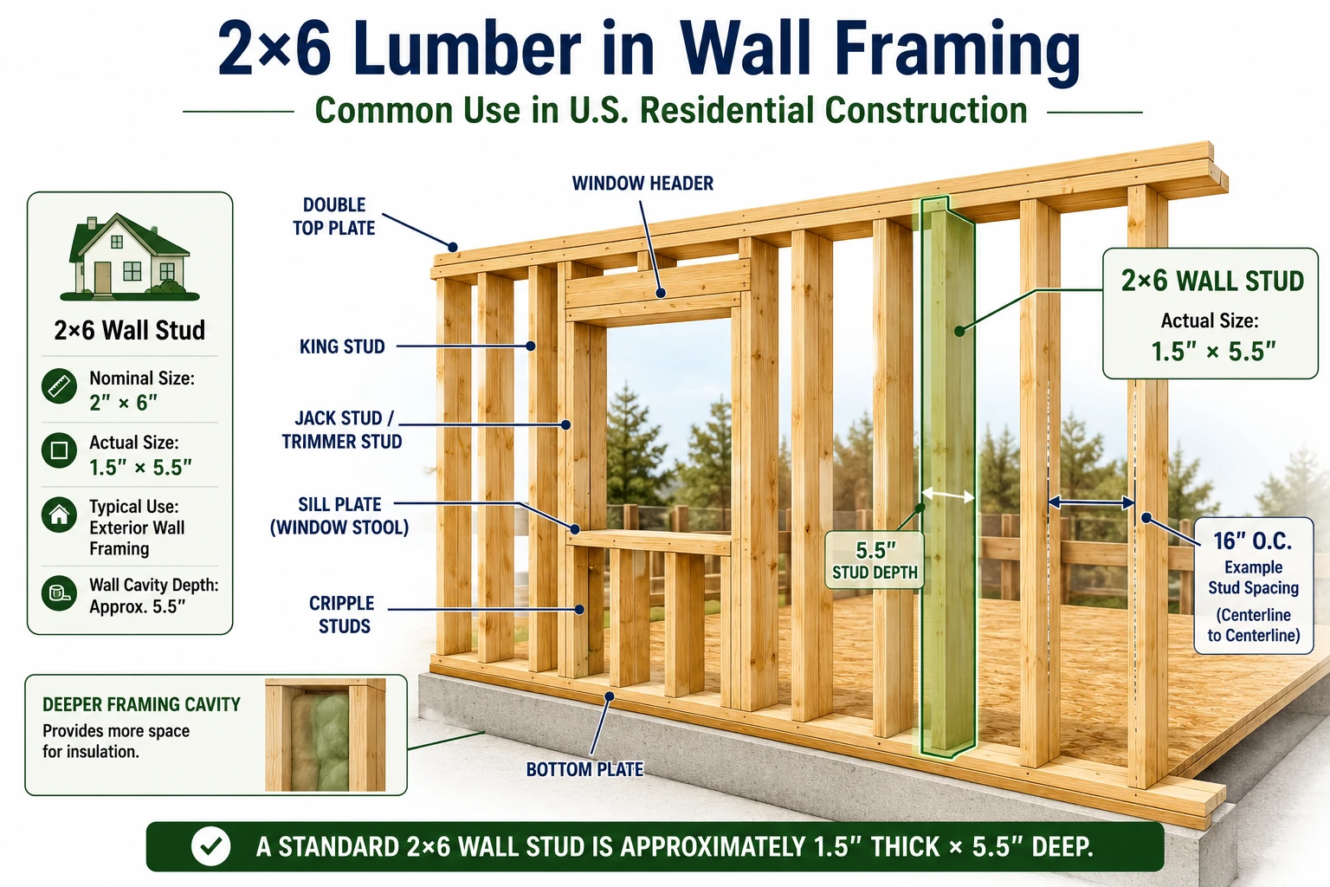
A 2×6 does not actually measure 2 inches by 6 inches. In modern U.S. construction, a standard surfaced 2×6 typically measures approximately 1.5 inches thick by 5.5 inches wide.
The term 2×6 describes the board’s nominal size, not its final finished dimensions.
This difference is important when framing walls, calculating clearances, planning floor or roof systems, estimating lumber quantities, and preparing construction drawings.
Quick Answer: What Is the Actual Size of a 2×6?
The standard dimensions commonly used for modern surfaced 2×6 dimensional lumber are:
| Measurement | 2×6 Dimension |
|---|---|
| Nominal size | 2″ × 6″ |
| Actual thickness | 1.5″ |
| Actual width/depth | 5.5″ |
| Actual size | 1.5″ × 5.5″ |
| Approx. metric size | 38 × 140 mm |
| Cross-sectional area | 8.25 sq. in. |
So, if you measure a typical 2×6 purchased from a lumber supplier in the United States, you should normally expect it to be about:
1.5 inches × 5.5 inches
rather than exactly 2 inches × 6 inches.
Why Is a 2×6 Not Actually 2 Inches by 6 Inches?
This is one of the most common questions people have when they first work with dimensional lumber.
The answer is the difference between nominal dimensions and actual dimensions.
The name 2×6 originates from the lumber’s nominal dimensions. During lumber production, the board is processed and surfaced to produce more consistent dimensions and smoother faces.
After this processing, its finished dimensions are smaller than the dimensions suggested by its name.
Therefore:
2″ × 6″ nominal → approximately 1.5″ × 5.5″ actual
This does not mean the lumber is incorrectly sized. It is the normal dimensional convention used for modern surfaced lumber.
Nominal Size vs Actual Size of a 2×6
Understanding the difference between nominal and actual dimensions is particularly important when reading construction plans or buying lumber.
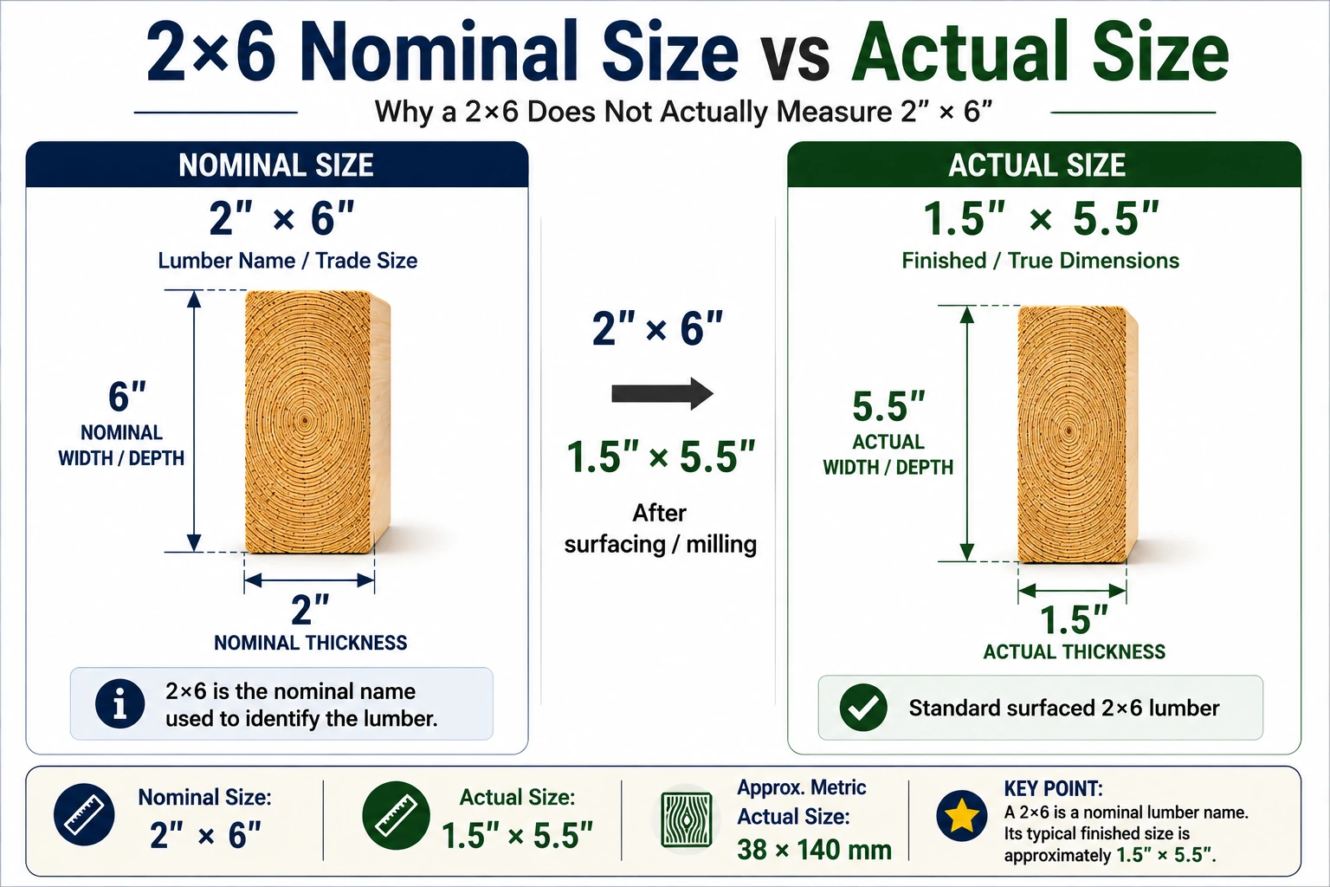
Nominal size
The nominal size is the standard name used to identify the lumber.
For this board:
Nominal size = 2″ × 6″
You ask for a “2×6” at a lumber supplier even though its finished dimensions are smaller.
Actual size
The actual size represents the approximate finished dimensions of the surfaced board.
For a typical modern 2×6:
Actual size = 1.5″ × 5.5″
The difference can affect construction calculations, especially when several framing members are placed together.
What Are the True Dimensions of a 2×6?
When someone asks for the true dimensions of a 2×6, they are normally asking for its finished or actual dimensions.
For standard modern surfaced dimensional lumber:
True 2×6 dimensions = approximately 1.5″ × 5.5″
The word “true” is not a separate lumber-sizing standard. It is simply another way homeowners, DIYers, builders, and online searchers commonly describe the actual finished dimensions.
The same applies to terms such as:
- real dimensions of a 2×6
- actual dimensions of a 2×6
- true size of a 2×6
- real size of a 2×6
- actual measurement of a 2×6
In normal modern construction, these questions generally refer to the same finished dimensions.
How Wide Is a 2×6 Actually?
A standard surfaced 2×6 is typically:
5.5 inches wide/deep
Its other dimension is approximately:
1.5 inches thick
Therefore, when the board is installed on edge, its deeper dimension is approximately 5.5 inches.
When it is used as a wall stud, for example, this depth contributes to the overall depth of the wall framing.
It is important not to assume that the “6” in 2×6 means the finished board will be exactly 6 inches wide.
How Thick Is a 2×6?
A standard modern surfaced 2×6 is approximately:
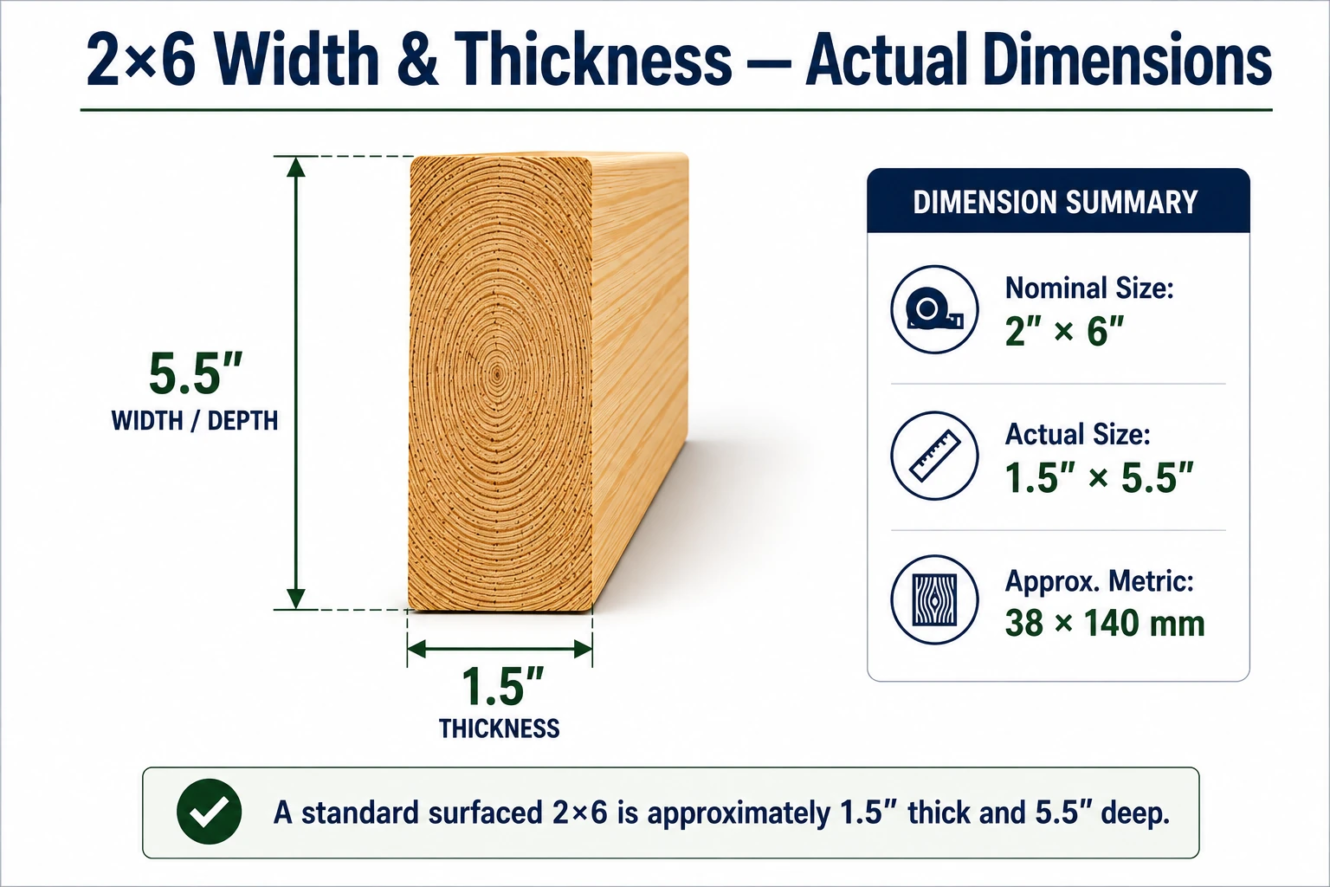
1.5 inches thick
This is the dimension represented nominally by the “2” in 2×6.
Therefore:
Nominal thickness: 2 inches
Actual thickness: approximately 1.5 inches
That half-inch difference can become significant when multiple framing members are assembled together.
For example, two standard 2×6 members placed face-to-face have a combined nominal description that might suggest 4 inches, but their typical actual combined thickness is approximately:
1.5″ + 1.5″ = 3 inches
Three members placed together would be approximately:
1.5″ × 3 = 4.5 inches
Always use actual dimensions when precise finished measurements matter.
2×6 Dimensions in Millimeters
A typical 2×6 measuring 1.5″ × 5.5″ converts approximately to:
38.1 mm × 139.7 mm
For practical construction references, this is often rounded to approximately:
38 mm × 140 mm
However, a metric lumber product labeled according to a different sizing system should not automatically be assumed to have exactly the same dimensions as a U.S. nominal 2×6.
Always verify the actual dimensions of the material being purchased.
2×6 Dimensions in Centimeters
The typical actual dimensions can also be expressed as approximately:
3.81 cm × 13.97 cm
or approximately:
3.8 cm × 14 cm
Again, the commonly recognized U.S. lumber designation remains 2×6, even though those nominal dimensions are not its exact finished measurements.
2×6 Actual Size Compared With Other Common Lumber Sizes
The same nominal-versus-actual principle applies to many commonly used dimensional lumber sizes.
| Nominal Lumber Size | Typical Actual Size |
|---|---|
| 2×4 | 1.5″ × 3.5″ |
| 2×6 | 1.5″ × 5.5″ |
| 2×8 | 1.5″ × 7.25″ |
| 2×10 | 1.5″ × 9.25″ |
| 2×12 | 1.5″ × 11.25″ |
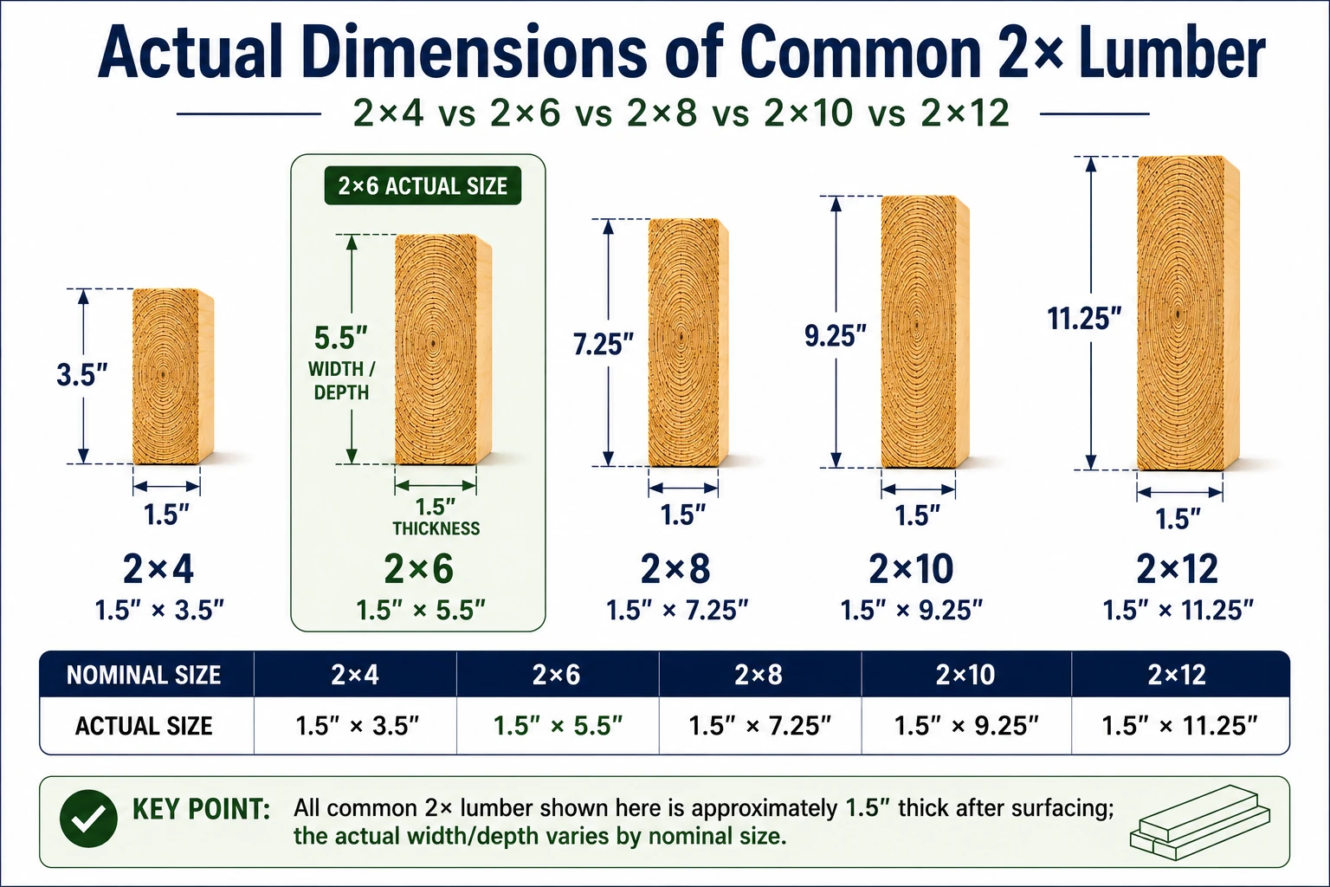
Notice that the thickness of these common “2-by” boards is typically approximately 1.5 inches.
The finished depth changes according to the nominal lumber size.
This is why construction drawings, framing calculations, clearances, and material layouts should be based on the appropriate actual dimensions rather than simply treating the nominal numbers as exact measurements.
Is a 2×6 Really 5.5 Inches Wide?
For a typical modern surfaced 2×6 used in U.S. construction, yes—the finished width/depth is approximately 5.5 inches.
That means:
2×6 nominal = approximately 1.5″ × 5.5″ actual
However, dimensions can vary somewhat depending on the product, manufacturing condition, moisture content, age, and type of lumber.
For precise construction work, physically measure the lumber or verify the manufacturer’s specifications rather than assuming every product will be identical.
Does Every 2×6 Have Exactly the Same Dimensions?
Not necessarily.
The 1.5″ × 5.5″ measurement is the typical finished size associated with standard modern surfaced 2×6 dimensional lumber.
However, actual measurements can vary.
Several factors can affect the dimensions or condition of a board.
Moisture
Wood can change dimensions as its moisture content changes.
Wet lumber may shrink as it dries.
Manufacturing tolerances
Finished lumber dimensions can have permitted manufacturing variations rather than every board measuring to an infinitely precise dimension.
Older lumber
Lumber from older buildings may not always match the dimensions of modern dimensional lumber.
If you are renovating or repairing an older structure, measure the existing framing before assuming it matches a modern 2×6.
Rough-sawn lumber
Rough lumber and other specially manufactured products may have dimensions different from standard surfaced dimensional lumber.
Specialty products
Engineered, specialty, appearance-grade, or other lumber products should be checked according to their actual manufacturer specifications.
For ordinary construction planning, however, 1.5″ × 5.5″ is the important reference dimension for a modern surfaced 2×6.
Common Uses of 2×6 Lumber
A 2×6 is widely used in residential and light-frame construction.
Depending on the design, species, grade, loading, spacing, and other requirements, 2×6 lumber may be used for applications such as:
Wall Framing
2×6 studs are commonly associated with deeper wall framing than 2×4 studs.
The approximately 5.5-inch framing depth provides additional cavity depth, which can be useful when the wall design requires more space for insulation or other components.
Floor Framing
2×6 lumber may be used as floor joists in appropriate applications, but its allowable span cannot be determined from its dimensions alone.
Roof Framing
A 2×6 may also be used as a roof rafter depending on the structural requirements.
Deck Construction
2×6 lumber can appear in deck framing and decking applications depending on the design and product.
Exterior applications may require appropriately treated or naturally durable lumber.
Blocking and Framing Components
Short sections of 2×6 lumber are frequently useful for blocking and other framing details.
The suitability of a 2×6 for a structural application should never be determined from dimensions alone.
Actual Size Does Not Tell You 2×6 Strength
One important distinction is that size and strength are not the same thing.
Knowing that a 2×6 measures approximately 1.5″ × 5.5″ does not tell you exactly how much weight it can safely support.
Structural performance can depend on factors including:
- lumber species
- lumber grade
- span
- spacing
- member orientation
- moisture/service conditions
- type and location of load
- support conditions
- connections
- deflection requirements
- applicable construction requirements
Two boards with the same physical dimensions can have different allowable structural properties.
Therefore, do not use the actual dimensions alone to determine allowable loads or spans.
Does the Length Change the Cross-Sectional Size of a 2×6?
Normally, the nominal length does not change the standard cross-sectional dimensions.
For example, standard surfaced boards sold as:
2×6×8
2×6×10
2×6×12
2×6×16
may all have approximately the same cross section:
1.5″ × 5.5″
The final number identifies the board’s nominal length, while 2×6 identifies its nominal cross-sectional size.
The actual supplied length and product specifications should still be verified when precise dimensions are required.
How Much Area Is in the Cross Section of a 2×6?
Using the typical actual dimensions:
1.5″ × 5.5″
the approximate cross-sectional area is:
8.25 square inches
This should not be confused with the nominal cross-sectional area.
If someone incorrectly calculated using 2″ × 6″, they would obtain:
12 square inches
That would substantially overstate the physical cross-sectional area of a typical finished 2×6.
This is another reason actual dimensions matter in construction calculations.
Why Actual 2×6 Dimensions Matter in Construction
The difference between nominal and actual dimensions may appear small, but it can affect real construction work.
Wall thickness
A 2×6 wall framing member provides approximately 5.5 inches of framing depth, not 6 inches.
Wall finishes and other layers must be considered separately when determining the complete wall thickness.
Openings and clearances
Actual lumber dimensions matter when determining available clear space around framing.
Construction drawings
Design drawings may identify lumber by its conventional nominal designation, while detailed dimensions and calculations account for the actual properties of the members.
Material takeoffs
Quantity calculations sometimes require actual dimensions rather than nominal labels.
Renovation work
Existing framing should be measured before replacement material is selected, particularly in older buildings.
Common Mistakes With 2×6 Dimensions
A few misunderstandings appear repeatedly when working with dimensional lumber.
Assuming a 2×6 measures exactly 2″ × 6″
For typical modern surfaced dimensional lumber, it does not.
Expect approximately:
1.5″ × 5.5″
Confusing nominal and actual dimensions
2×6 is the nominal designation.
1.5″ × 5.5″ represents the typical actual finished dimensions.
Assuming every piece of lumber is perfectly identical
Wood is a natural material, and product conditions and manufacturing tolerances can matter.
Measure the actual material where precision is important.
Using board size to determine structural capacity
Actual dimensions are only one factor in structural performance.
Species, grade, span, spacing, loads, support conditions, and other factors also matter.
Assuming a longer 2×6 can span its full length
Board length and allowable structural span are different concepts.
A 16-foot-long 2×6 does not automatically mean it can safely span 16 feet as a joist, rafter, or beam.
2×6 Actual Size FAQ
What are the actual dimensions of a 2×6?
A typical modern surfaced 2×6 used in U.S. construction measures approximately 1.5 inches × 5.5 inches.
What are the true dimensions of a 2×6?
The term “true dimensions” generally refers to the finished dimensions. A typical surfaced 2×6 is approximately 1.5″ thick × 5.5″ wide.
What is the real size of a 2×6?
The typical real or actual size is approximately 1.5″ × 5.5″.
Why isn’t a 2×6 actually 2 inches by 6 inches?
The 2×6 designation is a nominal lumber size. Processing and surfacing produce smaller finished dimensions, resulting in a typical modern actual size of approximately 1.5″ × 5.5″.
How wide is a 2×6 actually?
A standard surfaced 2×6 is typically approximately 5.5 inches wide/deep.
How thick is a 2×6?
A typical 2×6 is approximately 1.5 inches thick.
What is the nominal size of a 2×6?
Its nominal dimensions are 2 inches × 6 inches. These dimensions are used as the conventional lumber designation rather than representing its exact finished measurements.
What is a 2×6 in millimeters?
The typical actual dimensions of 1.5″ × 5.5″ are approximately 38.1 × 139.7 mm, commonly rounded to about 38 × 140 mm for reference.
What is a 2×6 in centimeters?
A typical 2×6 measures approximately 3.81 × 13.97 cm, or roughly 3.8 × 14 cm.
Is a 2×6 5.5 inches or 6 inches wide?
A typical modern surfaced 2×6 is approximately 5.5 inches wide/deep. The 6-inch measurement belongs to its nominal designation.
Are old 2×6 boards actually 2 inches by 6 inches?
Older lumber can differ from modern standard surfaced lumber, so existing boards in an older building should be physically measured rather than assumed to be 1.5″ × 5.5″ or exactly 2″ × 6″.
Is rough-sawn 2×6 the same size as a standard 2×6?
Not necessarily. Rough-sawn and specialty lumber can have different finished dimensions. Verify the specific product before using standard dimensional-lumber measurements.
Does a 2×6×8 measure 2 inches by 6 inches by 8 feet?
The “2×6” portion is nominal. A typical surfaced 2×6×8 has a cross section of approximately 1.5″ × 5.5″. Verify the supplied length and product specifications when exact dimensions matter.
Is a 2×6 stronger than a 2×4?
A 2×6 has a greater cross-sectional depth than a 2×4, but structural capacity cannot be determined from nominal size alone. Species, grade, span, orientation, loading, spacing, and other design conditions must also be considered.
Can a 2×6 be used as a floor joist?
Yes, 2×6 lumber may be used as a floor joist in appropriate designs. Whether it is suitable depends on the span, spacing, species, grade, loads, deflection criteria, and applicable requirements.
Final Answer: What Size Is a 2×6 Really?
For standard modern surfaced dimensional lumber commonly used in U.S. construction:
Nominal size: 2″ × 6″
Typical actual size: 1.5″ × 5.5″
That means a 2×6 is typically about 1.5 inches thick and 5.5 inches wide/deep, or approximately 38 × 140 mm.
The distinction between nominal and actual dimensions is important. Use the nominal designation when identifying and purchasing standard lumber, but use the appropriate actual dimensions when precise measurements, clearances, layouts, or calculations are required.
For structural applications, dimensions alone are not enough. The lumber’s species, grade, span, spacing, loading, orientation, support conditions, and applicable construction requirements should also be considered.



Leave a Reply
Want to join the discussion?Feel free to contribute!