
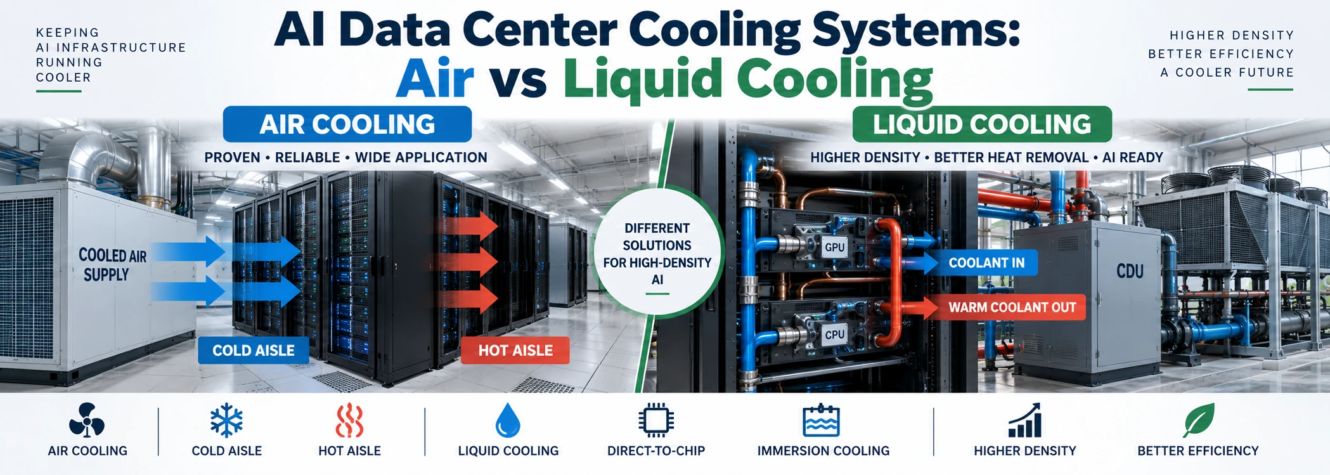
AI Data Center Cooling Systems: Air vs Liquid Cooling
AI data center cooling has become a critical part of modern data center design as high-density GPU servers generate large amounts of heat within increasingly compact rack footprints.
Traditional data centers have relied heavily on air cooling. However, as rack power density increases, moving enough heat away from processors using air alone can become more challenging. This is driving greater interest in liquid cooling technologies such as direct-to-chip cooling and immersion cooling.
The right cooling strategy depends on much more than whether a facility runs AI workloads.
Engineers must evaluate:
- Rack power density
- Server configuration
- Heat output
- Supply temperatures
- Cooling capacity
- Water availability
- Climate
- Redundancy requirements
- Facility layout
- Energy efficiency
- Future rack densities
This guide explains how AI data center cooling works, compares air cooling with liquid cooling, and examines the major systems used to control heat in high-density AI facilities.
Why Do AI Data Centers Need Advanced Cooling?
Nearly all electrical energy consumed by computing equipment eventually becomes heat that must be removed from the data hall.
As more computing power is concentrated into a rack, heat generation becomes more concentrated as well.
For example, a room containing many relatively low-density racks distributes its heat across a larger physical area.
A high-density AI environment can place much greater heat loads into individual rack footprints.
That affects:
- Airflow requirements
- Cooling equipment capacity
- Coolant distribution
- Pipe sizing
- Data hall layout
- Heat rejection
- Electrical demand
- Mechanical redundancy
Cooling therefore cannot be treated as an independent system added after server layouts are finalized.
It must be coordinated with the planned IT load and rack density.
For a detailed explanation of MW capacity and rack-level electrical demand, see:
AI data center power requirementsHow Does Data Center Cooling Work?
A data center cooling system performs one fundamental task:
Move heat from IT equipment to an environment where it can be safely rejected.
A simplified heat path may look like:
Processor → Server → Air or Liquid → Cooling System → Heat Rejection Equipment → Outdoor Environment
The exact path depends on the cooling architecture.
With conventional air cooling, heat moves primarily into the air surrounding the servers.
With direct liquid cooling, coolant can capture heat much closer to the processors.
In immersion systems, electronic components may be placed directly into a specially designed dielectric fluid.
Regardless of technology, heat must eventually leave the facility.
Major Types of AI Data Center Cooling
AI data centers can use several cooling approaches.
The main categories include:
- Air cooling
- Direct-to-chip liquid cooling
- Rear-door heat exchangers
- Immersion cooling
- Hybrid air-and-liquid cooling
There is no universally best system.
Each approach has different requirements, advantages, limitations, and applications.
1. Air Cooling
Air cooling is the traditional approach used throughout much of the data center industry.
Servers use internal fans to move air across heat-producing components.
The heated air then leaves the server and is collected by the room cooling system.
A simplified path is:
Cool Air → Server Intake → Electronic Components → Hot Exhaust Air → Cooling Unit
The cooling system removes heat from the air and returns conditioned air to the data hall.
Common Air-Cooling Equipment
Depending on facility design, air-cooled environments may use:
- Computer room air handlers
- Computer room air conditioners
- Chilled-water coils
- Direct-expansion equipment
- Fans
- Ductwork
- Raised floors
- Supply plenums
- Return-air plenums
- Economizers
The exact configuration varies considerably between facilities.
Hot-Aisle and Cold-Aisle Layout
One of the fundamental techniques used in air-cooled data centers is hot-aisle/cold-aisle arrangement.
Server racks are positioned so their fronts face one another in cold aisles.
Cool supply air enters the server fronts.
The server fans move that air through the equipment.
Hot exhaust leaves the rear of the racks into hot aisles.
This arrangement helps prevent hot exhaust air from immediately mixing with cold supply air.
Airflow Containment
Containment can improve airflow management further.
Two common approaches are:
Cold-Aisle Containment
The cold aisle is enclosed to reduce mixing between supply air and hot exhaust.
Hot-Aisle Containment
The hot exhaust aisle is enclosed and directed back toward the cooling system.
The goal in either case is to reduce unwanted air mixing.
Better airflow management can improve cooling effectiveness without necessarily increasing cooling equipment capacity.
Advantages of Air Cooling
Air cooling offers several practical advantages:
- Mature technology
- Widely understood
- Broad equipment compatibility
- Established maintenance practices
- No liquid delivered directly to processors
- Suitable for many conventional rack densities
Existing data centers are also more likely to have infrastructure originally designed around air cooling.
Limitations of Air Cooling for High-Density AI
Air has limited heat-carrying capacity compared with liquid.
As rack heat output rises, the amount of air that must be moved through the rack can become substantial.
This can create challenges such as:
- Higher airflow requirements
- Larger fan energy consumption
- Hot spots
- Air mixing
- Space requirements
- Increased mechanical infrastructure
For this reason, very high-density AI deployments can make liquid cooling attractive.
2. Direct-to-Chip Liquid Cooling
Direct-to-chip liquid cooling moves coolant close to the primary heat-producing components inside a server.
Cold plates are installed on components such as:
- GPUs
- CPUs
- Other high-heat processors
Coolant flows through passages within the cold plate and absorbs heat directly from the component.
A simplified heat path is:
GPU/CPU → Cold Plate → Coolant → CDU/Heat Exchanger → Facility Cooling Loop → Heat Rejection
This reduces the amount of heat that must first be transferred into the surrounding air.
Why Direct-to-Chip Cooling Works Well for AI
AI servers can contain multiple high-power accelerators inside a compact chassis.
Instead of relying entirely on airflow to remove that concentrated heat, cold plates intercept a substantial portion of it at the source.
This can help support higher rack densities.
However, direct-to-chip cooling does not necessarily eliminate air cooling completely.
Components that are not connected to the liquid loop may still reject heat into the server air.
This remaining heat is sometimes referred to as the residual air load.
As a result, many direct-liquid-cooled AI data halls use both liquid and air cooling.
Coolant Distribution Units (CDUs)
A Coolant Distribution Unit, commonly called a CDU, is an important component in many liquid-cooled data center systems.
Its role can include:
- Circulating coolant
- Controlling flow
- Managing pressure
- Monitoring temperatures
- Separating cooling loops through heat exchangers
- Providing system controls
Depending on the architecture, a CDU may serve:
- Individual racks
- Groups of racks
- Rows
- Larger portions of a data hall
CDU placement must be coordinated with rack layout, piping routes, service access, structural loading, and mechanical equipment space.
Primary and Secondary Cooling Loops
Liquid cooling systems may use multiple fluid loops.
A simplified architecture could include:
IT Cooling Loop → CDU → Facility Water Loop → Heat Rejection System
The IT-side coolant may circulate through server cold plates.
The facility-side loop then carries that captured heat toward chillers, cooling towers, dry coolers, or other heat-rejection equipment.
Separating loops can allow different:
- Fluid chemistry
- Temperatures
- Pressures
- Flow conditions
The exact configuration is project-specific.
3. Rear-Door Heat Exchangers
A rear-door heat exchanger is installed at the back of a server rack.
Hot server exhaust passes through the heat exchanger before entering the room.
Liquid flowing through the exchanger absorbs heat from that exhaust air.
This approach can reduce the heat released directly into the data hall.
Rear-door heat exchangers may be useful when:
- Rack density exceeds conventional room cooling capacity
- Direct-to-chip cooling is not available
- Existing facilities need additional localized cooling
- Server hardware remains primarily air cooled
They can provide a bridge between traditional air-cooled equipment and more liquid-intensive cooling architectures.
4. Immersion Cooling
Immersion cooling takes a fundamentally different approach.
Instead of cooling components using air or cold plates, servers or electronic components are immersed in a specially designed electrically non-conductive fluid.
This fluid is generally known as a dielectric fluid.
Heat transfers directly from the electronic components into the surrounding liquid.
There are two major immersion approaches:
- Single-phase immersion cooling
- Two-phase immersion cooling
Single-Phase Immersion Cooling
In a single-phase system, the cooling fluid remains liquid as it absorbs heat.
The heated fluid circulates toward a heat exchanger where the heat is removed.
The cooled fluid then returns to the equipment.
Two-Phase Immersion Cooling
In a two-phase system, the dielectric fluid can boil at a controlled temperature.
Heat from electronic components causes the fluid to vaporize.
The vapor then condenses on a cooled surface and returns to liquid form.
This uses the phase change of the fluid to transport heat.
Advantages of Immersion Cooling
Potential benefits can include:
- High heat-transfer capability
- Reduced dependence on server fans
- Support for high-density computing
- Compact thermal management
- Reduced airflow requirements
However, immersion cooling also changes how IT equipment is installed, serviced, and maintained.
It requires compatible hardware, fluids, tanks, maintenance procedures, and facility infrastructure.
Therefore, it should not simply be considered a drop-in replacement for conventional rack cooling.
5. Hybrid Cooling Systems
Many AI data centers may use a combination of cooling technologies rather than relying exclusively on air or liquid.
A hybrid facility might use:
- Direct-to-chip cooling for GPUs and CPUs
- Air cooling for remaining server components
- Chilled-water systems for facility cooling
- Dry coolers or cooling towers for heat rejection
Another facility could operate conventional air-cooled racks alongside newer liquid-cooled AI racks.
Hybrid strategies can be especially useful when facilities are being upgraded gradually.
Air Cooling vs. Liquid Cooling
The major difference is the medium used to capture and transport heat.
| Factor | Air Cooling | Liquid Cooling |
|---|---|---|
| Primary Cooling Medium | Air | Liquid coolant |
| Heat Capture | Through server airflow | Closer to heat-producing components |
| High-Density Capability | More constrained as heat density rises | Better suited to concentrated heat loads |
| Server Fans | Usually important | Can be reduced depending on design |
| Data Hall Airflow | Major design consideration | Often reduced but may still be required |
| Piping Near IT | Limited | Required in many designs |
| Leak Management | Less relevant to IT cooling | Important design consideration |
| Existing Facility Compatibility | Generally high | May require upgrades |
| AI Application | Suitable depending on density | Increasingly useful for high-density AI |
This table is a conceptual comparison.
Actual performance depends on the specific equipment and system design.
Is Liquid Cooling Better Than Air Cooling?
Not automatically.
The correct question is:
Which cooling architecture best matches the planned IT equipment and rack density?
Air cooling may remain entirely appropriate for lower-density equipment.
Liquid cooling becomes increasingly attractive when high heat density makes airflow difficult or inefficient.
Important decision factors include:
- Rack kW
- Hardware requirements
- Supply temperatures
- Facility infrastructure
- Water availability
- Climate
- Reliability targets
- Maintenance capability
- Future expansion
A mixed facility can also use both technologies.
Cooling Capacity and Rack Density
Cooling systems must ultimately match the heat generated by IT equipment.
At a simplified conceptual level:
Electrical IT Power → Heat Load
Therefore, increasing rack power generally increases the cooling load associated with that rack.
Suppose two racks operate at:
Rack A = 20 kW
Rack B = 100 kW
Rack B represents five times the IT power concentration within a similar rack footprint.
This does not mean every part of the cooling system is simply multiplied by five, but it illustrates why rack density is such an important thermal design variable.
Example: Data Hall Heat Load
Consider a hypothetical data hall containing:
- 200 racks
- Average IT load = 80 kW per rack
The total IT load is:
200 × 80 kW = 16,000 kW
or:
16 MW
Nearly all of that IT energy ultimately becomes heat that must be managed by the facility.
Therefore, the mechanical design must accommodate an enormous heat load while maintaining the required environmental conditions for the equipment.
This example demonstrates why high-density AI facilities require close coordination between electrical and mechanical engineers.
Cooling and PUE
Cooling systems contribute to the difference between IT energy consumption and total facility energy consumption.
Equipment such as the following can consume electricity:
- Fans
- Pumps
- Chillers
- Cooling towers
- Dry coolers
- CDU pumps
- Controls
More efficient heat removal can therefore contribute to better overall facility energy performance.
One common data center efficiency metric is Power Usage Effectiveness (PUE).
Detailed PUE calculations and their relationship with IT load are covered in:
AI data center power requirements and rack densityCooling Towers
Cooling towers reject heat by bringing water and air into contact so that some water evaporates.
Evaporation removes heat from the system.
Cooling towers can provide effective heat rejection, but they can also create significant water requirements.
Design considerations include:
- Local climate
- Water availability
- Water treatment
- Blowdown
- Plume
- Maintenance
- Water quality
Where water is constrained, developers may evaluate alternatives.
Dry Coolers
Dry coolers reject heat primarily through air without relying on evaporative water consumption in the same way as a cooling tower.
They use heat exchanger coils and fans to transfer heat to outdoor air.
Potential advantages include lower direct water consumption.
However, their performance depends strongly on outdoor temperature and the required fluid temperature.
In hot climates, design conditions can become challenging.
Chilled-Water Cooling
Chilled-water systems are widely used in large facilities.
A simplified chilled-water cooling chain might look like:
Data Hall → Chilled Water → Chiller → Condenser Loop → Heat Rejection
Chillers remove heat from the chilled-water loop.
Depending on the design, condenser heat may then be rejected through cooling towers or other equipment.
Large chilled-water systems can provide substantial cooling capacity, but they require significant mechanical infrastructure.
Water Use in AI Data Center Cooling
Not all data center cooling systems consume water in the same way.
Water consumption can vary dramatically depending on:
- Cooling towers
- Evaporative cooling
- Climate
- Cooling system design
- Operating temperatures
- Water-side economization
- Facility utilization
Liquid cooling also should not automatically be equated with high water consumption.
A liquid loop can circulate coolant repeatedly without continuously consuming that same volume.
The major water-consumption question often depends on how the facility ultimately rejects heat.
For a dedicated explanation of WUE, evaporative cooling, and facility water demand, see:
data center water usageWhat Is Free Cooling?
Free cooling, sometimes called economization, uses favorable outdoor conditions to reduce or avoid mechanical refrigeration.
Depending on system design, this can involve:
- Air-side economization
- Water-side economization
- Dry coolers
- Other heat-exchanger arrangements
The opportunity depends heavily on climate and required operating temperatures.
A colder location may offer more hours during which outdoor conditions can assist heat rejection.
This is one reason climate can influence data center site selection.
For broader land, power, water, hazard, and location considerations, see:
data center site selectionAI Cooling and Data Center Site Selection
Cooling requirements can affect where a data center should be built.
Site-level considerations may include:
- Ambient temperature
- Humidity
- Water availability
- Water cost
- Local restrictions
- Utility capacity
- Heat-rejection conditions
For example, two locations with similar electrical capacity may present very different cooling opportunities because of climate or water availability.
Cooling strategy should therefore be evaluated during early project planning.
Cooling Redundancy
Cooling is critical infrastructure.
If IT equipment continues producing heat while cooling capacity is lost, temperatures can rise rapidly.
Designers may therefore provide redundancy in:
- Pumps
- Chillers
- Cooling towers
- Dry coolers
- CDUs
- Controls
- Power supplies
The appropriate redundancy strategy depends on the reliability requirements of the facility.
Redundancy also affects:
- Equipment count
- Mechanical room size
- Pipe routing
- Electrical demand
- Construction cost
Leak Detection in Liquid-Cooled Data Centers
Bringing liquid closer to electronic equipment creates a new set of risk-management requirements.
Liquid-cooled facilities can incorporate:
- Leak detection cables
- Moisture sensors
- Pressure monitoring
- Flow monitoring
- Automatic isolation valves
- Drip containment
- Zoned piping
- Alarm systems
Piping connections and maintenance access should also be planned carefully.
The objective is not to assume leaks will never occur but to design the system so abnormal conditions can be detected and isolated quickly.
Cooling Distribution Inside the Data Hall
High-density liquid cooling can add substantial mechanical infrastructure near server racks.
Potential components include:
- Supply pipes
- Return pipes
- Manifolds
- Flexible hoses
- CDUs
- Valves
- Sensors
- Leak detection
- Heat exchangers
These components need physical space.
Their layout may affect:
- Rack spacing
- Ceiling zones
- Floor zones
- Maintenance aisles
- Structural support
- Cable routing
Mechanical and electrical routing must therefore be coordinated early.
Raised Floor vs. Slab Floor
Traditional data centers sometimes use raised-access floors to distribute conditioned air or route services.
High-density AI facilities may also use slab-floor configurations with overhead power and cooling distribution.
There is no single floor configuration required for all AI data centers.
The choice depends on:
- Cooling strategy
- Cable routing
- Pipe routing
- Equipment weight
- Maintenance requirements
- Facility standards
Heavy racks and cooling equipment also introduce structural considerations.
For dedicated structural load guidance, see:
data center floor loading requirementsCooling System Controls
Modern data center cooling systems depend heavily on monitoring and controls.
Important measurements can include:
- Supply temperature
- Return temperature
- Coolant flow
- Pressure
- Humidity
- Rack inlet temperature
- Differential pressure
- Pump status
- Valve position
- Leak alarms
These measurements allow the facility to respond to changing IT loads.
AI workloads can vary over time, so cooling systems benefit from controls capable of adjusting capacity efficiently.
Cooling System Commissioning
Cooling equipment must be tested before the data center enters full operation.
Commissioning can verify:
- Pumps
- Valves
- Sensors
- Controls
- Chillers
- Heat exchangers
- CDUs
- Cooling towers
- Dry coolers
- Redundant equipment
- Failure responses
Testing may also evaluate how systems respond when individual components are intentionally taken offline.
Cooling commissioning is part of the broader process of verifying that the facility performs according to its design intent.
For the complete construction and commissioning sequence, see:
data center construction processRetrofitting Existing Data Centers for AI Cooling
Existing data centers were not necessarily designed for today’s high-density AI equipment.
Adding AI racks may require upgrades to:
- Chilled-water capacity
- Piping
- Pumps
- CDUs
- Air handlers
- Heat rejection
- Controls
- Electrical capacity
- Structural support
One challenge is that the existing facility may have enough floor space for additional racks but not enough cooling capacity for their heat density.
This demonstrates why available square footage alone does not determine AI readiness.
Air-Cooled to Liquid-Cooled Transition
Facilities do not necessarily need to convert every rack simultaneously.
A phased approach may include:
- Retaining conventional air-cooled racks
- Installing facility liquid loops
- Adding CDUs
- Deploying liquid-ready racks
- Increasing liquid-cooled capacity over time
This can allow a facility to support new AI hardware while continuing to operate existing equipment.
However, phased upgrades should be planned carefully so temporary configurations do not create mechanical bottlenecks.
Cooling and Construction Cost
Advanced cooling infrastructure can affect construction cost through:
- Chillers
- Cooling towers
- Dry coolers
- CDUs
- Pumps
- Heat exchangers
- Piping
- Controls
- Water treatment
- Mechanical rooms
- Commissioning
The cost impact depends on facility size, rack density, cooling architecture, redundancy, and local conditions.
Because construction cost is a separate search intent, detailed cost analysis is covered here:
data center construction costCooling Considerations During Building Design
Cooling architecture can influence the physical building.
Design teams may need to reserve space for:
- Mechanical rooms
- Pipe risers
- Equipment yards
- Cooling towers
- Dry coolers
- Chillers
- CDUs
- Service corridors
- Maintenance clearances
Structural engineers may also need to account for large mechanical equipment and fluid-filled systems.
Therefore, the cooling concept should be established before architectural and structural layouts become difficult to change.
Choosing an AI Data Center Cooling System
A practical cooling selection process begins with the IT equipment.
Step 1: Define IT Hardware
Identify the planned server and accelerator configurations.
Step 2: Determine Rack Density
Estimate typical and maximum kW per rack.
Step 3: Identify Heat Capture Requirements
Determine whether air cooling can adequately support the equipment or whether liquid cooling is required.
Step 4: Select Heat Transport Strategy
Evaluate air systems, direct liquid cooling, rear-door heat exchangers, immersion, or hybrid approaches.
Step 5: Determine Heat Rejection
Evaluate:
- Cooling towers
- Dry coolers
- Chillers
- Economization
- Hybrid systems
Step 6: Evaluate Water and Climate
Consider local water availability and outdoor design conditions.
Step 7: Define Redundancy
Determine which cooling components require additional capacity or backup.
Step 8: Plan for Expansion
Allow realistic pathways for higher future rack densities where appropriate.
AI Data Center Cooling Checklist
Before finalizing the cooling design, project teams should evaluate:
- IT load
- Average rack density
- Maximum rack density
- Server cooling requirements
- Airflow requirements
- Liquid supply temperature
- Return temperature
- Coolant type
- CDU requirements
- Pipe routing
- Heat exchanger capacity
- Chiller capacity
- Heat rejection method
- Water availability
- Outdoor design conditions
- Cooling redundancy
- Leak detection
- Monitoring
- Maintenance access
- Expansion capacity
- Commissioning requirements
Air vs. Liquid Cooling: Which Should You Choose?
A simplified decision framework is:
Air Cooling May Be Suitable When:
- Rack densities remain manageable with airflow
- Servers are designed primarily for air cooling
- Existing infrastructure has sufficient capacity
- Liquid infrastructure would provide limited benefit
Direct Liquid Cooling May Be Suitable When:
- GPU and CPU heat density is high
- Servers are liquid-cooling compatible
- High rack density is required
- Airflow becomes difficult to scale
Immersion Cooling May Be Considered When:
- Extremely high heat transfer is required
- Compatible IT hardware is available
- The operating model supports immersion maintenance
- The facility is specifically designed around the technology
Hybrid Cooling May Be Suitable When:
- Multiple generations of hardware coexist
- Only part of the heat load requires liquid cooling
- An existing data center is transitioning toward higher-density AI
The final choice requires engineering analysis rather than a simple kW threshold.
Common AI Data Center Cooling Mistakes
Designing Cooling After Selecting the Racks
Cooling and IT equipment should be coordinated from the beginning.
Assuming All AI Racks Have the Same Density
Rack loads vary significantly by hardware and configuration.
Assuming Liquid Cooling Eliminates Air Cooling
Many direct-to-chip systems still leave a residual air-cooling requirement.
Ignoring Heat Rejection
Capturing heat at the processor is only part of the cooling chain. That heat still needs to leave the facility.
Ignoring Water Availability
Some heat-rejection systems depend substantially on water.
Ignoring Future Hardware
AI hardware can change faster than buildings. Reasonable flexibility can reduce future retrofit difficulty.
Ignoring Maintenance Access
CDUs, valves, pumps, manifolds, filters, and piping all require service access.
Frequently Asked Questions
What is AI data center cooling?
AI data center cooling is the collection of systems used to remove heat generated by AI computing equipment such as GPU servers. It can include air cooling, direct-to-chip liquid cooling, rear-door heat exchangers, immersion cooling, and hybrid systems.
Why do AI servers need liquid cooling?
Not every AI server requires liquid cooling. However, high-density GPU systems can generate concentrated heat loads that become increasingly difficult to manage using air alone. Liquid can capture and transport heat more effectively near high-power components.
Is liquid cooling better than air cooling for AI?
Liquid cooling can be better suited to high-density AI equipment, but air cooling remains appropriate for many configurations. The correct choice depends on rack density, server design, facility infrastructure, climate, and operational requirements.
What is direct-to-chip cooling?
Direct-to-chip cooling uses liquid-cooled cold plates attached to heat-producing components such as GPUs and CPUs. Coolant flowing through the plates absorbs heat close to its source.
What is a CDU in a data center?
A Coolant Distribution Unit manages coolant circulation between liquid-cooled IT equipment and the facility cooling system. Depending on design, it can control flow, pressure, temperature, and heat exchange between cooling loops.
What is immersion cooling?
Immersion cooling places compatible electronic equipment into electrically non-conductive dielectric fluid. Heat transfers directly from the components into the fluid.
Does liquid cooling use more water?
Not necessarily. Liquid cooling describes how heat is captured and transported near IT equipment. Actual water consumption depends heavily on the facility’s heat-rejection system, such as whether it uses evaporative cooling or a more water-independent approach.
Can an existing data center be converted to liquid cooling?
Potentially, yes. However, upgrades may be required for piping, CDUs, heat exchangers, pumps, controls, heat rejection, electrical systems, and structural support.
Does higher rack density require more cooling?
Generally, higher IT power concentrated into a rack creates a higher concentrated heat load. Cooling capacity and distribution must therefore be designed for the actual rack and equipment configuration.
Do liquid-cooled servers still need fans?
Some do. Direct-to-chip cooling may remove much of the processor heat while other components continue to reject heat into the air. Requirements depend on server design.
Final Thoughts
AI data center cooling is evolving as AI hardware concentrates more computing power and heat into individual racks.
Air cooling remains a proven and important technology, particularly where rack densities can be managed effectively through good airflow design and containment.
For higher-density AI systems, direct-to-chip liquid cooling can move heat away from GPUs and CPUs more efficiently by capturing it closer to the source.
Rear-door heat exchangers can provide additional rack-level heat removal, while immersion cooling offers a fundamentally different approach for specialized high-density deployments.
The key principle is that no cooling technology should be selected in isolation.
A complete AI data center cooling strategy must coordinate:
IT Hardware → Rack Density → Heat Capture → Heat Transport → Heat Rejection → Facility Infrastructure
It should also account for power availability, water conditions, climate, redundancy, maintenance, controls, and future expansion.
As AI rack densities increase, successful data center design will depend increasingly on integrating cooling requirements into the earliest stages of site planning, building design, and infrastructure engineering.


