Data Center Site Selection: Land, Power & Water
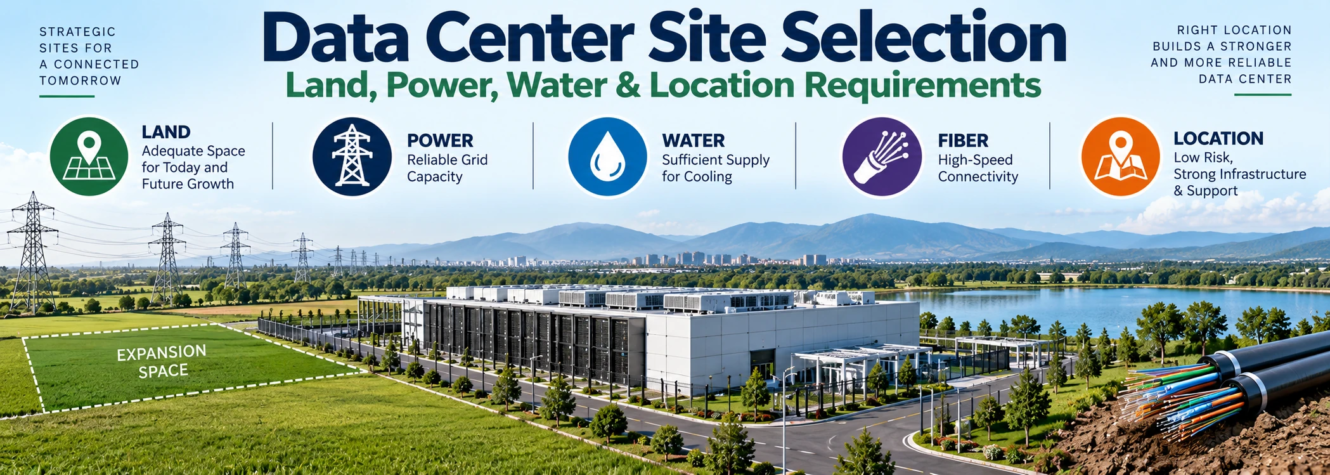
Data center site selection is the process of evaluating and choosing a location that can support the land, electricity, connectivity, cooling, water, construction, regulatory, and operational requirements of a data center.
For modern facilities—especially large AI data centers—the location decision can determine whether a project is technically feasible before construction even begins.
A site may offer inexpensive land but insufficient grid capacity. Another location may have excellent power availability but face flood risk, water limitations, permitting delays, or poor fiber connectivity.
That is why successful data center site selection requires much more than finding a large parcel of land.
The project team must evaluate the complete infrastructure ecosystem surrounding the site.
Key considerations typically include:
- Land availability
- Utility power capacity
- Grid expansion potential
- Fiber connectivity
- Water availability
- Climate
- Natural hazards
- Transportation
- Construction access
- Zoning
- Permits
- Environmental restrictions
- Workforce
- Taxes and incentives
- Future expansion
This guide explains these factors and shows how developers can systematically evaluate potential data center locations.
Why Data Center Site Selection Matters
Data centers depend heavily on infrastructure outside the building.
A conventional commercial building may be able to connect to existing utilities without major changes.
A large data center can require significantly more supporting infrastructure.
The location may need to accommodate:
Utility infrastructure → Data center building → Cooling infrastructure → Fiber networks → Backup systems → Future expansion
If one critical resource is unavailable, the entire project can become difficult, expensive, delayed, or even infeasible.
Site selection should therefore happen before detailed facility design.
Major Data Center Site Selection Factors
| Site Factor | Why It Matters |
|---|---|
| Land | Determines building footprint and expansion capacity |
| Grid Power | Supports IT and facility electrical loads |
| Fiber | Connects the facility to networks and users |
| Water | May support certain cooling systems |
| Climate | Influences cooling and environmental conditions |
| Natural Hazards | Affect resilience and insurance risk |
| Zoning | Determines whether development is permitted |
| Permitting | Can influence project schedule |
| Transportation | Supports construction and equipment delivery |
| Workforce | Supports construction and operations |
| Taxes/Incentives | Can affect long-term economics |
| Expansion Space | Supports future capacity growth |
1. Land Requirements
The first visible requirement is land.
However, evaluating land for a data center involves more than calculating whether the building physically fits.
A suitable parcel may need space for:
- Data halls
- Electrical rooms
- Mechanical areas
- Utility substations
- Transformers
- Generators
- Fuel systems
- Cooling equipment
- Water infrastructure
- Security setbacks
- Internal roads
- Loading areas
- Stormwater systems
- Parking
- Future buildings
Large campuses may require substantial additional land beyond the footprint of the first data center building.
Usable Land vs. Total Land
The total acreage listed for a property is not necessarily the amount that can actually be developed.
Usable land can be reduced by:
- Wetlands
- Floodplains
- Steep slopes
- Easements
- Utility corridors
- Setbacks
- Protected areas
- Drainage requirements
- Access restrictions
For example, a parcel may appear large enough on a map but lose significant developable area after environmental and civil constraints are considered.
Developers should therefore evaluate usable developable land, not just total acreage.
2. Site Shape and Layout
Parcel geometry can affect data center planning.
A regular-shaped site generally provides more flexibility for:
- Building placement
- Substation layout
- Generator yards
- Cooling equipment
- Internal roads
- Security perimeter
- Expansion
An irregular parcel can create inefficient spaces or restrict future development.
The project team should test conceptual layouts before acquiring the site.
A preliminary site plan can reveal whether the required infrastructure actually fits.
3. Future Expansion
Expansion capacity is particularly important for data centers.
The first phase may represent only part of the eventual campus.
A site can initially support:
Building 1
and later expand to:
Building 1 + Building 2 + Building 3 + Additional Utility Infrastructure
Expansion planning should consider more than vacant land.
The site may also require future capacity for:
- Transformers
- Substations
- Generators
- Cooling systems
- Water systems
- Fiber routes
- Roads
A parcel with unused acreage but no path to additional utility power may have limited expansion value.
4. Grid Power Availability
For many modern data centers, electricity is one of the most important site-selection factors.
Before choosing a location, developers should determine whether the local electrical system can support the planned facility.
Important questions include:
- How much capacity is available?
- At what voltage can service be provided?
- Where is the nearest suitable substation?
- Is new transmission infrastructure required?
- How long could interconnection take?
- Can additional capacity be provided later?
- Are redundant utility feeds possible?
- What is the reliability history of the local grid?
The answers can influence both location and project schedule.
Detailed calculations for MW demand and rack power density are covered separately here:
AI data center power requirements5. Utility Interconnection
Available electricity and deliverable electricity are not always the same thing.
A region may generate large amounts of power while the specific site lacks sufficient transmission or substation capacity.
The utility may need to construct or upgrade:
- Transmission lines
- Substations
- Transformers
- Feeders
- Protection systems
These projects can take significant time.
For this reason, developers should engage the utility early in the site-selection process.
A beautiful site with an unacceptable utility schedule can become a poor development choice.
6. Power Redundancy
Critical data centers may evaluate whether a location can support diverse or redundant utility connections.
Possible considerations include:
- Multiple substations
- Separate feeders
- Diverse transmission paths
- Independent utility sources where feasible
However, two electrical feeds are not necessarily truly independent.
They may share:
- A substation
- Transmission infrastructure
- Utility equipment
- Physical routes
The project team should therefore investigate the actual upstream infrastructure rather than relying only on the number of connections shown on a plan.
For the equipment that distributes electricity after it reaches the facility, see:
data center electrical infrastructure7. Electricity Cost
Electricity is a major operating input for data centers.
Therefore, site evaluation can include:
- Utility tariffs
- Demand charges
- Time-of-use pricing
- Large-customer rates
- Power-purchase options
- Renewable energy availability
- Future rate uncertainty
The lowest electricity price should not automatically determine the site.
A location with cheap power but limited capacity or long interconnection delays may be less attractive than a location with better infrastructure.
Capacity, reliability, schedule, and cost should be evaluated together.
8. Fiber Connectivity
Data centers exist to process, store, and move information.
They therefore need reliable network connectivity.
A site-selection study should identify:
- Nearby fiber routes
- Carrier availability
- Internet exchanges
- Cloud connectivity
- Long-haul networks
- Metropolitan fiber
- Potential route diversity
The facility may need connections from multiple telecommunications providers.
9. Fiber Route Diversity
Two fiber connections entering a building are not automatically redundant.
If both follow the same underground route, a single excavation incident could damage both.
A more resilient strategy may use:
- Separate entry points
- Different physical routes
- Multiple carriers
- Diverse upstream paths
Physical diversity should be verified rather than assumed.
This is particularly important for facilities where network availability is critical.
10. Water Availability
Water can be another important data center site-selection factor.
Its importance depends heavily on the cooling technology.
Some facilities can use substantial water for heat rejection, while other designs can reduce or avoid certain forms of cooling-related water consumption.
Before choosing a site, developers may investigate:
- Municipal water capacity
- Industrial water sources
- Reclaimed water
- Groundwater restrictions
- Drought conditions
- Water rights
- Wastewater capacity
- Future water availability
Water should be considered alongside cooling design rather than evaluated independently.
For dedicated coverage of consumption and WUE, see:
data center water usage11. Water Quality
Quantity is not the only consideration.
Water quality can affect cooling and mechanical systems.
Potential issues include:
- Mineral content
- Hardness
- Corrosion
- Biological growth
- Treatment requirements
Poor water quality may require additional treatment equipment and maintenance.
The engineering team should therefore evaluate the available water source before finalizing cooling infrastructure.
12. Cooling Strategy and Site Location
The planned cooling system can change what makes a site attractive.
Potential cooling technologies include:
- Air cooling
- Chilled-water systems
- Evaporative cooling
- Direct-to-chip liquid cooling
- Rear-door heat exchangers
- Immersion cooling
- Hybrid systems
Climate and resource availability can influence which systems perform effectively.
For a detailed comparison, see:
AI data center cooling systems13. Climate
Climate affects both construction and long-term operation.
Site-selection teams may evaluate:
- Outdoor temperature
- Humidity
- Extreme heat
- Extreme cold
- Seasonal variation
- Wind
- Snow
- Ice
- Dust
- Air quality
Cooler climates can provide opportunities for economization under suitable conditions.
Hot or humid climates can increase cooling challenges.
However, climate alone does not determine whether a location is suitable.
A warmer region with excellent power and fiber infrastructure may still be a strong data center market.
14. Flood Risk
Flooding can create serious risk for critical infrastructure.
Site studies should consider:
- River flooding
- Coastal flooding
- Storm surge
- Flash flooding
- Surface drainage
- Groundwater
- Historical flood events
Critical electrical and mechanical equipment may require special protection where flood exposure exists.
Developers should also evaluate how extreme weather could affect roads, utility infrastructure, and surrounding areas—not just the building footprint.
15. Stormwater Drainage
Large data centers can create extensive impervious areas.
These include:
- Roofs
- Roads
- Equipment yards
- Parking
- Concrete pads
Rainfall that previously infiltrated into undeveloped land may become runoff.
The civil design may therefore require:
- Detention basins
- Retention systems
- Drainage channels
- Underground storage
- Storm sewers
Stormwater requirements can consume substantial site area.
They should be considered during land acquisition rather than after the layout is finalized.
16. Seismic Risk
Earthquake exposure varies significantly by region.
In seismic areas, structural and equipment systems may require additional design considerations.
These can affect:
- Building structure
- Equipment anchorage
- Pipe supports
- Cable systems
- Generators
- Transformers
- Cooling equipment
Site-selection teams should understand regional seismic hazards before detailed structural design begins.
17. Wind and Severe Weather
Potential weather hazards may include:
- Hurricanes
- Tornadoes
- High winds
- Hail
- Snowstorms
- Ice storms
These conditions can influence:
- Structural design
- Roof systems
- Exterior equipment
- Backup power
- Fuel storage
- Utility reliability
The appropriate response depends on the site’s actual hazard profile.
18. Wildfire Risk
Wildfire can also affect data center site selection in some regions.
Evaluation may include:
- Vegetation
- Fire history
- Smoke exposure
- Access roads
- Emergency response
- Utility vulnerability
Smoke and ash can affect outdoor mechanical equipment and air-handling strategies even when the building itself is not directly threatened.
19. Geotechnical Conditions
Before major construction, developers need to understand the soil beneath the proposed facility.
A geotechnical investigation can evaluate:
- Soil bearing capacity
- Settlement potential
- Groundwater
- Expansive soils
- Rock
- Fill material
- Liquefaction potential
- Excavation conditions
Poor soil conditions can require:
- Ground improvement
- Deep foundations
- Additional excavation
- Imported fill
- Specialized drainage
These measures can affect both cost and construction schedule.
20. Topography
A relatively flat site can simplify construction, but every project should be evaluated individually.
Steep or irregular terrain may increase:
- Earthwork
- Retaining walls
- Drainage complexity
- Road grades
- Foundation requirements
A topographic survey helps the civil team estimate how much grading may be required.
Large cut-and-fill quantities can materially change site-development complexity.
21. Environmental Conditions
Environmental due diligence can identify constraints before land acquisition.
Potential issues include:
- Wetlands
- Protected species
- Contaminated soil
- Previous industrial use
- Waterways
- Habitat restrictions
- Archaeological or cultural resources
Environmental problems do not automatically make a site unusable, but they may increase permitting requirements, cost, or schedule risk.
22. Zoning and Land Use
The site must permit the intended development.
Before acquisition, developers should review:
- Existing zoning
- Permitted uses
- Building height
- Setbacks
- Noise restrictions
- Equipment yards
- Generator restrictions
- Landscaping requirements
- Parking requirements
Some jurisdictions have specific regulations for data centers.
Others may treat them under industrial or technology-related land-use categories.
Early discussions with local authorities can reveal potential approval issues.
23. Permitting Environment
Permitting can influence how quickly a project moves from land acquisition to construction.
Potential approvals can involve:
- Planning departments
- Building departments
- Fire authorities
- Environmental agencies
- Water authorities
- Utility companies
- Transportation agencies
A location with strong infrastructure but an uncertain approval path may carry significant schedule risk.
Developers should investigate both formal requirements and realistic approval timelines.
24. Community Considerations
Large data centers can attract local attention.
Community concerns may involve:
- Generator noise
- Water use
- Electricity demand
- Land use
- Traffic
- Visual impact
- Tax incentives
Early communication can help project teams understand potential concerns before approvals are requested.
Good site selection considers how the facility fits within the surrounding community—not only whether the parcel is technically buildable.
25. Noise
Data centers can contain equipment that produces continuous or periodic noise.
Potential sources include:
- Generators
- Cooling towers
- Chillers
- Fans
- Transformers
Nearby residential areas may therefore influence site suitability.
Noise studies and appropriate equipment placement can become important parts of planning.
26. Air Quality and Generator Permitting
Backup generators use combustion engines in many data center designs.
Depending on location and project scale, generator installations may require air-quality review or permits.
Site-selection teams should determine whether local regulations could affect:
- Number of generators
- Operating hours
- Testing
- Emissions controls
- Fuel type
These requirements can influence the backup-power strategy and project schedule.
27. Transportation and Construction Access
Data center construction requires large amounts of material and heavy equipment.
The site should provide suitable access for:
- Concrete trucks
- Steel deliveries
- Cranes
- Transformers
- Generators
- Cooling equipment
- Modular equipment
Large transformers and generators can be especially challenging to transport.
Project teams should evaluate:
- Road width
- Bridge limits
- Turning radii
- Overhead clearances
- Site entrances
- Staging areas
The route from manufacturer or delivery point to the site can be as important as the site entrance itself.
28. Proximity to Airports, Rail and Major Highways
Major transportation networks can support construction logistics and operations.
Access to highways can simplify equipment delivery.
Airports can support:
- Staff travel
- Vendor access
- Emergency technical support
However, proximity to transportation infrastructure must still be balanced against other factors such as land cost, security, and local hazards.
29. Workforce Availability
Data centers require skilled people during both construction and operation.
Construction may require:
- Electricians
- Mechanical trades
- Pipefitters
- Controls technicians
- Commissioning specialists
- Structural trades
- Civil contractors
Operations may require:
- Facility engineers
- Electrical technicians
- Mechanical technicians
- Network personnel
- Security staff
A region experiencing simultaneous large data center developments may face labor constraints.
Workforce availability should therefore be considered during regional site comparison.
30. Security
Physical security begins with location.
Site-selection teams may evaluate:
- Surrounding land uses
- Public road exposure
- Perimeter control
- Vehicle access
- Setback opportunities
- Emergency response
A suitable parcel should allow the security design to create controlled access without interfering with normal operations.
31. Emergency Services
Proximity and access to emergency services can also be evaluated.
These may include:
- Fire departments
- Emergency medical services
- Police
- Hospitals
Data centers have sophisticated internal fire-protection systems, but local emergency response remains part of overall site risk assessment.
32. Taxes and Economic Incentives
Some regions provide economic incentives for data center development.
These may involve:
- Property taxes
- Sales taxes
- Equipment taxes
- Utility incentives
- Job creation programs
Such incentives can materially affect project economics.
However, tax advantages should not override fundamental infrastructure requirements.
A site with attractive incentives but inadequate power or fiber may still be unsuitable.
33. Construction Cost Differences by Location
Labor, materials, logistics, utility work, and site conditions can vary between regions.
A site may require additional spending for:
- Utility extensions
- Rock excavation
- Soil improvement
- Flood mitigation
- Water infrastructure
- Road improvements
These costs should be included when comparing sites.
For detailed cost analysis, see:
data center construction cost34. Site Selection and Construction Materials
Local conditions can also influence structural and envelope decisions.
For example:
- Wind affects structural requirements.
- Seismic conditions affect framing and anchorage.
- Snow affects roof loading.
- Soil affects foundations.
- Climate affects envelope design.
For a dedicated discussion of structural systems, see:
data center construction materials35. Sustainability Considerations
Sustainability objectives can influence location selection.
Potential considerations include:
- Renewable electricity
- Carbon intensity of the grid
- Water stress
- Reclaimed-water availability
- Heat-reuse opportunities
- Local environmental impact
A site with access to lower-carbon electricity may support an owner’s sustainability strategy.
However, sustainability should be evaluated across the full project rather than using one metric alone.
36. Data Center Site Selection for AI Facilities
AI infrastructure can make site selection even more power-sensitive.
High-density computing can require:
- Greater electrical capacity
- Larger substations
- More transformers
- More cooling capacity
- Stronger utility expansion plans
This can change the traditional order of site evaluation.
Instead of asking:
“Where can we build the data center?”
developers may first need to ask:
“Where can the required power be delivered at the required time?”
Land that cannot support the required utility infrastructure may have little value for a large AI project regardless of its purchase price.
37. Greenfield vs. Brownfield Data Center Sites
Developers may consider either greenfield or brownfield locations.
Greenfield Site
A greenfield project is developed on land without an existing facility suitable for the proposed data center.
Potential advantages include:
- Flexible layout
- Purpose-built infrastructure
- Expansion planning
- Modern campus design
Potential challenges can include:
- New utility connections
- New roads
- Longer development work
- Environmental approvals
Brownfield Site
A brownfield or redevelopment site may contain existing buildings or infrastructure.
Potential advantages can include:
- Existing utilities
- Existing roads
- Faster access to developed areas
Potential challenges can include:
- Demolition
- Contamination
- Existing structural limitations
- Inadequate utility capacity
Neither option is automatically superior.
The decision depends on the actual site and project requirements.
38. Urban vs. Rural Data Center Locations
Urban and rural sites offer different tradeoffs.
Urban Locations
Potential benefits:
- Strong fiber networks
- Proximity to users
- Large workforce
- Existing infrastructure
Potential challenges:
- Expensive land
- Limited expansion
- Noise restrictions
- Dense surroundings
Rural Locations
Potential benefits:
- Larger parcels
- Expansion space
- Lower land costs in some markets
Potential challenges:
- Limited fiber
- Limited workforce
- Utility upgrades
- Longer equipment logistics
The ideal location depends on the type of data center being developed.
39. Hyperscale vs. Edge Site Selection
Different data center types prioritize different site characteristics.
Hyperscale Facilities
These may prioritize:
- Large MW capacity
- Large land parcels
- Expansion
- Major fiber routes
- Utility partnerships
Edge Data Centers
These may prioritize:
- Proximity to users
- Network latency
- Urban connectivity
- Smaller footprints
A site-selection strategy should therefore begin with the facility’s intended function.
40. Data Center Site Selection Scoring Matrix
A scoring matrix can help compare multiple locations systematically.
Here is a simplified example:
| Factor | Example Weight | Site A | Site B | Site C |
|---|---|---|---|---|
| Power | 25% | 9 | 6 | 8 |
| Fiber | 15% | 8 | 9 | 7 |
| Land | 10% | 7 | 9 | 8 |
| Water/Cooling | 10% | 8 | 7 | 6 |
| Natural Hazards | 10% | 8 | 6 | 9 |
| Permitting | 10% | 7 | 8 | 6 |
| Construction | 10% | 8 | 7 | 7 |
| Expansion | 10% | 9 | 8 | 6 |
The weights above are only an illustrative framework—not universal industry requirements.
A real project should assign weights based on its own priorities.
For an AI campus, for example, power availability and utility schedule might receive substantially more emphasis than for a smaller facility.
41. Fatal-Flaw Analysis
Before spending substantial resources on a candidate site, developers can perform a fatal-flaw analysis.
The objective is to identify conditions that could make the location unacceptable.
Possible fatal flaws include:
- Insufficient power
- Unacceptable utility schedule
- No viable fiber route
- Severe flood exposure
- Incompatible zoning
- Unmanageable environmental restrictions
- Insufficient usable land
- No expansion potential
- Unacceptable geotechnical conditions
Finding these problems early can prevent expensive design work on an unsuitable site.
42. Data Center Site Due-Diligence Checklist
Land
- Confirm property boundaries
- Verify usable acreage
- Review easements
- Review setbacks
- Evaluate site shape
- Reserve future expansion space
Power
- Confirm required MW
- Contact utility
- Determine available capacity
- Confirm service voltage
- Review substation requirements
- Review interconnection schedule
- Evaluate future power capacity
- Investigate utility redundancy
Fiber
- Identify carriers
- Map nearby fiber routes
- Confirm available capacity
- Plan multiple entrances
- Verify route diversity
Water
- Determine cooling water requirements
- Confirm water availability
- Evaluate water quality
- Investigate reclaimed water
- Review drought restrictions
- Confirm wastewater capacity
Civil and Structural
- Complete topographic survey
- Review flood risk
- Perform geotechnical investigation
- Estimate earthwork
- Review stormwater requirements
- Evaluate seismic conditions
Environmental
- Identify wetlands
- Review previous site use
- Investigate contamination
- Review protected habitats
- Determine environmental permits
Planning and Permits
- Verify zoning
- Meet local authorities
- Review building requirements
- Review generator regulations
- Estimate approval schedule
Logistics
- Review highway access
- Check heavy-equipment routes
- Verify bridge limitations
- Plan construction entrances
- Identify staging areas
Operations
- Evaluate workforce
- Review security
- Review emergency services
- Evaluate local supply chain
- Review long-term expansion
43. What Happens After a Site Is Selected?
Once the preferred location passes due diligence, the project can move toward:
- Detailed surveys
- Geotechnical design
- Civil engineering
- Architectural design
- Structural design
- Electrical engineering
- Mechanical engineering
- Utility coordination
- Permitting
- Procurement
- Construction
The overall sequence is covered in:
data center construction processCommon Data Center Site Selection Mistakes
Choosing Land Before Confirming Power
Cheap land has little value to a large data center if adequate electricity cannot be delivered.
Looking Only at Current Utility Capacity
Future expansion can require substantially more power than the first phase.
Assuming Fiber Availability Means Fiber Diversity
Multiple connections may share the same physical route.
Ignoring Water Until Cooling Design
Cooling technology and water availability should be coordinated early.
Evaluating Total Acreage Instead of Usable Acreage
Floodplains, wetlands, setbacks, drainage, and easements can significantly reduce usable land.
Ignoring Long-Lead Utility Work
The building may be completed before required utility infrastructure is ready.
Focusing Only on Natural Hazard Maps
Resilience also depends on roads, utility systems, drainage, communications, and surrounding infrastructure.
Ignoring Expansion Infrastructure
Future buildings require future power, cooling, fiber, roads, and utility space—not just vacant land.
Frequently Asked Questions
What is data center site selection?
Data center site selection is the process of evaluating potential locations based on land, electricity, fiber connectivity, water, climate, natural hazards, construction conditions, regulations, cost, and future expansion.
What is the most important factor when choosing a data center location?
There is no universal single factor, but power availability is often one of the most critical considerations for large modern and AI data centers. Fiber, land, hazards, permitting, water, and expansion can also materially affect feasibility.
How much land does a data center need?
There is no universal acreage requirement. Land demand depends on building size, electrical infrastructure, cooling systems, security, roads, stormwater management, setbacks, and future expansion.
Why is power important for data center site selection?
Servers and supporting infrastructure require continuous electricity. Large data centers may also require major utility upgrades, substations, and future grid capacity.
Do data centers need water?
Some cooling systems use water, while other designs can reduce water dependence. The site’s water requirements therefore depend on the cooling architecture and environmental conditions.
Why is fiber important for a data center?
Fiber connects the facility to networks, cloud platforms, customers, and other data centers. Capacity and physical route diversity can both be important.
Are colder climates better for data centers?
Cool climates can provide cooling advantages in some designs, but temperature is only one factor. Power, fiber, land, hazards, regulation, workforce, and other infrastructure may be more important to a particular project.
Should data centers avoid flood zones?
Flood exposure should be carefully evaluated because critical infrastructure requires high resilience. Site elevation, drainage, flood type, surrounding infrastructure, and mitigation options all matter.
What is a data center site-selection checklist?
A site-selection checklist systematically reviews power, land, fiber, water, natural hazards, environmental conditions, zoning, permits, transportation, workforce, security, and future expansion before development proceeds.
Why is site selection especially important for AI data centers?
AI facilities can require high electrical capacity and high-density cooling infrastructure. This can make utility capacity, interconnection timing, expansion potential, and cooling resources especially important during site selection.
Final Thoughts
Successful data center site selection begins with a simple principle:
Do not evaluate the land separately from the infrastructure required to operate the data center.
A strong location must bring several systems together:
Land + Power + Fiber + Cooling Resources + Resilience + Permits + Construction Access + Expansion
For large AI facilities, power availability and delivery schedule can become particularly important because high-density computing may require substantial electrical infrastructure.
But power alone does not make a site viable.
A candidate location must also provide sufficient usable land, reliable connectivity, an appropriate cooling strategy, manageable natural hazards, practical construction conditions, and a realistic approval path.
The best data center site is therefore not necessarily the cheapest land or the location with the lowest electricity rate.
It is the location where the complete infrastructure ecosystem can support the facility reliably today—and continue supporting its growth in the future.