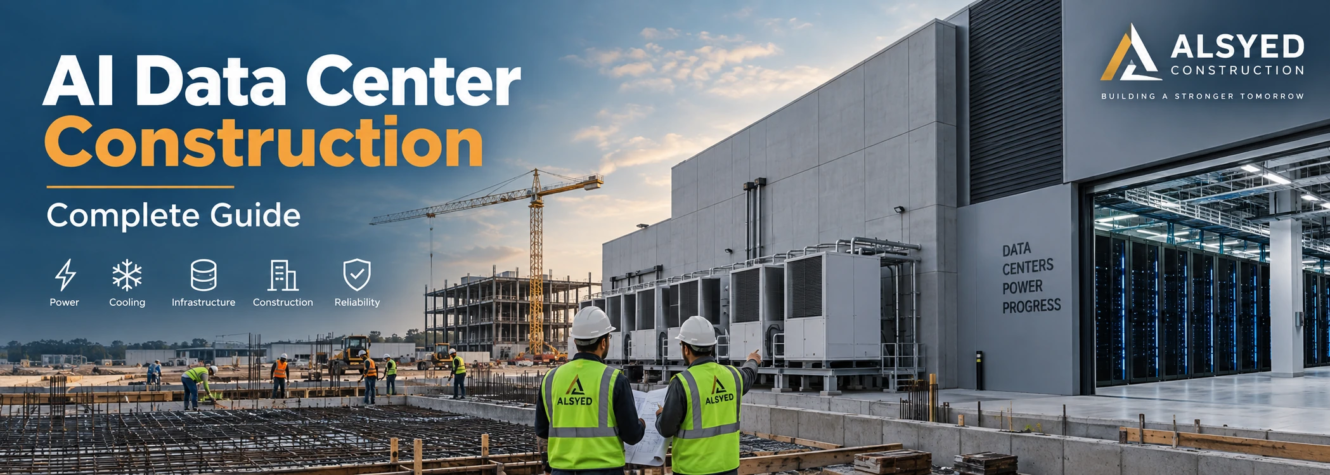
AI Data Center Construction: Complete Guide
Artificial intelligence is changing data center construction. Facilities built for AI training, inference, machine learning, and high-performance computing must support enormous computing loads while maintaining reliable power, cooling, network connectivity, and continuous operation.
This makes AI data center construction fundamentally different from constructing a conventional commercial building—and increasingly different from building a traditional data center.
An AI facility is not simply a building filled with servers. It is an integrated system where the building structure, electrical infrastructure, cooling equipment, water systems, telecommunications, fire protection, security, and IT hardware must work together.
High-density GPU clusters are especially important to this shift. Packing more computing power into each rack increases electrical demand and heat generation within a relatively small footprint. That affects everything from utility planning and mechanical design to structural loads and equipment layouts.
This guide explains how AI data centers are constructed, what infrastructure they require, and which factors must be considered from site selection through commissioning.
What Is an AI Data Center?
An AI data center is a specialized facility designed to house computing infrastructure used for artificial intelligence workloads.
These workloads may include:
- AI model training
- AI inference
- Machine learning
- Generative AI
- Large language models
- High-performance computing
- GPU-accelerated computing
The fundamental building blocks may look familiar: servers, racks, electrical equipment, cooling systems, network infrastructure, and backup power.
The difference is density and scale.
AI servers can concentrate substantial computing power into individual racks. As rack power increases, the facility must deliver more electricity to the same physical area while removing the resulting heat.
Consequently, power capacity and cooling capacity become two of the most important constraints in AI data center design.
How Is AI Data Center Construction Different?
Traditional commercial buildings are primarily designed around people. Data centers are primarily designed around equipment.
AI data centers take this concept further because high-performance computing can place unusually demanding requirements on building infrastructure.
Major considerations include:
- Utility power availability
- Total IT load
- Rack power density
- Electrical redundancy
- Backup generation
- Heat rejection
- Air and liquid cooling
- Structural floor loads
- Water availability
- Fiber connectivity
- Fire protection
- Physical security
- Equipment maintainability
- Future capacity expansion
These systems are interconnected.
For example, increasing computing capacity increases electrical demand. More electrical energy consumed by IT equipment means more heat must be removed. That may require additional cooling equipment, which itself consumes power and occupies physical space.
Successful AI data center construction therefore depends heavily on coordination between civil, structural, architectural, electrical, mechanical, telecommunications, fire protection, controls, and IT teams.
Major Components of an AI Data Center
A typical AI data center includes far more than the data hall where servers operate.
Depending on the project, the facility or campus may include:
- Data halls
- Electrical rooms
- Utility substations
- Transformers
- Switchgear
- UPS systems
- Battery rooms
- Backup generators
- Mechanical rooms
- Chillers or other heat-rejection equipment
- Pumps and piping
- Cooling towers where applicable
- Network rooms
- Operations areas
- Fire protection systems
- Security infrastructure
- Loading and maintenance areas
Large campuses may contain multiple data center buildings supported by shared utility and infrastructure systems.
The design should therefore begin at the campus level rather than treating each data hall as an isolated space.
1. AI Data Center Site Selection
One of the earliest—and most consequential—decisions is where to build the facility.
Land price alone does not determine whether a site is suitable.
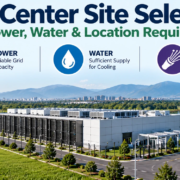
A potential site must be evaluated against several infrastructure requirements, including:
- Available utility power
- Grid connection capacity
- Land area
- Fiber connectivity
- Water availability
- Road access
- Natural hazards
- Environmental restrictions
- Permitting conditions
- Local workforce
- Future expansion potential
For AI facilities, available electrical capacity can become a decisive site-selection factor.
A property may provide sufficient acreage for a large campus but still be unsuitable if the utility cannot deliver the required power within the project’s schedule.
Similarly, a location with strong electrical infrastructure may become less attractive if it lacks fiber redundancy, has significant flood risk, or cannot accommodate future expansion.
The complete location evaluation is covered separately in our:
data center site selection guideThat guide focuses specifically on land, power, water, fiber, hazards, permits, and location requirements.
2. Site Preparation and Civil Work
Once a site is selected, construction typically begins with civil and site-development activities.
The exact scope depends on the land, soil conditions, local infrastructure, and campus design.
Typical work can include:
- Clearing and grubbing
- Excavation
- Cut and fill
- Grading
- Soil stabilization
- Stormwater management
- Underground utilities
- Access roads
- Equipment yards
- Retaining structures
- Security perimeter construction
- Parking and loading areas
Large electrical and mechanical systems also require substantial exterior space.
Transformer yards, substations, generators, cooling equipment, fuel systems, and other infrastructure must be coordinated with building access, maintenance routes, security setbacks, and future construction phases.
3. Foundations and Structural Systems
An AI data center structure must safely support both the building and its technical infrastructure.
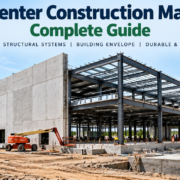
Common structural systems may incorporate:
- Reinforced concrete
- Structural steel
- Precast concrete
- Concrete slabs
- Composite construction
- Concrete masonry
- Metal deck systems
- Insulated wall and roof assemblies
Material selection depends on project requirements such as structural capacity, construction schedule, durability, fire resistance, local climate, security, and cost.
Specialized equipment may also require dedicated foundations or housekeeping pads.
Examples include:
- Transformers
- Generators
- Chillers
- Pumps
- UPS equipment
- Battery systems
- Large electrical cabinets
Rather than covering each structural material in detail here, our dedicated resource explains:
data center construction materialsIt covers concrete, structural steel, wall systems, roof systems, and their roles in resilient data center construction.
4. Data Center Floor Loading
Structural loading deserves particular attention in data halls and equipment rooms.
A server rack can concentrate substantial weight within a small footprint. Electrical equipment, batteries, UPS systems, and other infrastructure can create even greater loads.
Structural engineers may need to evaluate:
- Uniform loads
- Concentrated loads
- Point loads
- Rack loads
- Equipment loads
- Rolling loads
- Raised-floor loads
- Installation loads
The route used to move heavy equipment into the building can also matter.
A floor may be adequate for equipment in its final location but still need verification for the loads created while that equipment is transported through corridors or service areas.
There is no single floor capacity appropriate for every data center. The required design load depends on the equipment, layout, structural system, and applicable codes.
For the detailed structural topic, see:
data center floor loading requirementsThat supporting guide covers PSF, racks, equipment loads, raised floors, and related structural considerations.
5. AI Data Center Power Requirements
Power is one of the defining requirements of an AI data center.
GPU-based computing can create very high electrical demand, particularly when thousands of processors operate simultaneously.
Engineers therefore need to establish the expected IT load early in the project.
Important variables include:
- Number of racks
- Power per rack
- Server configuration
- GPU density
- Total IT capacity
- Cooling-system demand
- Electrical losses
- Redundancy requirements
- Future expansion
A critical distinction is the difference between IT power and total facility power.
Servers are not the only electrical consumers.
Cooling equipment, pumps, fans, controls, lighting, security systems, and electrical losses also contribute to total facility demand.
This means a facility designed around a particular IT load generally needs additional electrical capacity to support the infrastructure surrounding that IT equipment.
Because power demand is a large topic of its own, MW demand, rack density, energy use, and capacity planning are covered here:
AI data center power requirements6. Data Center Electrical Infrastructure
Utility capacity determines how much power may be available, but electrical infrastructure determines how that power reaches the computing equipment safely and reliably.
A large facility may contain:
- Utility substations
- Medium-voltage equipment
- Transformers
- Switchgear
- Switchboards
- Automatic transfer systems
- UPS systems
- Battery systems
- Backup generators
- Busways
- Power distribution units
- Rack-level distribution
- Electrical monitoring systems
Reliability is especially important.
A conventional building can sometimes tolerate a temporary electrical interruption. A critical data center may be designed specifically to prevent a single equipment failure or maintenance event from interrupting computing operations.
This is why terms such as N, N+1, 2N, redundancy, concurrent maintainability, and fault tolerance frequently appear in data center engineering.
The detailed electrical architecture is covered separately in:
data center electrical infrastructureThat article focuses specifically on transformers, UPS systems, switchgear, PDUs, redundancy, and rack power distribution.
7. Backup Power and Resilience
Data centers typically require backup power because utility interruptions can occur.
A common high-level sequence is:
Utility supply → UPS support → generator startup → generator-supported operation
UPS systems can bridge the short period between loss of utility power and availability of backup generation.
Generators can then support critical loads for a longer period, subject to system design and fuel availability.
Backup-power planning can involve:
- Generator capacity
- Generator redundancy
- Fuel storage
- Battery runtime
- Automatic transfer
- Maintenance access
- Fuel delivery
- Emissions requirements
- Noise requirements
The exact arrangement varies according to the facility’s reliability objectives.
8. AI Data Center Cooling Systems
Electricity consumed by servers ultimately creates heat.
As computing density increases, heat becomes concentrated within a smaller physical area.
Cooling design therefore has to consider both total heat load and heat density.
Traditional cooling approaches can include:
- Computer room air handlers
- Computer room air-conditioning units
- Chilled-water systems
- Hot-aisle containment
- Cold-aisle containment
High-density AI hardware is also accelerating adoption of liquid-based cooling technologies.
These may include:
- Direct-to-chip liquid cooling
- Rear-door heat exchangers
- Coolant distribution units
- Immersion cooling
- Hybrid air-and-liquid systems
Liquid cooling does not mean that every part of an AI facility becomes liquid cooled. A project may use different cooling approaches for different equipment densities.
The appropriate solution depends on hardware requirements, rack density, climate, water strategy, efficiency targets, and facility design.
Our detailed comparison is available here:
AI data center cooling systemsIt focuses specifically on air versus liquid cooling, direct-to-chip systems, immersion cooling, and high-density AI infrastructure.
9. Water Requirements
Water and cooling are closely related, but data center water consumption varies significantly by cooling strategy and location.
Water may be associated with:
- Cooling towers
- Evaporative cooling
- Adiabatic systems
- Humidification
- Heat rejection
- Mechanical processes
Site conditions matter as well.
A cooling strategy that is practical in a water-rich region may be undesirable in an area facing water scarcity.
Project teams may therefore evaluate:
- Water availability
- Water quality
- Seasonal availability
- Treatment requirements
- Discharge requirements
- Local restrictions
- Long-term water cost
Water Usage Effectiveness (WUE) is one metric used to evaluate water consumption in relation to IT energy use.
Rather than duplicating that topic here, water consumption and WUE are covered in:
data center water usage10. Building Envelope
The data center envelope protects critical infrastructure from weather and environmental conditions.
Depending on the design, it may use:
- Precast concrete panels
- Insulated metal panels
- Concrete masonry
- Structural wall systems
- Insulated roofing
- Membrane roofing
- Fire-rated assemblies
- Waterproofing systems
Important performance considerations include:
- Wind resistance
- Water penetration
- Thermal performance
- Fire resistance
- Security
- Durability
- Maintainability
Because data centers contain sensitive and expensive equipment, water intrusion and envelope failure can create consequences far beyond ordinary building damage.
11. Fire Protection and Life Safety
Data centers combine electronics, electrical equipment, batteries, generators, fuel systems, cabling, and other infrastructure.
Fire protection therefore requires coordination between multiple disciplines.
Depending on the building and applicable requirements, protection may include:
- Fire detection
- Early-warning smoke detection
- Automatic sprinklers
- Pre-action systems
- Fire-rated walls
- Fire doors
- Clean-agent systems where appropriate
- Emergency controls
- Alarm and monitoring systems
Different spaces can have different hazards.
A data hall, battery room, generator area, and office space may not require identical protection strategies.
Life safety remains fundamental regardless of the value of the equipment being protected.
12. Physical Security
Data centers can contain extremely valuable hardware and sensitive information.
Physical security may therefore begin at the property boundary rather than at the building entrance.
Typical layers can include:
- Perimeter fencing
- Controlled gates
- Vehicle barriers
- Guard stations
- CCTV
- Visitor screening
- Access-control systems
- Biometric authentication
- Security vestibules
- Restricted internal zones
Access can become progressively more restrictive as a person moves from public or administrative areas toward critical infrastructure.
Security planning must also remain compatible with emergency access and safe evacuation.
13. Fiber and Telecommunications
An AI data center needs more than electricity. It also requires high-capacity connectivity.
Fiber infrastructure is therefore an important component of both site selection and building design.
Planning may consider:
- Available carriers
- Fiber capacity
- Diverse routes
- Separate building entrances
- Network rooms
- Meet-me rooms
- Cable pathways
- Underground conduits
Route diversity can be particularly valuable.
Two fiber connections may not provide meaningful redundancy if both travel through the same physical route and can be damaged by the same event.
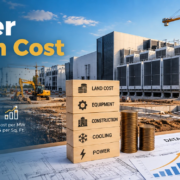
14. Data Center Construction Cost
AI data centers can require very large capital investments because the building shell represents only part of the total project.
Major cost categories can include:
- Land
- Site development
- Structural construction
- Building envelope
- Utility infrastructure
- Substations
- Transformers
- Switchgear
- UPS systems
- Batteries
- Generators
- Cooling equipment
- Mechanical piping
- Fire protection
- Security
- Controls
- Commissioning
This is one reason data center economics are often discussed in terms of cost per MW as well as cost per square foot.
Two data centers with similar floor areas can have dramatically different infrastructure requirements if one supports much greater IT capacity.
Because this pillar article is intended as an overview, detailed cost benchmarks belong in the dedicated:
data center construction cost guideThat page focuses specifically on cost per MW, cost per square foot, major cost drivers, and AI facility considerations.
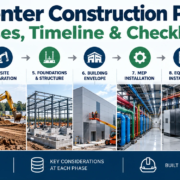
15. Data Center Construction Process
Although projects vary, construction generally progresses through a sequence of interconnected phases.
1. Feasibility and Capacity Planning
The developer establishes the intended IT capacity, reliability objectives, budget, location criteria, and future growth requirements.
2. Site Selection and Due Diligence
Land, utilities, fiber, water, environmental conditions, hazards, and permitting constraints are evaluated.
3. Design
Civil, architectural, structural, mechanical, electrical, fire protection, security, telecommunications, and controls systems are coordinated.
4. Procurement
Long-lead equipment may need to be purchased early.
This can include transformers, switchgear, generators, UPS equipment, and major cooling systems.
5. Site Development
Earthwork, utilities, roads, drainage, foundations, and equipment yards are constructed.
6. Building Construction
The structural frame, slabs, roof, walls, and internal spaces are completed.
7. MEP Installation
Electrical, mechanical, plumbing, fire protection, controls, and related infrastructure are installed.
8. Equipment Installation
Major electrical and cooling equipment is positioned, connected, and prepared for testing.
9. Testing and Commissioning
Individual systems and integrated systems are tested before the facility enters normal operation.
For the full sequence, timeline, and checklist, use:
data center construction process16. Long-Lead Equipment and Construction Scheduling
One unusual aspect of data center construction is that the building itself may not determine the overall project schedule.
Critical infrastructure can have substantial procurement and delivery periods.
Potential schedule constraints include:
- Utility interconnection
- Substation work
- Transformers
- Switchgear
- Generators
- UPS equipment
- Chillers
- Cooling equipment
- Specialized electrical components
This means procurement strategy should be coordinated with design and construction from an early stage.
Waiting until the building is nearly complete to order critical infrastructure can delay facility energization.
17. Commissioning
Commissioning is critical because a data center is a collection of interconnected systems.
Testing an individual generator, UPS, pump, or chiller does not necessarily prove that the facility will respond correctly when multiple systems interact.
Commissioning can verify:
- Electrical distribution
- UPS operation
- Generator startup
- Automatic transfer
- Cooling performance
- Pump operation
- Controls
- Fire alarms
- Monitoring systems
- Emergency sequences
Integrated testing may simulate abnormal conditions such as loss of utility power.
The objective is to determine whether the entire facility responds as designed—not merely whether individual components operate.
18. Modular and Prefabricated Construction
Some data center projects use prefabrication to reduce work performed on site and improve repeatability.
Potential applications include:
- Prefabricated electrical rooms
- Modular power systems
- Skid-mounted mechanical systems
- Preassembled piping
- Modular data halls
- Prefabricated equipment assemblies
Off-site fabrication can occur while foundations and other site work continue.
However, modular construction still requires careful coordination of transportation, lifting, foundations, connections, tolerances, testing, and commissioning.
19. Designing for Future AI Growth
One of the greatest challenges in AI data center construction is that computing technology can change faster than buildings.
A facility designed around today’s rack densities may need to support more demanding hardware later.
Future-ready planning can include:
- Reserved utility capacity
- Expandable substations
- Additional transformer locations
- Future generator positions
- Larger electrical pathways
- Additional cooling capacity
- Future piping connections
- Expandable data halls
- Reserved building pads
- Additional land
This does not mean every project should build all future infrastructure immediately.
Instead, designers can identify which future upgrades would become extremely difficult or expensive after the facility is operational and make appropriate provisions during initial construction.
Key AI Data Center Construction Requirements
| Area | Primary Construction Consideration |
|---|---|
| Site | Land, grid power, fiber, water and expansion |
| Civil | Grading, drainage, utilities and equipment yards |
| Structure | Building and concentrated equipment loads |
| Electrical | High-capacity reliable power distribution |
| Backup Power | UPS, batteries and generators |
| Cooling | Removal of high-density computing heat |
| Water | Cooling-related availability and consumption |
| Telecommunications | High-capacity and resilient fiber connectivity |
| Fire Protection | Life safety and critical-equipment protection |
| Security | Layered physical access control |
| Commissioning | Verification of integrated systems |
| Expansion | Future power, cooling and computing capacity |
Common Challenges in AI Data Center Construction
Grid Capacity
A developer can secure land and still face delays if sufficient utility power is unavailable.
Grid capacity should therefore be investigated during early feasibility rather than after design is substantially complete.
High Power Density
AI computing can concentrate large electrical loads into relatively small areas.
This affects electrical distribution, cooling, equipment layout, and future scalability.
Heat Density
More computing power means more heat.
The cooling system must remove that heat continuously while maintaining operating conditions required by the IT hardware.
Long-Lead Equipment
Critical electrical and mechanical equipment can affect the entire construction schedule.
Early procurement planning is therefore essential.
Water Constraints
Projects using water-dependent cooling need to evaluate local availability, regulations, quality, and long-term sustainability.
Rapid Hardware Evolution
The computing hardware installed when a building opens may differ significantly from equipment deployed several years later.
Flexibility can therefore become an important design consideration.
Multidisciplinary Coordination
A change in one system can affect several others.
Increasing rack density, for example, may require changes to electrical distribution, cooling, piping, controls, structural support, and utility capacity.
This interdependence makes coordination one of the central challenges of AI data center construction.
Frequently Asked Questions
What is AI data center construction?
AI data center construction is the process of planning and building specialized facilities that support artificial intelligence and high-performance computing infrastructure. These buildings require coordinated structural, electrical, cooling, telecommunications, security, fire-protection, and control systems.
What makes an AI data center different from a traditional data center?
The major difference is often infrastructure density. High-performance AI hardware can require significantly greater electrical power and cooling capacity per rack, affecting the design of the entire facility.
What are the most important requirements for building an AI data center?
The major requirements include suitable land, sufficient grid capacity, reliable electrical infrastructure, adequate cooling, structural capacity, fiber connectivity, security, fire protection, and room for future expansion.
How much power does an AI data center require?
There is no single value. Power demand depends on IT capacity, rack density, cooling systems, redundancy, and facility scale. Smaller facilities may require a few megawatts, while very large campuses can require far more.
Why is cooling important in AI data centers?
Computing equipment converts much of the electricity it consumes into heat. High-density AI hardware can create large heat loads in a small space, making efficient heat removal essential for reliable operation.
Do all AI data centers use liquid cooling?
No. Cooling technology depends on equipment and rack density. Air cooling remains suitable for many applications, while high-density systems may use direct-to-chip liquid cooling, rear-door heat exchangers, immersion cooling, or hybrid approaches.
What structural loads must be considered?
Engineers may need to consider uniform floor loads, concentrated rack loads, heavy electrical equipment, batteries, cooling equipment, rolling loads, and installation loads.
Why is power availability important when selecting a data center site?
A data center cannot operate beyond the electrical capacity available to it. Obtaining new utility capacity can also require major infrastructure and significant lead time, making power availability an important early site-selection criterion.
Why are data centers expensive to build?
In addition to the building itself, data centers require extensive electrical, mechanical, backup-power, cooling, security, controls, and commissioning infrastructure. Higher reliability and computing density can further increase capital requirements.
What happens after construction is completed?
Critical systems undergo testing and commissioning. The facility can then progress toward IT installation and operational readiness after the required systems have been verified.
Final Thoughts
AI data center construction is fundamentally an infrastructure challenge.
The building must provide a reliable physical environment for enormous amounts of computing equipment while continuously supplying electricity, removing heat, maintaining connectivity, protecting equipment, and preparing for failures.
This is why the most important decisions often begin before construction.
Site selection determines whether sufficient land, power, water, and connectivity are available. Structural design determines whether heavy equipment can be supported safely. Electrical infrastructure delivers and protects the power required by the computing load. Cooling infrastructure removes the resulting heat. Commissioning verifies that these systems work together when the facility is placed under operational conditions.
AI adds another challenge: rapid technological change.
Higher-density hardware can increase both power and cooling requirements without necessarily requiring proportionally more floor area. A successful AI data center therefore needs to address current computing requirements while allowing practical paths for future expansion.
Treating the facility as an integrated system—from the utility connection and building structure all the way to the individual server rack—is the foundation of successful AI data center construction.