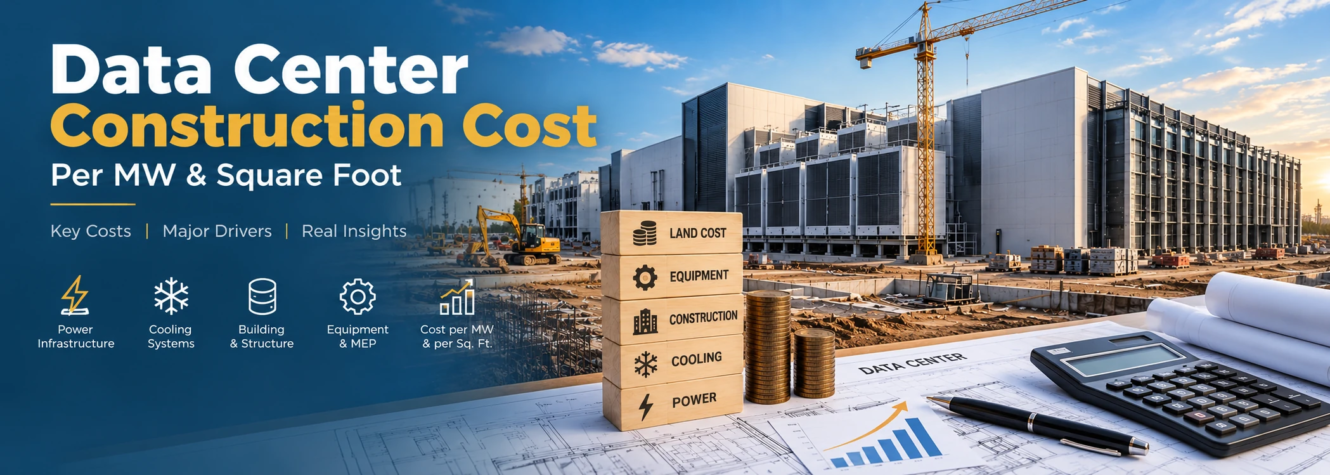
Data Center Construction Cost: Per MW & Square Foot
The data center construction cost can vary dramatically from one project to another because a data center is much more than a conventional building shell. Electrical capacity, cooling infrastructure, redundancy, site conditions, utility connections, equipment density, and the intended computing workload can account for a large portion of the total investment.
This becomes even more important with artificial intelligence.
AI and high-performance computing facilities can require greater power and cooling capacity within the same physical footprint. As a result, comparing data centers only by construction cost per square foot can be misleading.
For many projects, cost per megawatt (MW) of IT capacity provides a more useful benchmark.
However, both metrics have value.
Cost per square foot helps evaluate the physical building, while cost per MW provides greater insight into the expensive power and cooling infrastructure required to operate the computing equipment.
This guide explains both approaches, the major components of data center construction costs, and why two facilities of similar size can have very different project budgets.
How Much Does It Cost to Build a Data Center?
There is no single universal cost for building a data center.
A small edge facility, enterprise data center, hyperscale facility, colocation building, and high-density AI data center have very different requirements.
Total development cost can include:
- Land acquisition
- Site preparation
- Utility infrastructure
- Building construction
- Structural systems
- Electrical infrastructure
- Backup power
- Cooling systems
- Fire protection
- Security
- Controls
- Telecommunications infrastructure
- Testing and commissioning
- Professional fees
- Contingency
The amount spent on each category depends heavily on the intended capacity and reliability of the facility.
For this reason, asking “How much does a data center cost per square foot?” provides only part of the answer.
A more complete cost analysis considers both physical area and IT capacity.
Data Center Construction Cost Per MW
Cost per MW expresses project cost relative to the amount of IT electrical capacity the facility is designed to support.
The basic concept is:
Cost per MW = Applicable project cost ÷ IT capacity in MW
For example, suppose a project has an applicable construction cost of $120 million and provides 12 MW of IT capacity.
The simplified calculation would be:
$120 million ÷ 12 MW = $10 million per MW
This does not mean every 12 MW data center will cost $120 million.
The example simply demonstrates the metric.
Actual cost per MW varies according to factors such as:
- Location
- Utility infrastructure
- Power density
- Cooling technology
- Redundancy
- Building type
- Labor cost
- Material prices
- Equipment specifications
- Procurement conditions
- Schedule
- Site constraints
It is also important to confirm what is included in a published cost-per-MW figure before comparing it with another project.
One estimate may include land and utility work while another may include only construction and MEP infrastructure.
Why Cost Per MW Matters
Electrical and mechanical infrastructure represents a major portion of many data center budgets.
Two facilities could each contain 200,000 square feet but support very different IT loads.
For example:
Facility A: 200,000 sq. ft. with 10 MW IT capacity
Facility B: 200,000 sq. ft. with 30 MW IT capacity
Facility B may require significantly greater electrical distribution, backup generation, cooling capacity, and supporting infrastructure even though the buildings have similar floor areas.
Cost per MW therefore provides a useful way to compare infrastructure intensity.
Data Center Construction Cost Per Square Foot
Cost per square foot remains useful, particularly for evaluating building construction and comparing physical facilities.
The basic calculation is:
Cost per square foot = Total applicable construction cost ÷ Gross building area
If a 100,000-square-foot facility has an applicable construction cost of $100 million:
$100 million ÷ 100,000 sq. ft. = $1,000 per sq. ft.
Again, this is only an example—not a universal benchmark.
Actual cost per square foot depends on what is included in the project cost and how much technical infrastructure is installed.
Why Square-Foot Costs Can Be Misleading
A normal warehouse and a data center could have similar structural footprints but dramatically different costs.
The difference comes from infrastructure.
A data center may require:
- Large transformers
- Medium-voltage switchgear
- UPS systems
- Batteries
- Backup generators
- Busways
- Power distribution equipment
- Chillers
- Pumps
- Cooling towers
- Liquid-cooling infrastructure
- Advanced controls
- Fire-protection systems
- Physical security
- Redundant systems
Consequently, the building shell may represent only part of the total investment.
For high-density AI facilities, this difference can become even more pronounced.
Typical Data Center Cost Categories
A data center budget can be divided into several broad categories.
| Cost Category | Typical Scope |
|---|---|
| Land | Property acquisition and related costs |
| Site Work | Earthwork, roads, drainage and utilities |
| Structure | Foundations, slabs and structural frame |
| Envelope | Walls, roofing, waterproofing and insulation |
| Electrical | Substations, transformers, switchgear and distribution |
| Backup Power | UPS, batteries, generators and fuel systems |
| Cooling | Chillers, cooling towers, piping and liquid cooling |
| Fire Protection | Detection, suppression and rated assemblies |
| Security | Fencing, access control and surveillance |
| Telecom | Fiber pathways and network-support infrastructure |
| Controls | BMS, monitoring and control systems |
| Commissioning | Testing and verification of critical systems |
The percentage represented by each category changes from project to project.
1. Land Cost
Land prices vary enormously by location.
A large hyperscale campus may require substantial acreage not only for the buildings but also for:
- Substations
- Generator yards
- Cooling equipment
- Roads
- Stormwater systems
- Security setbacks
- Utility corridors
- Future expansion
Cheap land does not automatically mean a cheap data center.
If the site lacks adequate power, fiber, water, or transportation infrastructure, the cost of developing those services can outweigh the original land savings.
Site suitability therefore has a direct relationship with project economics.
For the location factors that should be evaluated before land acquisition, see:
data center site selection2. Site Preparation and Civil Cost
Site-development costs depend heavily on existing conditions.
Potential expenses include:
- Clearing
- Excavation
- Grading
- Soil improvement
- Rock removal
- Stormwater systems
- Underground utilities
- Roads
- Retaining walls
- Equipment pads
- Security fencing
Poor soil conditions can increase foundation costs.
A sloped site may require extensive cut-and-fill operations.
Flood mitigation, drainage infrastructure, or unusual environmental requirements can also increase development costs.
A seemingly inexpensive property can therefore become expensive once civil construction begins.
3. Structural Construction Cost
The structural portion of the project includes the systems required to support the building and its equipment.
Potential components include:
- Foundations
- Reinforced concrete slabs
- Structural steel
- Precast concrete
- Roof framing
- Equipment foundations
- Exterior structural walls
Data centers can contain unusually heavy equipment.
Server racks, batteries, UPS equipment, transformers, and mechanical systems can influence structural design.
Higher structural loads can require thicker slabs, additional reinforcement, larger foundations, or stronger framing systems.
For more information about the systems commonly used to construct these buildings, see:
data center construction materials4. Floor Loading and Structural Capacity
Floor design can also affect cost.
Data halls and equipment areas may need to support:
- Server racks
- Battery cabinets
- UPS systems
- Electrical cabinets
- Cooling equipment
- Raised-floor systems
- Rolling equipment
The required capacity should be established using actual equipment loads rather than applying a generic data-center floor rating.
Increasing structural capacity after construction can be significantly more difficult than incorporating it into the original design.
Our dedicated structural guide covers:
data center floor loading requirements5. Electrical Infrastructure Cost
Electrical infrastructure is one of the largest cost drivers in many data center projects.
The system may include:
- Utility interconnection
- Substations
- Transformers
- Medium-voltage switchgear
- Low-voltage switchgear
- UPS systems
- Batteries
- Generators
- Automatic transfer systems
- Busways
- Power distribution units
- Electrical monitoring
More IT capacity generally means more electrical infrastructure.
Redundancy can increase cost further because additional equipment may be installed to maintain operation during maintenance or equipment failure.
A facility requiring 2N electrical architecture, for example, can have substantially different infrastructure requirements from a facility designed with less redundancy.
For the engineering role of each major component, read:
data center electrical infrastructure6. AI Power Density and Project Cost
AI changes data center economics partly because it can increase computing density.
Higher-density racks can require greater electrical capacity within a smaller amount of floor area.
This means a relatively compact AI data hall can still require substantial:
- Transformer capacity
- Switchgear
- UPS capacity
- Busway
- Rack distribution
- Backup generation
- Cooling capacity
This is another reason square-foot cost alone may not accurately represent an AI facility.
Understanding the expected IT load is essential when preparing early project budgets.
For the power side of AI facilities, including MW demand and rack density, see:
AI data center power requirements7. Cooling System Cost
Cooling is another major capital-cost category.
The system has to remove the heat generated by servers and other equipment continuously.
Cooling infrastructure may include:
- Chillers
- Cooling towers
- Dry coolers
- Pumps
- Heat exchangers
- Air-handling equipment
- Piping
- Controls
- Containment systems
- Coolant distribution units
The appropriate system depends on factors such as climate, IT load, rack density, water availability, and efficiency goals.
High-density AI workloads can require liquid cooling or hybrid cooling strategies, which may change both equipment and piping requirements.
The dedicated comparison is available at:
AI data center cooling systems8. Water Infrastructure Cost
Water requirements can also influence both capital and operating costs.
Where water-dependent cooling is used, the project may need:
- Water connections
- Storage
- Treatment equipment
- Pumps
- Cooling towers
- Piping
- Water-quality controls
- Discharge infrastructure
Water availability may even influence which cooling technology is selected.
In water-constrained regions, designers may evaluate systems that reduce direct water consumption, although those alternatives can involve other energy or capital-cost tradeoffs.
For the water-specific topic, see:
data center water usage9. Backup Generators and UPS Cost
Data centers typically require systems that maintain critical power when utility electricity is interrupted.
Two major components are:
UPS systems: provide immediate short-duration power and power conditioning.
Backup generators: provide longer-duration emergency power according to the facility design.
Associated costs can include:
- Generators
- UPS modules
- Batteries
- Fuel storage
- Fuel piping
- Exhaust systems
- Acoustic treatment
- Transfer equipment
- Controls
- Generator yards
Redundancy can significantly affect the quantity of equipment required.
10. Fire Protection Cost
Fire protection can include:
- Detection systems
- Early-warning smoke detection
- Sprinklers
- Pre-action systems
- Fire-rated walls
- Fire doors
- Alarm systems
- Specialized suppression where appropriate
Battery rooms, electrical areas, generator systems, and data halls may require different approaches.
Fire-protection costs therefore depend on the facility layout, equipment, applicable codes, insurance requirements, and local authority requirements.
11. Security Cost
Physical security is typically more extensive than in an ordinary commercial building.
Potential systems include:
- Perimeter fencing
- Guard facilities
- Vehicle barriers
- CCTV
- Access control
- Biometric systems
- Security vestibules
- Intrusion detection
- Monitoring systems
Large campuses may have multiple layers of security extending from the property perimeter to individual critical rooms.
12. Fiber and Telecommunications Cost
A data center needs high-capacity communications infrastructure.
Costs may include:
- Fiber connections
- Diverse carrier routes
- Underground conduits
- Building entry points
- Meet-me rooms
- Cable pathways
- Internal network-support infrastructure
A project may deliberately provide physically separate fiber routes so that damage to one pathway does not disconnect the facility.
13. Commissioning Cost
Commissioning should not be treated as an optional final inspection.
Data centers contain interconnected critical systems that must operate correctly during both normal and abnormal conditions.
Testing can involve:
- Utility power
- Switchgear
- UPS systems
- Batteries
- Generators
- Cooling systems
- Pumps
- Controls
- Fire alarms
- Building management systems
- Integrated failure scenarios
Commissioning adds project cost, but discovering system-level problems after the data center becomes operational can be far more disruptive.
AI Data Center Construction Cost
AI facilities can differ economically from traditional data centers because higher-density computing can shift spending toward power and cooling infrastructure.
Major AI-related cost drivers include:
Higher Rack Power
More electrical capacity may be required for each rack.
Higher Cooling Density
Removing more heat from a smaller space can require advanced cooling infrastructure.
Liquid Cooling
Some high-density deployments may require coolant distribution units, additional piping, heat exchangers, or other liquid-cooling components.
Utility Capacity
Large AI projects may require significant grid interconnection or utility infrastructure.
Structural Requirements
Heavy racks and supporting equipment may affect floor and equipment-foundation design.
Rapid Expansion
Developers may invest in infrastructure that supports future phases even if the full computing capacity is not installed immediately.
For a broad explanation of how these systems fit together, see:
AI data center constructionWhat Factors Increase Data Center Construction Cost?
Several variables can push project cost upward.
1. Higher Redundancy
Additional equipment and independent power or cooling paths increase capital expenditure.
2. Higher Power Density
More MW within the same footprint requires more intensive electrical and mechanical infrastructure.
3. Difficult Site Conditions
Poor soils, rock excavation, flood mitigation, and extensive grading can increase civil and structural costs.
4. Limited Utility Infrastructure
New substations, transmission upgrades, or other utility work can add significant cost and schedule risk.
5. High-Cost Labor Markets
Construction labor varies considerably between regions.
6. Long-Lead Equipment
Supply constraints can affect equipment pricing and project schedules.
7. Accelerated Schedule
Fast-track projects may require additional labor, early procurement, prefabrication, or premium logistics.
8. Advanced Cooling
Very high-density computing may require more sophisticated cooling infrastructure.
9. Regulatory Requirements
Permitting, environmental mitigation, emissions restrictions, and local codes can affect the budget.
Cost Per MW vs. Cost Per Square Foot
Neither metric should automatically replace the other.
They answer different questions.
| Metric | Most Useful For |
|---|---|
| Cost per MW | Comparing infrastructure capacity |
| Cost per sq. ft. | Comparing physical building cost |
| Total project cost | Understanding complete capital requirement |
| Cost per rack | Certain equipment-density comparisons |
For AI facilities, cost per MW is often especially informative because power density can vary significantly.
A project with a small physical footprint may still have a large capital budget if it supports a high IT load.
Example Data Center Cost Calculation
Consider a hypothetical project with:
- Building area: 150,000 sq. ft.
- IT capacity: 20 MW
- Applicable project cost: $200 million
Cost Per Square Foot
$200,000,000 ÷ 150,000 = $1,333 per sq. ft.
Cost Per MW
$200,000,000 ÷ 20 = $10 million per MW
These figures are examples for explaining the calculations only.
They should not be treated as current market benchmarks.
Real-world comparisons require consistent cost scope.
Why Cost Estimates Can Differ So Much
Two consultants can provide very different data center cost estimates without either calculation necessarily being wrong.
One estimate may include:
- Land
- Utility infrastructure
- Building
- MEP systems
- Commissioning
Another may exclude land and off-site utility work.
Similarly, one cost-per-MW benchmark may refer to shell-and-core construction while another includes fully fitted technical infrastructure.
When comparing estimates, ask:
- Is land included?
- Is utility interconnection included?
- Is IT equipment included or excluded?
- What redundancy level is assumed?
- What cooling technology is assumed?
- What geographic market is being used?
- Are professional fees included?
- Is commissioning included?
- Is contingency included?
- What year are the prices based on?
Without consistent scope, two headline cost figures should not be compared directly.
Data Center Construction Cost Breakdown by Project Phase
Costs also occur at different stages of development.
Planning and Due Diligence
Includes site studies, utility investigations, surveys, geotechnical work, environmental analysis, and early design.
Design
Includes architectural and engineering services across structural, electrical, mechanical, civil, fire protection, security, and telecommunications disciplines.
Procurement
Major electrical and cooling equipment may need to be purchased before installation begins.
Site and Building Construction
Includes civil work, foundations, structural construction, envelope, roads, and site infrastructure.
MEP Installation
Electrical and mechanical systems are installed and integrated.
Testing and Commissioning
Systems are tested individually and together before operational handover.
For the complete project sequence, see:
data center construction processHow Can Data Center Construction Costs Be Controlled?
Cost reduction should not mean compromising the reliability required by the facility.
Instead, developers can focus on eliminating unnecessary cost and reducing uncertainty.
Useful strategies include:
- Verify utility capacity early
- Perform detailed site due diligence
- Establish realistic IT loads
- Match redundancy to operational requirements
- Standardize repeatable designs
- Identify long-lead equipment early
- Coordinate structural and MEP systems
- Consider prefabrication where practical
- Plan future expansion before construction
- Use value engineering carefully
- Track scope changes
- Commission critical systems properly
One of the biggest opportunities is making major infrastructure decisions early.
Changing a wall finish late in design may have limited financial impact. Changing the required electrical capacity, cooling strategy, or redundancy architecture can affect the entire project.
Frequently Asked Questions
What is the average data center construction cost?
There is no reliable single average that applies to every data center. Cost varies according to location, IT capacity, redundancy, cooling technology, building type, site conditions, and what is included in the estimate.
How is data center construction cost per MW calculated?
Divide the applicable project cost by the facility’s IT capacity in megawatts. The scope of the project cost should be clearly defined before comparing the result with other facilities.
How is data center cost per square foot calculated?
Divide the applicable construction cost by the gross building area. This metric is useful for physical building comparisons but does not fully describe differences in power and cooling density.
Why are data centers so expensive to build?
They require extensive electrical, cooling, backup-power, security, controls, fire-protection, telecommunications, and commissioning infrastructure in addition to conventional building construction.
Are AI data centers more expensive?
They can be more infrastructure-intensive because high-density AI hardware may require greater electrical and cooling capacity per rack. However, actual cost depends on the specific project and should not be generalized solely from the AI label.
Is electrical infrastructure a major data center cost?
Yes. Transformers, switchgear, UPS systems, batteries, generators, busways, distribution equipment, and utility connections can represent a substantial portion of the capital budget.
Does liquid cooling increase construction cost?
It can change the cost structure by introducing additional piping, coolant distribution, heat exchangers, controls, and related equipment. Whether total cost rises or falls depends on the complete cooling architecture and operating requirements.
Does land price significantly affect data center cost?
It can, but land price is only one factor. An inexpensive site requiring major utility upgrades, earthwork, or new infrastructure may ultimately cost more than a better-served site with a higher purchase price.
Should data center cost be compared per MW or per square foot?
Both can be useful. Cost per square foot evaluates physical building intensity, while cost per MW better reflects infrastructure relative to computing capacity. Comparisons should use the same cost scope.
Final Thoughts
Data center construction cost cannot be understood from a single price-per-square-foot figure.
A data center is both a building and a highly engineered power-and-cooling facility.
The physical structure provides the space, protection, and support required by the equipment, but electrical and mechanical infrastructure allows the computing hardware to operate continuously.
For this reason, project economics should generally be evaluated using several metrics, including total project cost, cost per square foot, and cost per MW of IT capacity.
AI makes this distinction even more important.
As rack density increases, greater computing capacity can be installed within the same amount of floor space. The cost of power delivery, cooling, redundancy, and supporting infrastructure may therefore increase without a proportional increase in building area.
The most reliable estimate is ultimately project-specific.
It should begin with clearly defined IT capacity, rack density, redundancy, cooling strategy, site conditions, utility availability, and expansion requirements. Once these inputs are established, the structural, electrical, mechanical, and civil scopes can be developed into a realistic construction budget.