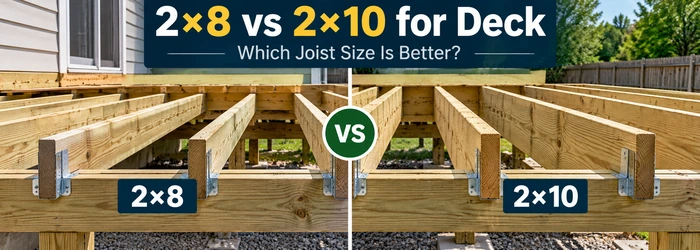
2×8 vs 2×10 for Deck: Which Joist Size Is Better?
Choosing between 2×8 vs 2×10 for deck framing is not simply a matter of selecting the larger piece of lumber. Both sizes can be appropriate for residential decks, but the correct choice depends on the joist span, spacing, lumber species and grade, loading, support layout, cantilever, decking system, and applicable building requirements.
A 2×10 is deeper than a 2×8, so under otherwise comparable conditions it generally provides greater bending stiffness and structural capacity. However, that does not mean every deck needs 2×10 joists.
A properly designed 2×8 deck can be an efficient and economical solution for shorter spans, while 2×10 joists may become attractive when longer spans, greater stiffness, or fewer intermediate supports are desired.
This guide explains how to make the comparison correctly for a U.S. residential deck.
2×8 vs 2×10 Deck Joists: Quick Comparison
| Feature | 2×8 Deck Joist | 2×10 Deck Joist |
|---|---|---|
| Nominal size | 2″ × 8″ | 2″ × 10″ |
| Typical actual size | 1.5″ × 7.25″ | 1.5″ × 9.25″ |
| Width | 1.5″ | 1.5″ |
| Depth | 7.25″ | 9.25″ |
| Relative stiffness | Lower | Higher |
| Long-span potential | Less | Greater |
| Material weight | Lower | Higher |
| Typical material cost | Lower | Higher |
| Floor/deck depth | Shallower | Deeper |
| Best suited for | Shorter or moderate spans | Longer or more demanding spans |
| Final selection | Must be verified | Must be verified |
The most important difference is depth.
Both members are typically about 1.5 inches wide, but the 2×10 has approximately 2 inches of additional actual depth.
That additional depth can significantly affect structural performance.
Actual Size of 2×8 and 2×10 Lumber
The dimensions printed in lumber names are nominal dimensions rather than the typical finished dimensions of surfaced dimensional lumber.
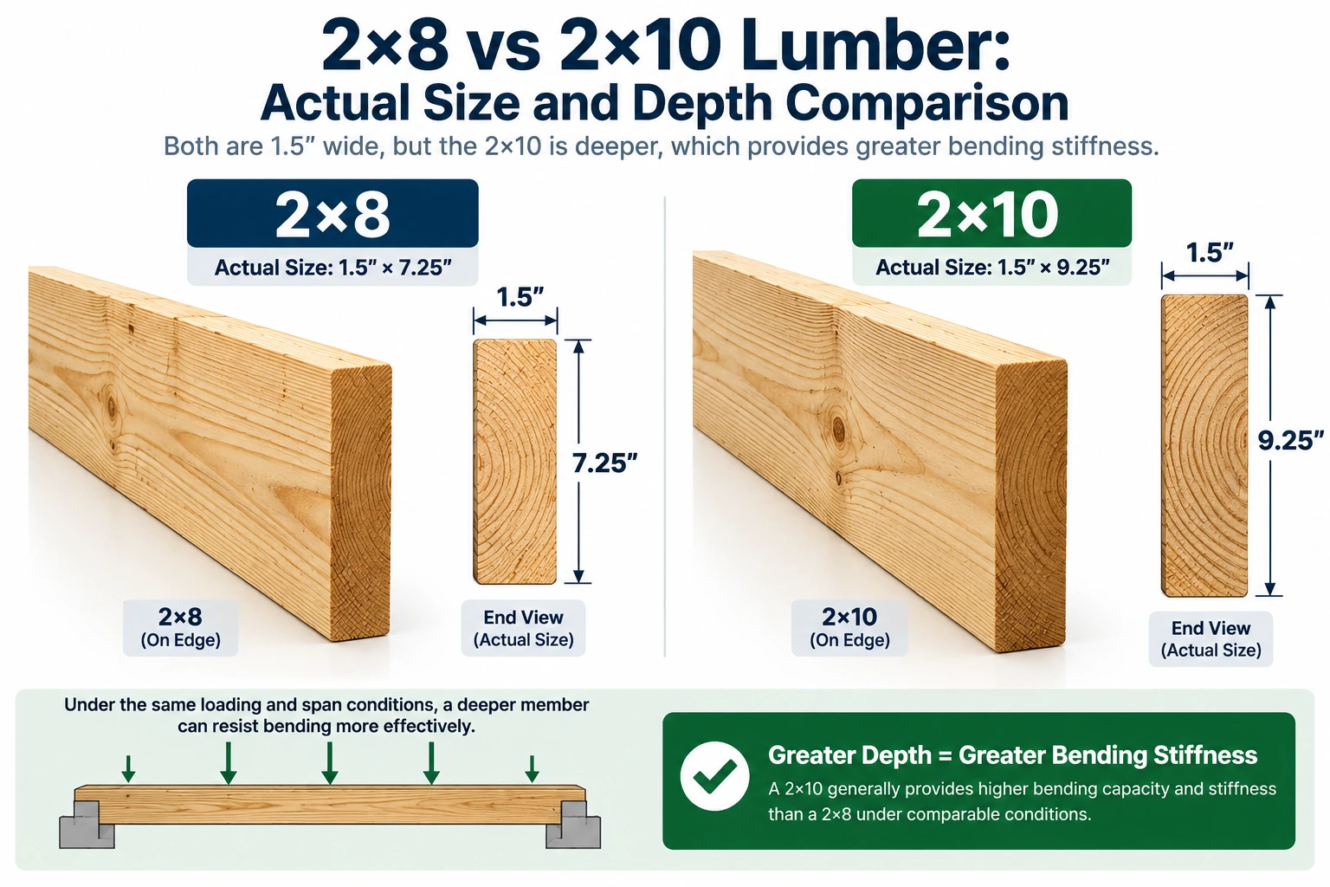
A typical:
2×8 = approximately 1.5″ × 7.25″
2×10 = approximately 1.5″ × 9.25″
For deck joists, these boards are normally installed on edge, meaning the deeper dimension is vertical.
This orientation is important because member depth strongly influences bending stiffness.
A 2×10 therefore should not be thought of as simply a 2×8 with two extra inches of wood. The increased vertical depth changes how efficiently the member resists bending.
Why Joist Depth Matters
Deck joists behave primarily as horizontal structural members spanning between supports.
When people and other loads are placed on the deck, the joists bend.
Increasing the vertical depth of a rectangular member can substantially increase its resistance to bending and deflection.
This is why deeper joists are commonly considered when a deck needs:
- longer spans
- greater stiffness
- reduced floor movement
- fewer intermediate supports
- more demanding loading conditions
However, depth is only one variable.
A 2×10 should not automatically be assumed adequate merely because it is deeper than a 2×8.
2×8 vs 2×10 Deck Joist Span
One of the most common questions is:
How far can a 2×8 or 2×10 span on a deck?
There is no single correct span that applies to every 2×8 or every 2×10.
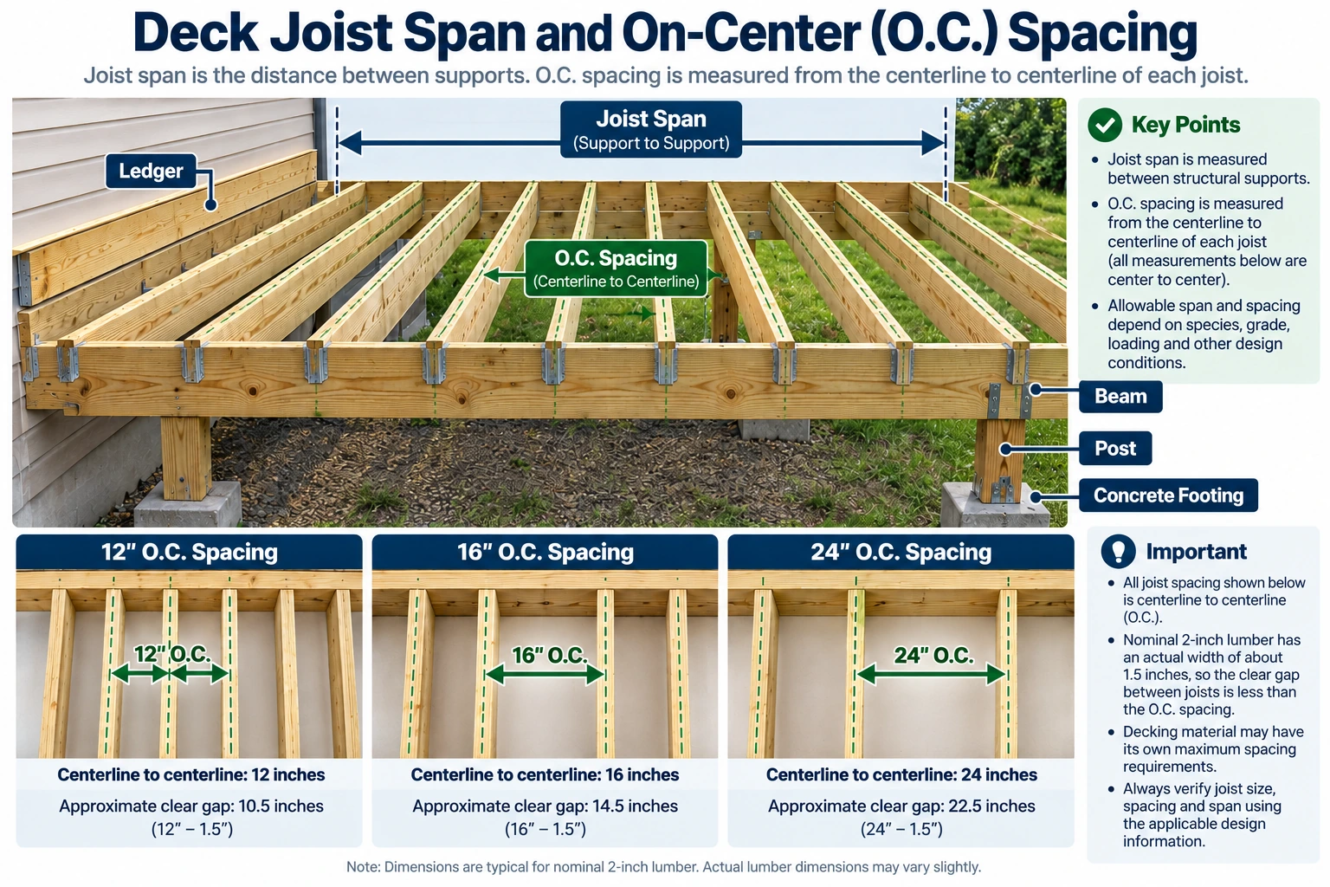
Allowable deck joist span can depend on:
- lumber species
- lumber grade
- joist spacing
- design loads
- moisture/service conditions
- support arrangement
- cantilever conditions
- connection details
- applicable code or design criteria
For example, a specific grade of Southern Pine may have different allowable spans than the same nominal size in another species group.
Similarly, a joist installed at 12″ O.C. does not carry the same tributary deck width as a joist installed at 24″ O.C.
Therefore, simple claims such as:
“A 2×8 spans 8 feet and a 2×10 spans 10 feet”
should not be treated as universal design rules.
The appropriate span should be verified using the applicable span table, code provisions, or engineered design information for the actual project.
Does a 2×10 Span Farther Than a 2×8?
Under otherwise comparable conditions, a 2×10 generally has greater span potential than a 2×8.
Assume both members have the same:
- species
- grade
- spacing
- loading
- moisture conditions
- support arrangement
The greater depth of the 2×10 generally provides an important structural advantage.
But that does not create one universal span difference.
Changing the species, grade, spacing, load, or other design conditions can change the allowable span.
So the useful question is not:
“How many more feet does a 2×10 span?”
Instead ask:
“Under my exact deck conditions, which joist satisfies the required span and performance criteria?”
2×8 vs 2×10 at 12″ O.C.
Reducing joist spacing generally reduces the tributary width supported by each joist.
At 12 inches on center, joists are relatively closely spaced.
This arrangement may be useful where:
- higher floor stiffness is desired
- decking requires closer support
- diagonal decking creates additional support considerations
- the structural design calls for closer spacing
A 2×8 at 12″ O.C. and a 2×10 at 12″ O.C. still should not be assumed to have equal span capability simply because their spacing is identical.
Member depth and structural properties remain different.
2×8 vs 2×10 at 16″ O.C.
16 inches on center is a common framing arrangement in residential construction.
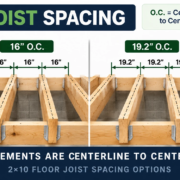
O.C. means on center, measured from the centerline of one joist to the centerline of the adjacent joist.
With nominal 2-inch dimensional lumber having an actual width of approximately 1.5 inches:
16″ O.C. ≠ 16″ clear space
The approximate clear gap between adjacent joists is:
16″ − 1.5″ = 14.5″
At 16″ O.C., either 2×8 or 2×10 joists may potentially be appropriate depending on the required span and other design conditions.
The joist size alone cannot determine suitability.
2×8 vs 2×10 at 24″ O.C.
Increasing spacing increases the tributary deck width carried by each joist.
Moving from 16″ O.C. to 24″ O.C. also increases the unsupported distance between joists for the decking.
Therefore, wider spacing affects both:
- joist loading, and
- decking performance
A joist might satisfy structural requirements while the selected decking product does not permit that spacing.
Always verify both the joists and decking system.
Joist Spacing Can Change the Answer
Consider two otherwise similar deck layouts.
One uses joists at 12″ O.C.
Another uses joists at 24″ O.C.
The wider-spaced joists support a greater tributary width of deck surface. This generally increases the load carried by each joist.
That is why a statement such as:
“2×8 is enough for my deck”
is incomplete without knowing the spacing and span.
Joist size + spacing + span + loading must be considered together.
Lumber Species Matters
Two boards with identical dimensions can have different structural properties.
Common structural lumber species or species groups encountered in the United States can include:
- Southern Pine
- Douglas Fir-Larch
- Hem-Fir
- Spruce-Pine-Fir (SPF)
Their allowable design values are not necessarily identical.
Consequently:
No. 2 2×8 from one species group ≠ automatically identical to No. 2 2×8 from another species group.
The same principle applies to 2×10 lumber.
Always use design information applicable to the actual species and grade being installed.
Lumber Grade Matters Too
Lumber grade can significantly affect structural performance.
Structural lumber may contain characteristics such as:
- knots
- slope of grain
- checks
- splits
- wane
- other natural imperfections
Grading evaluates these characteristics and assigns the lumber to an appropriate structural category.
Therefore, knowing only that a joist is “2×10” is not enough.
You also need to know its species and grade.
Pressure-Treated 2×8 vs 2×10 for Decks
Exterior deck framing commonly uses lumber suitable for outdoor exposure, and pressure-treated lumber is widely used for this purpose.
Treatment helps protect wood against conditions such as decay and insect attack, depending on the treatment and intended use.
However:
Pressure treatment does not eliminate structural design requirements.
A pressure-treated 2×8 still must be appropriate for its:
- span
- spacing
- species
- grade
- loading
- exposure condition
- support configuration
The same applies to a treated 2×10.
Fasteners, connectors, and hardware should also be suitable for the treatment and exposure environment.
2×8 vs 2×10 Deck Stiffness
Structural strength is not the only consideration.
A deck can technically support its required load and still feel excessively flexible.
Users may notice:
- bounce
- vibration
- movement
- shaking
A deeper joist generally provides an important stiffness advantage under otherwise comparable conditions.
Because a 2×10 is deeper than a 2×8, it may produce a noticeably stiffer framing system in some layouts.
But floor performance also depends on:
- span
- spacing
- blocking where applicable
- decking stiffness
- fastening
- connections
- beam/support layout
Therefore, simply upgrading from 2×8 to 2×10 does not automatically correct every deck movement problem.
2×8 vs 2×10 for Long Deck Spans
Longer joist spans are one of the strongest reasons to consider deeper lumber.
As span increases, both bending demand and deflection become increasingly important.
A deck with a long distance between the ledger and beam—or between two beams—may benefit from deeper joists.
In these situations, a 2×10 may be more practical than a 2×8.
However, eventually the design may require:
- a different beam layout
- additional support
- different joist spacing
- larger joists
- engineered framing
rather than simply increasing one board size.
Can You Use 2×8 Joists for a Deck?
Yes, 2×8 lumber can be used for deck joists when the design conditions permit.
A 2×8 may be a practical choice where:
- spans are relatively moderate
- appropriate species and grade are available
- spacing is suitable
- design loads are satisfied
- decking requirements are met
- the support layout is efficient
Using 2×10 lumber where a properly designed 2×8 already satisfies all requirements may add unnecessary material depth and cost.
Can You Use 2×10 Joists for a Deck?
Yes.
A 2×10 may be appropriate where:
- longer spans are required
- increased stiffness is desirable
- the deck has fewer intermediate supports
- deeper framing works with the architectural layout
- applicable span/design information permits the configuration
Again, larger does not automatically mean properly designed.
Connections, bearing, lateral restraint, beams, posts, footings, and other parts of the deck must also be adequate.
2×8 vs 2×10 Deck Cost
A 2×8 generally uses less wood than a 2×10 of the same length and is often less expensive per piece.
However, joist price alone does not determine the cheapest deck design.
Suppose using deeper joists allows a different support arrangement.
That could affect the number or location of:
- beams
- posts
- footings
- connectors
Conversely, using smaller joists with additional support may sometimes be more economical.
Material prices also vary significantly by region, lumber species, treatment, grade, length, and market conditions.
Therefore, compare the total framing-system cost, not merely the price of one 2×8 against one 2×10.
2×8 vs 2×10 Weight and Handling
A 2×10 generally contains more material than a 2×8 of the same length.
It will therefore typically be heavier.
Actual weight varies with:
- wood species
- moisture content
- treatment
- board length
For a small deck, this difference may not matter much.
For large projects with many long joists, material handling can become more noticeable.
Deck Joist Span vs Joist Length
Do not confuse joist span with total joist length.
Span generally refers to the distance between structural supports.
A joist may physically be longer than its supported span because it:
- extends past a beam
- forms a cantilever
- overlaps or continues beyond a support
Therefore, a 12-foot-long board does not automatically have a 12-foot structural span.
This distinction becomes particularly important when evaluating deck cantilevers.
2×8 vs 2×10 Deck Joist Cantilever
A cantilever occurs when the joist extends beyond its supporting beam.
Cantilevers can be useful for:
- architectural layout
- deck edge positioning
- reducing the apparent setback of posts and beams
However, the permitted cantilever is not arbitrary.
It can depend on:
- joist size
- joist span
- species
- grade
- spacing
- loading
- applicable design requirements
Do not assume that upgrading from 2×8 to 2×10 automatically permits any desired cantilever.
The complete framing configuration must be verified.
Decking Requirements Matter
The deck surface itself affects joist-spacing decisions.
Different decking materials may have different support requirements.
Examples include:
- pressure-treated wood decking
- cedar or other wood decking
- composite decking
- PVC decking
Some products may require closer joist spacing, especially under particular installation conditions.
Composite decking manufacturers, for example, commonly publish installation requirements for maximum joist spacing.
Therefore, selecting a 2×10 does not automatically mean you should increase the joist spacing.
The decking manufacturer’s requirements still apply.
2×8 vs 2×10 for Composite Decking
Composite decking can make joist spacing especially important.
Even if the supporting joists are structurally capable of a wider spacing, the decking itself may require closer support.
This may depend on:
- product line
- board profile
- board orientation
- installation pattern
- application
For example, diagonal installation can change support requirements for some products.
Always check the specific decking manufacturer’s installation instructions.
Ledger, Beam, and Post Design Still Matter
Deck joists do not work alone.
Loads generally travel through a structural path such as:
decking → joists → ledger/beam → posts/walls → footings/foundation → soil
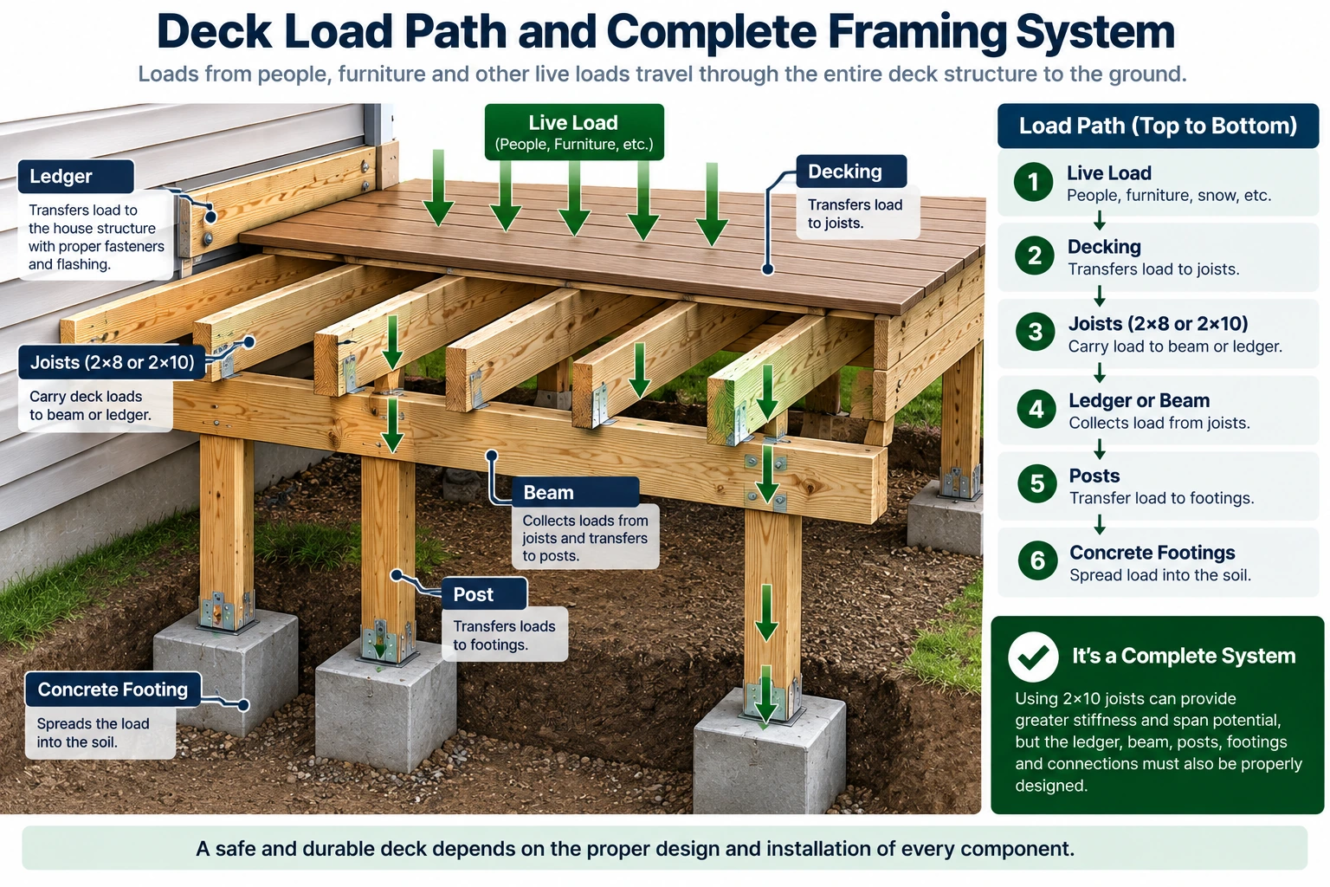
Increasing joist size does not automatically strengthen every other component.
A properly designed deck should consider:
- ledger attachment
- joist hangers
- beam sizing
- post sizing
- footing dimensions
- bearing
- lateral connections
- uplift resistance where applicable
- corrosion-resistant hardware
A deck with oversized joists can still have serious problems if its connections or foundations are inadequate.
2×8 vs 2×10 for a Freestanding Deck
A freestanding deck does not rely on the building ledger in the same way as a typical attached deck.
Instead, the framing may use beams and posts on both sides.
Whether 2×8 or 2×10 joists are appropriate still depends on:
- span between supports
- joist spacing
- loads
- species
- grade
- cantilever
- overall deck geometry
The absence of a ledger does not eliminate the need for proper structural sizing.
Common Mistakes When Choosing 2×8 or 2×10 Deck Joists
Mistake 1: Choosing by Board Size Alone
A larger board does not automatically create a compliant deck.
Mistake 2: Using One Span Number From the Internet
Span depends on multiple design variables.
Mistake 3: Ignoring Species and Grade
Two boards of identical size may have different structural properties.
Mistake 4: Confusing O.C. Spacing With Clear Gap
16″ O.C. means centerline-to-centerline, not 16 inches of open space.
Mistake 5: Ignoring Decking Requirements
Joists may be adequate while the decking requires closer spacing.
Mistake 6: Ignoring Cantilever
Joist span and overhang are different design considerations.
Mistake 7: Assuming Pressure Treatment Means Stronger
Treatment addresses durability/exposure requirements; structural suitability still needs verification.
Mistake 8: Looking Only at Joist Cost
The beam, posts, footings, connectors, and labor can affect total project cost.
Mistake 9: Ignoring Connections
Joist hangers, ledger connections, fasteners, and bearing are part of the structural system.
Mistake 10: Assuming 2×10 Is Always Better
A properly selected 2×8 may be entirely appropriate for a particular deck.
When Should You Choose 2×8 Deck Joists?
Consider 2×8 lumber when the verified design shows that it comfortably satisfies the project requirements and:
- the required span is moderate
- shallower framing is useful
- material economy matters
- support locations are convenient
- suitable species and grade are available
- the selected decking works with the spacing
There is no structural benefit in unnecessarily increasing member size if the smaller member already provides the required performance.
When Should You Choose 2×10 Deck Joists?
Consider 2×10 lumber when:
- greater span potential is useful
- increased stiffness is desirable
- support spacing makes deeper joists advantageous
- reducing deck bounce is important
- the design requires greater structural performance
- the additional framing depth is acceptable
The final selection should still be confirmed using the appropriate design information.
2×8 vs 2×10: Which Is Better for a Deck?
Neither size is universally better.
Choose 2×8 when it satisfies the required span, spacing, loads, stiffness, decking, and support conditions without unnecessary material.
Choose 2×10 when the design benefits from its greater depth, stiffness, or span potential.
For many homeowners, the temptation is to choose 2×10 simply because it sounds stronger.
A better approach is to design the entire deck system.
The most economical solution may involve a smaller joist with efficient beam placement. Another deck may benefit significantly from deeper joists that allow a more open support layout.
The answer depends on the project.
Frequently Asked Questions
Is 2×8 or 2×10 better for deck joists?
Neither is automatically better. A 2×10 generally provides greater stiffness and span potential under comparable conditions, while a 2×8 can be efficient for shorter or moderate spans. Verify the actual design conditions.
Can I use 2×8 for deck joists?
Yes, when the applicable span/design information permits the required span, spacing, species, grade, loading, and other conditions.
Can I use 2×10 for deck joists?
Yes. 2×10 lumber is commonly suitable for many deck-framing applications when properly selected and designed.
Is a 2×10 stronger than a 2×8?
Under otherwise comparable conditions, the greater depth of a 2×10 generally provides greater bending capacity and stiffness. Actual structural performance still depends on species, grade, span, loading, and other factors.
How far can a 2×8 span on a deck?
There is no single span applicable to every 2×8. Use the appropriate span information for the lumber species, grade, spacing, loads, and project conditions.
How far can a 2×10 span on a deck?
Again, there is no universal number. A 2×10 generally has greater span potential than a comparable 2×8, but its allowable span must be determined for the actual design conditions.
Should deck joists be 16″ O.C.?
16″ O.C. is a common arrangement, but it is not automatically correct for every deck. Joist design and the selected decking system must both permit the spacing.
Can deck joists be 24″ O.C.?
Some configurations may permit wider spacing, but both the joists and decking must be suitable for it. Do not select 24″ O.C. solely because larger joists are being used.
Is 2×10 better for composite decking?
Not automatically. Composite decking support requirements are product-specific. Even strong 2×10 joists may need closer spacing if required by the decking manufacturer.
Are 2×10 joists worth the extra cost?
They can be when their additional depth provides useful span or stiffness advantages. If a 2×8 already comfortably satisfies the design, the additional material may not provide enough benefit to justify the cost.
Final Takeaway
The 2×8 vs 2×10 for deck decision should be based on the complete framing system rather than a simple rule about board size.
A typical 2×8 measures approximately 1.5″ × 7.25″, while a typical 2×10 measures approximately 1.5″ × 9.25″. The extra depth of the 2×10 generally provides an important stiffness and structural advantage under comparable conditions.
But the correct joist also depends on:
- span
- spacing
- species
- grade
- loads
- cantilever
- decking
- connections
- support layout
- exposure conditions
- applicable building requirements
For an actual project, verify the selected joists using the appropriate span tables, design information, manufacturer requirements, and applicable local building provisions.
A properly designed 2×8 can be better than an unnecessarily oversized 2×10, while a 2×10 can be the better solution where its additional depth provides a genuine structural or layout advantage.