
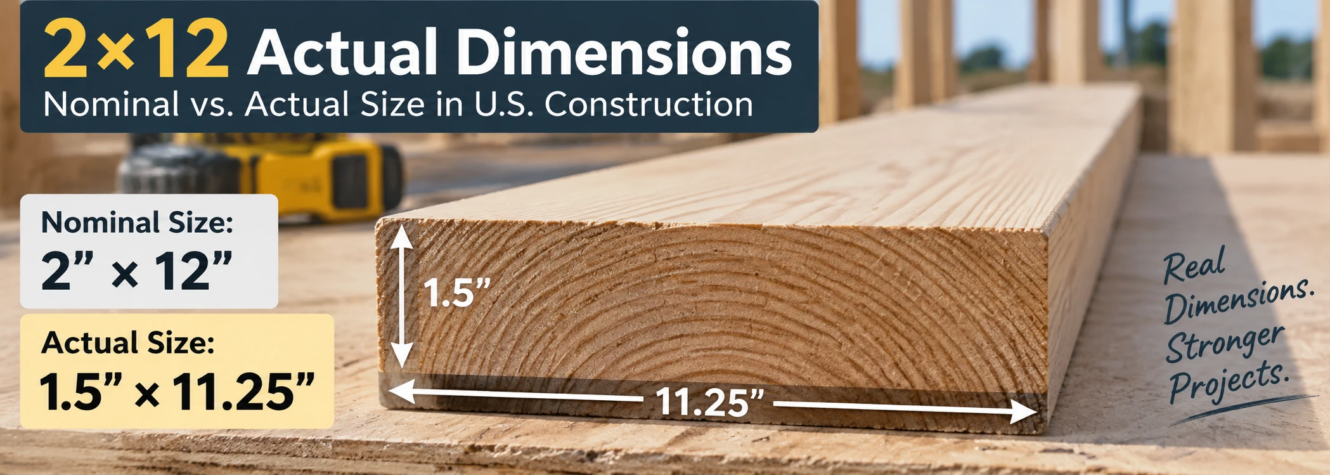
2×12 Actual Dimensions: Actual Size, Width & Thickness
A 2×12 does not actually measure 2 inches by 12 inches. In modern U.S. construction, a standard surfaced 2×12 typically measures approximately 1.5 inches thick by 11.25 inches wide.
The term “2×12” refers to the lumber’s nominal size, while 1.5″ × 11.25″ represents its typical finished or actual dimensions.
This difference is important for contractors, framers, designers, estimators, homeowners, and DIYers because actual lumber dimensions affect framing depth, clearances, material calculations, connections, blocking, and construction details.
Quick Answer: What Is the Actual Size of a 2×12?
For standard modern surfaced dimensional lumber in the United States:
| Measurement | Nominal Size | Typical Actual Size |
|---|---|---|
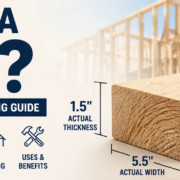
| Thickness | 2″ | 1.5″ |
| Width / Depth | 12″ | 11.25″ |
| Overall size | 2″ × 12″ | 1.5″ × 11.25″ |
| Metric equivalent | — | Approx. 38 × 286 mm |
Therefore:
Nominal size: 2″ × 12″
Typical actual size: 1.5″ × 11.25″
The American Wood Council also identifies 2×12 dimension lumber with a typical dry dressed size of 1.5″ × 11.25″, and gives the soft metric conversion as approximately 38 × 286 mm.
What Does 2×12 Mean?
A 2×12 is a nominal lumber designation.
The numbers in the name do not represent the exact dimensions of the finished board that you normally purchase from a lumber supplier.
For a typical modern surfaced 2×12:
- Nominal thickness = 2 inches
- Nominal width = 12 inches
- Actual thickness = approximately 1.5 inches
- Actual width/depth = approximately 11.25 inches
So when someone refers to a 2×12 joist, rafter, board, or framing member, they are normally using its nominal trade designation.
This nominal-sizing convention is standard across common dimensional lumber sizes.
Why Isn’t a 2×12 Actually 2 Inches by 12 Inches?
This is one of the most common questions about dimensional lumber.
The simple explanation is that 2×12 is a nominal designation rather than the literal finished dimensions of the surfaced board.
Lumber is processed to produce more consistent finished dimensions and surfaces. Consequently, the final dressed dimensions are smaller than the nominal designation.
For standard dry dimension lumber, the relationship is approximately:
2″ × 12″ nominal → 1.5″ × 11.25″ actual
The American Wood Council notes that U.S. lumber-sale rules recognize nominal dimensions along with corresponding minimum dressed sizes established through the American Softwood Lumber Standard.
2×12 Nominal Size vs Actual Size
Understanding the difference between nominal size and actual size is essential when working with lumber.
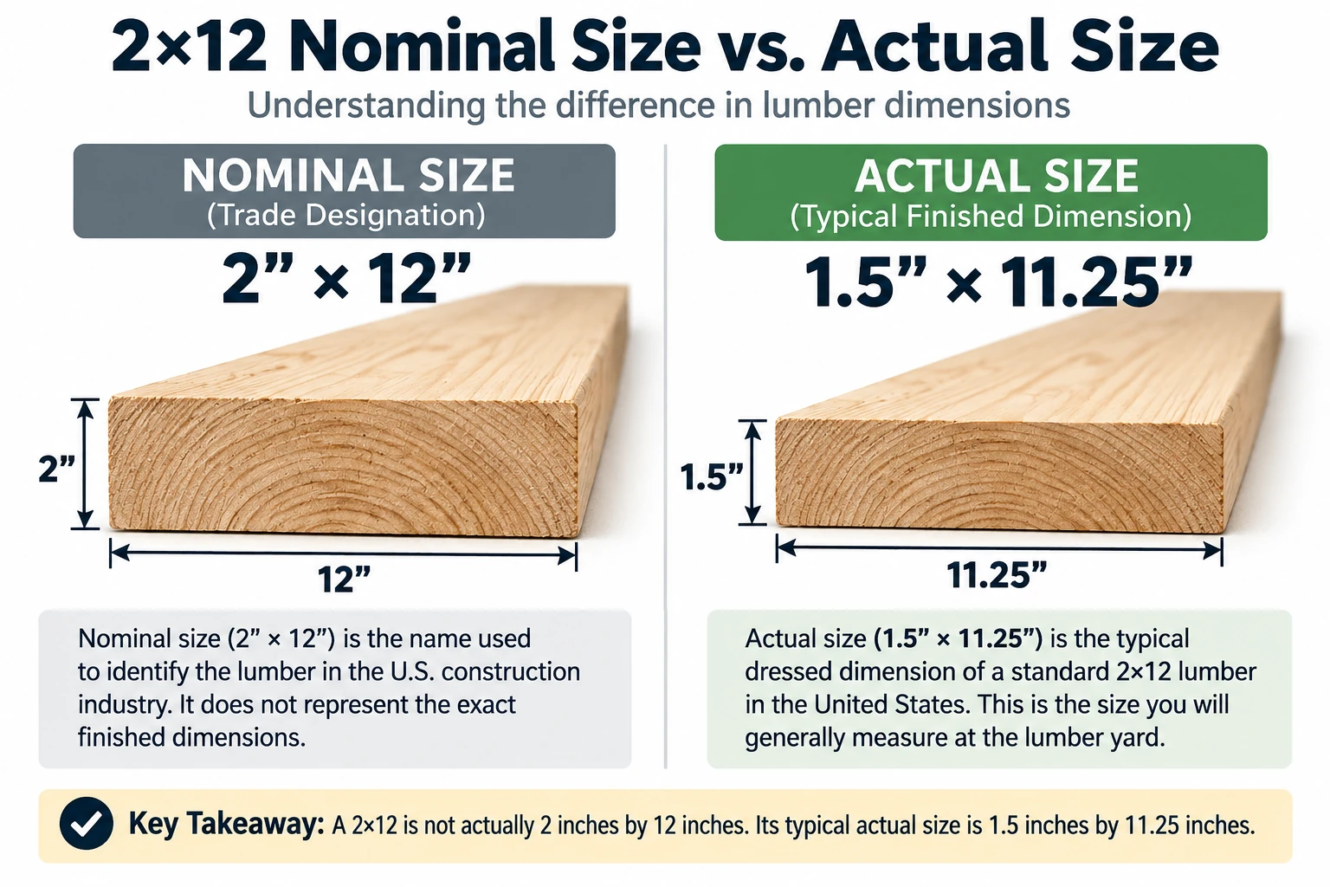
Nominal Size
The nominal size is the conventional name used to identify the lumber.
For this member:
Nominal size = 2″ × 12″
This is the name you are likely to see in:
- construction drawings
- lumber schedules
- framing discussions
- material lists
- supplier listings
- estimating documents
Actual Size
The actual size describes the approximate physical dimensions of the finished surfaced lumber.
For a standard dry 2×12:
Actual size = approximately 1.5″ × 11.25″
When precise dimensions matter, the actual dimensions are usually more useful than simply assuming the board measures exactly 2″ × 12″.
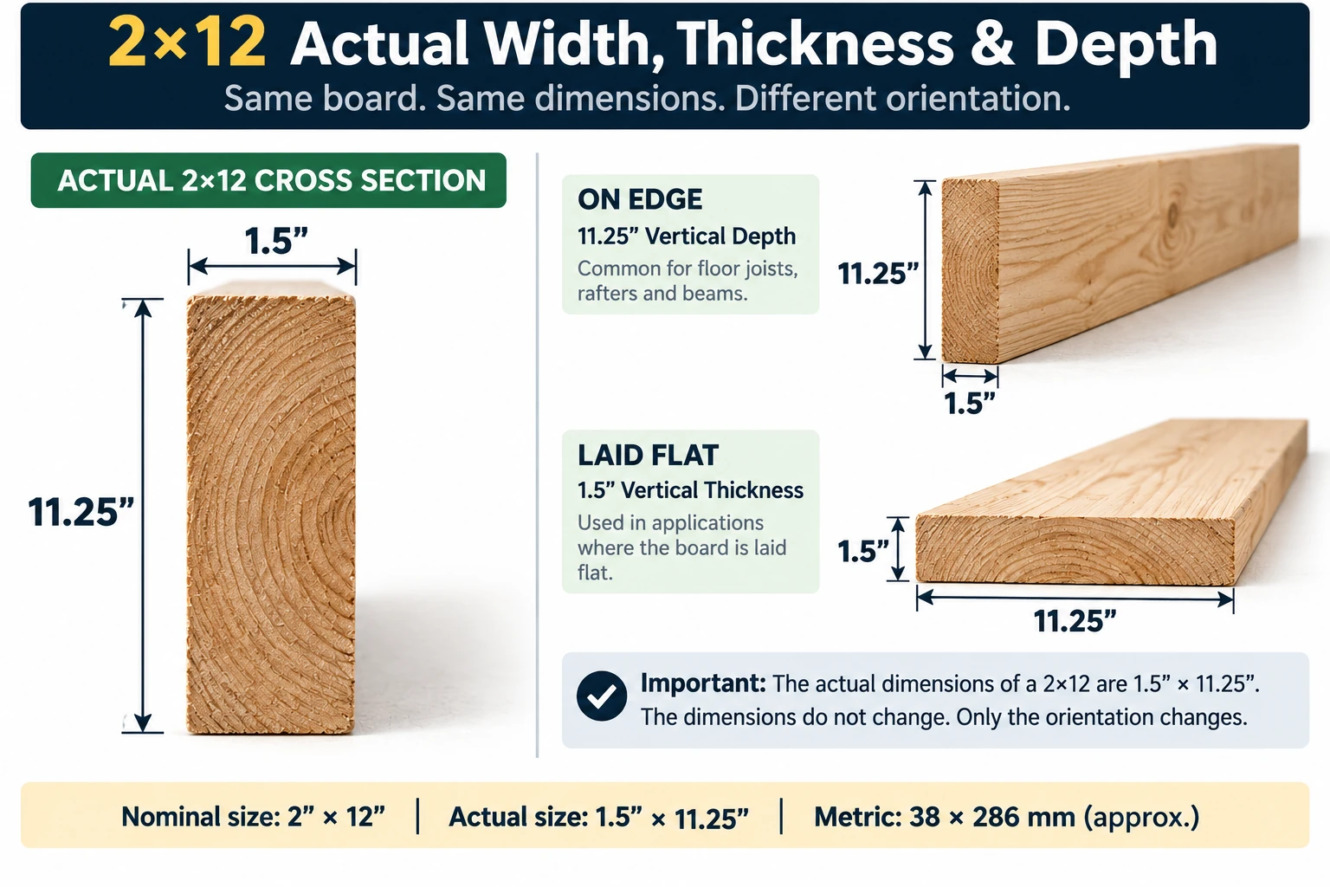
What Is the Actual Width of a 2×12?
The typical actual width of a standard surfaced 2×12 is:
11.25 inches
This dimension may also be described as the depth depending on how the lumber is oriented.
For example, when a 2×12 is installed on edge as a floor joist, the approximately 11.25-inch dimension becomes the vertical depth of the joist.
So:
2×12 actual width/depth = approximately 11.25″
The terminology can change with orientation, but the physical cross-sectional dimensions do not.
What Is the Actual Thickness of a 2×12?
A standard modern surfaced 2×12 is typically:
1.5 inches thick
Therefore:
Nominal thickness = 2″
Actual thickness = approximately 1.5″
This dimension becomes especially important when multiple members are installed side by side.
For example, dimensionally:
- One 2×12 = approximately 1.5″ thick
- Two 2×12s side by side = approximately 3″ total thickness
- Three 2×12s side by side = approximately 4.5″ total thickness
These calculations describe dimensions only. They should not be interpreted as establishing the structural capacity of a built-up beam, header, or other assembly.
2×12 Dimensions in Millimeters
The typical actual dimensions of a 2×12 can also be expressed in metric units.
Approximately:
1.5″ × 11.25″ = 38 × 286 mm
More precisely:
- 1.5 inches = 38.1 mm
- 11.25 inches = 285.75 mm
For practical reference, this is commonly rounded to:
38 mm × 286 mm
The American Wood Council specifically lists the soft metric conversion for a 2×12 as 38 × 286 mm.
However, a metric lumber product should not automatically be assumed to be identical to a North American nominal 2×12. Always verify the actual product dimensions.
Common 2× Lumber Actual Dimensions
Comparing nearby lumber sizes makes the nominal-versus-actual system easier to understand.
| Nominal Lumber Size | Typical Actual Size |
|---|---|
| 2×4 | 1.5″ × 3.5″ |
| 2×6 | 1.5″ × 5.5″ |
| 2×8 | 1.5″ × 7.25″ |
| 2×10 | 1.5″ × 9.25″ |
| 2×12 | 1.5″ × 11.25″ |
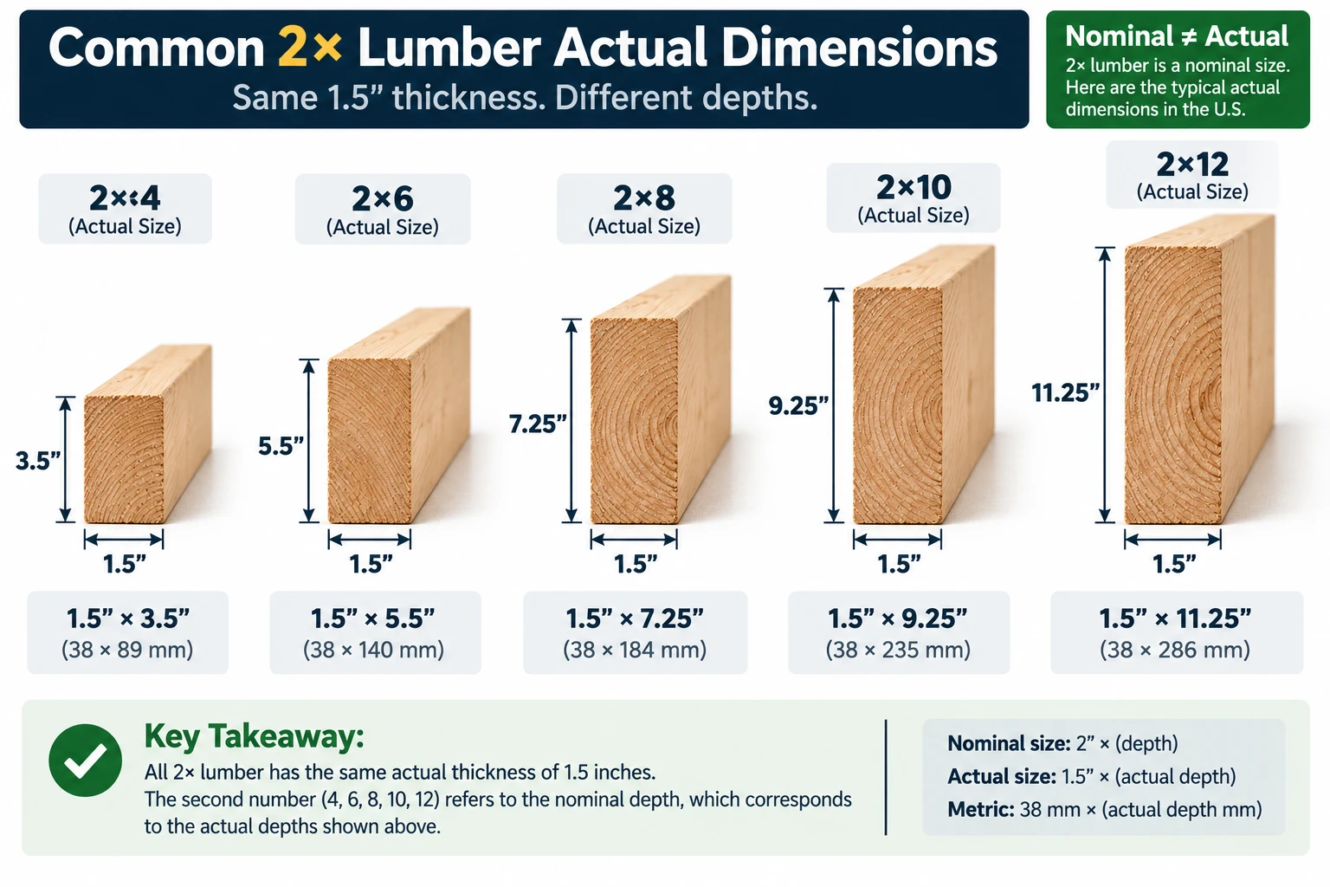
Notice that all these common 2× members typically have an actual thickness of approximately 1.5 inches.
The larger nominal number primarily changes the deeper dimension.
For a 2×12, that finished depth is typically approximately 11.25 inches.
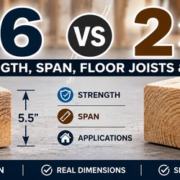
2×12 vs 2×10 Actual Dimensions
A 2×10 and 2×12 generally have the same typical finished thickness but different depths.
| Lumber | Actual Thickness | Actual Width/Depth |
|---|---|---|
| 2×10 | 1.5″ | 9.25″ |
| 2×12 | 1.5″ | 11.25″ |
The typical difference in depth is therefore approximately:
2 inches
However, this dimensional comparison alone should not be used to determine how much weight either member can support or how far it can safely span.
Structural performance depends on additional factors.
Does a 2×12’s Length Change Its Cross-Sectional Dimensions?
Normally, the nominal length of a standard dimensional-lumber member does not change its standard cross-sectional size.
For example, boards described as:
- 2×12×8
- 2×12×10
- 2×12×12
- 2×12×16
may all have a typical cross section of approximately:
1.5″ × 11.25″
The final number generally identifies the board’s length, while 2×12 identifies its nominal cross-sectional size.
Actual products should still be checked when precise dimensions are important.
What Is the Cross-Sectional Area of a 2×12?
Using the typical actual dimensions:
1.5″ × 11.25″
the approximate cross-sectional area is:
16.875 square inches
This is considerably different from calculating the area using the nominal dimensions.
Using nominal dimensions:
2″ × 12″ = 24 square inches
But using typical actual dimensions:
1.5″ × 11.25″ = 16.875 square inches
Therefore, using nominal dimensions in calculations that require the physical cross section can produce incorrect results.
Why Actual 2×12 Dimensions Matter in Construction
A difference of a fraction of an inch may appear minor, but it can become important in real construction work.
Floor Framing Depth
When a 2×12 is installed on edge as a joist, its typical physical depth is approximately 11.25 inches, not 12 inches.
Additional materials such as subflooring and finishes affect the complete floor assembly depth.
Blocking
Blocking installed between 2×12 framing members must correspond to the actual framing dimensions.
Assuming a full 12-inch depth can create unnecessary fitting problems.
Openings and Clearances
Actual lumber dimensions matter when coordinating framing with:
- pipes
- ducts
- electrical components
- openings
- architectural details
- other structural members
Construction Drawings
Plans commonly identify lumber by nominal size, but detailed physical dimensions must account for the actual member dimensions where necessary.
Renovation Work
Existing framing should be measured rather than assumed to match modern dimensional-lumber sizes.
Older, rough-sawn, specialty, or differently manufactured lumber may have dimensions that differ from a typical modern surfaced 2×12.
Common Uses of 2×12 Lumber
Because a 2×12 is one of the deeper commonly available dimensional-lumber sizes, it may be used in several framing applications when appropriate for the design.
Potential applications include:
Floor Joists
2×12 lumber may be specified for floor framing where the structural design, span, spacing, species, grade, loads, and applicable requirements support its use.
Roof Rafters
Some roof-framing designs may use 2×12 rafters.
The appropriate rafter size cannot be selected solely from nominal dimensions; roof loads, spacing, span, species, grade, slope, and other design conditions must be considered.
Headers and Built-Up Members
2×12 lumber may appear in built-up framing components in appropriate designs.
However, simply placing multiple 2×12 boards together does not establish a safe header or beam capacity.
Deck Framing
2×12 lumber can also be used in some deck-framing systems where the design calls for deeper dimensional lumber.
The required member size should be verified for the specific project.
Does Actual 2×12 Size Tell You Its Strength?
No.
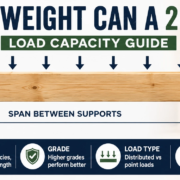
Knowing that a typical 2×12 measures approximately 1.5″ × 11.25″ is not enough to determine its allowable load or span.
Structural performance can depend on factors including:
- wood species
- lumber grade
- span
- member spacing
- orientation
- support conditions
- load magnitude and distribution
- load duration
- moisture/service conditions
- connections
- defects
- deflection limits
- applicable building-code and design requirements
Two pieces of lumber with identical physical dimensions can have different structural properties.
Therefore, 2×12 actual size, 2×12 strength, 2×12 load capacity, and 2×12 span are related but separate topics.
Is a 2×12 Actually 11.25 Inches Wide?
For standard modern dry surfaced dimension lumber in the United States, 11.25 inches is the typical dressed width/depth associated with a nominal 12-inch dimension.
However, do not assume every piece of wood everywhere will measure exactly 11.25 inches.
Dimensions can differ for reasons such as:
- rough-sawn lumber
- older lumber
- specialty products
- moisture condition
- manufacturing tolerances
- different lumber standards or markets
If a project depends on precise dimensions, measure the actual material being used.
How to Measure a 2×12
You can verify the dimensions using a tape measure or caliper.
Measure across the narrow face.
For a typical surfaced 2×12, this should be approximately:
1.5 inches
Then measure across the wider face.
This should typically be approximately:
11.25 inches
For renovation work, measuring existing framing is particularly important because older lumber may not match today’s typical dressed dimensions.
Common Mistakes With 2×12 Dimensions
Several mistakes repeatedly occur when people work with nominal lumber sizes.
Assuming a 2×12 measures exactly 2″ × 12″: For typical modern surfaced lumber, it does not. Expect approximately 1.5″ × 11.25″.
Confusing nominal and actual dimensions: The 2×12 designation is nominal; 1.5″ × 11.25″ represents the typical finished dimensions.
Confusing width with depth: A 2×12 installed on edge has an approximately 11.25-inch vertical depth. The same board laid flat has an approximately 11.25-inch horizontal width. Its dimensions have not changed—only its orientation has.
Using dimensions alone to determine load capacity: Board dimensions are only one factor in structural performance.
Assuming board length equals allowable span: A 16-foot-long 2×12 should not automatically be assumed capable of safely spanning 16 feet. Board length and allowable structural span are different concepts.
Frequently Asked Questions
What is the actual size of a 2×12?
A standard modern dry surfaced 2×12 in the U.S. typically measures approximately 1.5 inches × 11.25 inches.
How wide is a 2×12 actually?
The wider dimension of a typical surfaced 2×12 is approximately 11.25 inches.
How thick is a 2×12?
A standard surfaced 2×12 is typically approximately 1.5 inches thick.
Why is a 2×12 only 11.25 inches wide?
The 2×12 name represents the lumber’s nominal dimensions. The finished surfaced member has smaller actual dimensions.
What is a 2×12 in millimeters?
A typical 1.5″ × 11.25″ 2×12 is approximately 38 × 286 mm.
Is a 2×12 actually 12 inches wide?
No. A standard modern surfaced 2×12 is typically approximately 11.25 inches wide/deep.
Are all 2×12 boards exactly the same size?
Not necessarily. Product condition, manufacturing tolerances, moisture, rough-sawn lumber, historic lumber, and specialty products can result in differences. Measure the material when exact dimensions matter.
Is a 2×12 stronger than a 2×10?
A 2×12 has a deeper typical cross section than a 2×10, but board size alone does not determine allowable structural capacity. Species, grade, span, spacing, loading, orientation, support conditions, and other design factors must also be considered.
Can a 2×12 span 20 feet?
Actual dimensions alone cannot answer this. Allowable span depends on species, grade, spacing, loading, deflection criteria, use, and applicable design requirements. Use appropriate span/design data for the specific application.
Final Takeaway
The most important dimensions to remember are:
Nominal 2×12 = 2″ × 12″
Typical actual 2×12 = 1.5″ × 11.25″
Approximate metric equivalent = 38 × 286 mm
The 2×12 designation is the standard nominal lumber name; it should not be interpreted as the exact physical dimensions of a finished surfaced board.
For layout, clearances, detailing, and physical measurements, use the actual dimensions. For structural questions such as allowable span or load capacity, dimensions alone are not enough—species, grade, loading, spacing, supports, connections, and applicable design requirements must also be considered.




Leave a Reply
Want to join the discussion?Feel free to contribute!